












Impressive demolition project for Ghent hospital
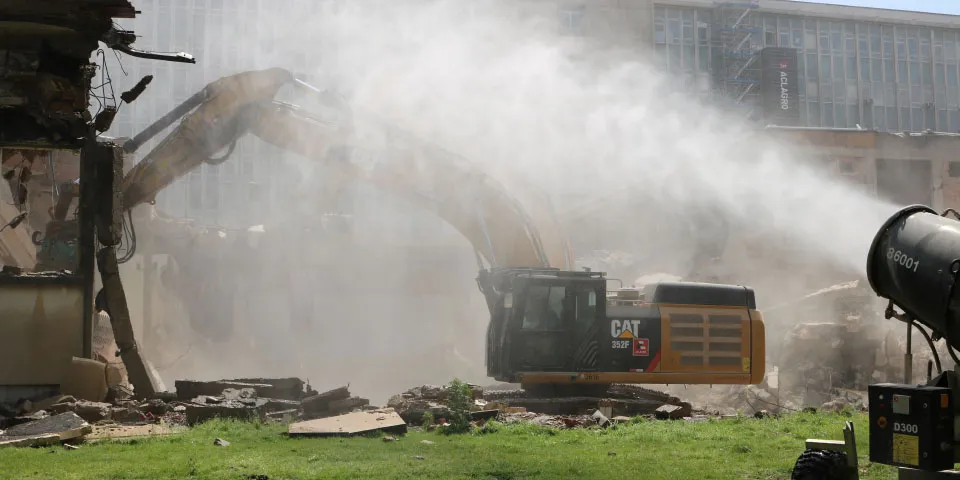
UZ Gent has been a landmark in the city of Ghent since 1959. In 2029, it will mark a new milestone in its history with the arrival of an iconic new building covering around 75,000 m². But on this busy site, old buildings first have to be demolished. K4 and P7, for example, have to go to maintain parking capacity during the works. However, the presence of asbestos meant that the work had to be carried out with the utmost care. Aclagro was happy to take it on.
Aclagro knows exactly how to remove asbestos-containing materials from a building safely.
The new building for UZ Gent is set to become the heart of the approximately 40 ha campus, connecting its main buildings into a single whole. Once ready for use, it will be adaptable to future needs and requirements, and provide a pleasant environment for patients, visitors, staff and all other campus users. But space first has to be cleared. The new building will be constructed on the site of the current car park building and will also include an underground car park. To provide temporary parking capacity during construction, buildings K4 and P7 are being demolished. Because they contained asbestos, these buildings had already been empty for some time. The demolition work is therefore far from straightforward. It is just the job for Aclagro, which has extensive experience in asbestos treatment and is already familiar with the site and UZ Gent’s operations from previous projects.
K4 and P7 on the UZ Gent site have to go to maintain parking capacity during construction of the new building.
Demolition in three phases
Project manager Wim Grammens speaks to us on site while demolition of the first building, P7, is well under way. “Every demolition project takes place in three phases. The first step is stripping out the building. Once all the materials have been removed, we can get to work on the asbestos.” To prevent hazardous asbestos fibres from escaping, the building is sealed and placed under negative pressure. “The regulations are very clear about the procedures that must be followed when dealing with asbestos. For example, measurements are taken every day to monitor the negative pressure. Our people are also trained to work with this material. They understand the risks and know what they are doing.” Those are the words of Thomas Laton, who works for Aclagro as an asbestos site supervisor. Only after this phase can the actual demolition begin. The project is currently running somewhat behind schedule, entirely due to the additional precautions Aclagro has taken in response to coronavirus. To ensure everyone’s safety, only half the workforce could work on site.
Thomas Laton and Wim Grammens during demolition of K4 and P7. “Aclagro’s attention to the sensitivities of a hospital site means we remain a familiar face to UZ Gent.”
Minimising disruption to the surroundings
Asbestos was not the only challenge in this demolition project. As this is a hospital, Aclagro has also done everything possible to minimise disruption to patients. Grammens: “Before the project began, we carried out tests at the weekend to see what impact drilling into the concrete would have.” Cancer patients receive radiotherapy right next to the K4 building. “We were determined to make sure that no vibrations would be felt there. So we assumed the worst-case scenario and brought out the heavy equipment at the worst point in the building. Although the results showed that we could proceed with demolition with confidence, we will of course continue to monitor this closely throughout the works,” says Grammens. A third consideration is the site’s location. There is heavy traffic not only on the UZ Gent grounds, but the site is also surrounded by an urban area. “The concrete walls are metres thick. Demolition inevitably generates a lot of dust. We therefore keep mist cannons running continuously to suppress the dust and prevent it from causing a nuisance to the neighbourhood.”
The presence of asbestos made the demolition of K4 and P7 far from straightforward. Aclagro, however, has an experienced team with expertise in this area.
Everything within the same group
It is precisely this attention to the sensitivities of the site that makes Aclagro a familiar face to UZ Gent, and has done for more than ten years. “Our strength also lies in our size. We can do everything ourselves, from demolition to asbestos removal, remediation and infrastructure works, using specialist teams within our group. That means the management has just one point of contact for overseeing the entire project,” Laton concludes.
Question about this story? Ask your question
Keep following this
Get an email when a new story is published. No account needed.
- ThemeCircular construction and demolition
- SubjectNews







