












Healthy soil
Text Valérie CouplezImage iStock
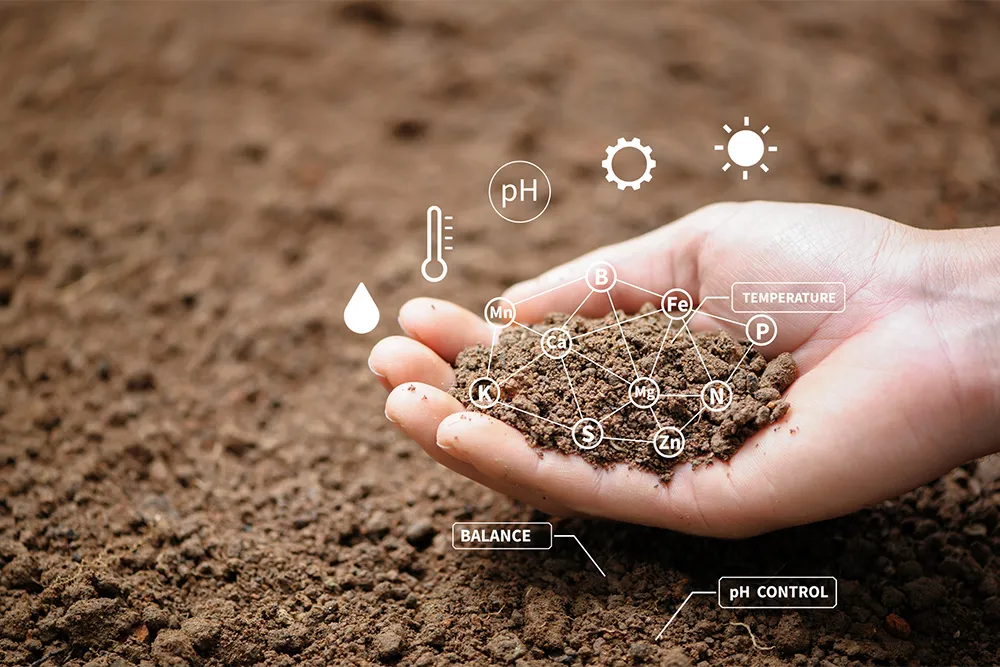
The healthy foundation for a sustainable future
The eighth edition of the Soil Congress took place in December. It gave the federations representing the soil and groundwater remediation sector (Denuo, OVB, VEB and VOBAS) a platform to put soil quality on the agenda of the next Flemish government. They are calling for an ambitious policy backed by the resources needed to achieve ‘healthy soil, the foundation for a sustainable future’. This was also the theme of an inspiring afternoon.
Before turning their attention to Flanders, the Soil Congress first looked further afield. Europe is also preparing a Soil Monitoring Directive. Victor Dries, from the International Management Team at OVAM, gave an update. The European Commission published its proposal in July last year. The end goal is 2050. That is the deadline Europe has set itself to achieve healthy soil in all its member states. The proposal has three key elements: a new harmonised definition of soil health, the development of a framework for soil monitoring, and a focus on sustainable soil management and the remediation of contaminated sites. “Soil must be able to provide a range of ecosystem services. These include biodiversity, resilience to natural disasters, food supply and health. To monitor soil quality, a range of parameters are considered: salinisation, erosion, loss of organic carbon, compaction, nutrient surplus (phosphorus, nitrogen is not a criterion), diffuse soil contamination, reduced water retention capacity … A risk-based approach is proposed to identify contaminated sites. Potentially contaminated sites should be identified within seven years. The draft Soil Directive currently on the table is broad in scope and covers various aspects, many of which will be familiar from Flemish soil policy,” said Dries.
A closer look at Flanders
But what exactly is the situation in Flanders? One thing is clear: for the first time, there is broad-based concern in Flanders about the quality of our soil and water, among both the public and policymakers. The PFAS crisis has certainly played a part. Werner Annaert, Director-General of OVAM, brought the figures with him.
“85,000 plots are considered potentially contaminated. Of these, 50,000 have already been investigated and more than 4,600 have been remediated. OVAM will probably have around 12,000 potentially contaminated plots remediated by the party liable for remediation or, where necessary, will take action itself. In the coming years, we want to maintain the pace of investigations and encourage innovation in investigation and remediation. The public also wants greater transparency. We want to make all investigations and remediation projects available on www.bodemkwaliteit.be. This will enable us to create a soil information sheet for each plot, a step towards an adapted soil certificate. In the longer term, we want to move from soil management to soil stewardship, so that we create not only restored soil but healthy soil too. We see a clear link here with CO2 capture and food safety, and will need to consider greater cooperation with a wider range of other entities. This applies to Europe too, because pollution does not stop at borders.”

Recommendations for the next legislative term
Things are going well today, but many challenges remain. Future crises like the one we are now experiencing with PFAS cannot be ruled out. Our soil will also play a crucial role in tackling climate change, as it is becoming increasingly clear that healthy, robust soil is essential for climate adaptation and resilience to climate change. The federations representing the soil and groundwater remediation sector, Denuo, OVB, VEB and VOBAS, have therefore made several recommendations for the next legislative term in Flanders:
- Take an integrated approach to soil: achieving truly healthy soil requires more than soil remediation alone. An integrated framework is needed that considers not only soil contamination but also other parameters, tailored to the future function of the soil and the water pressure in its different layers.
- Align regulations across the three regions: regulatory differences between the three regions hamper soil quality and the redevelopment of contaminated sites for housing or business use. Consider, for example, a major construction project in Brussels. Earthworks for such a project can quickly require three technical reports, one for each region, each following its own guidelines. The result is a complex tangle of advice. There is an urgent need for interregional harmonisation.
- Keep soil policy ambitious: soil quality has improved in recent years, but the original targets have not yet been met. The sector is therefore urging the authorities to retain current obligations and instruments (soil certificates, the transfer procedure and the soil movement procedure) and to build further on its pioneering international role. It proposes that, from 2036, soil contamination for which no soil remediation project has yet been submitted should no longer be considered ‘historic’. This measure will help speed up the remediation of contaminated sites in Flanders.
- Balance costs against environmental benefits: for major works in areas where groundwater is already contaminated with PFAS, the legally required full treatment of groundwater serves no purpose. Treatment technologies are not yet sufficiently developed, and the treated water subsequently mixes again with contaminated groundwater. The developer incurs enormous costs without any improvement to the environment. The BATNEEC principle should also be applied here.
- Further develop Flanders’ expertise and competitive position: with its Temporary Framework for Action, Flanders was the first to draw up clear rules for PFAS. It is streets ahead of the other regions and neighbouring countries. We need to build on this, so that other substances of concern do not catch us off guard again. A proactive policy is therefore needed to prevent similar crises in future.
Een zakelijke vraag aan OVAM? Get in touch
Companies in this story

Keep following this
Get an email when a new story is published. No account needed.
- SubjectNews
- CompanyOVAM







