












‘Gypsum is 100% recyclable, cradle to cradle’
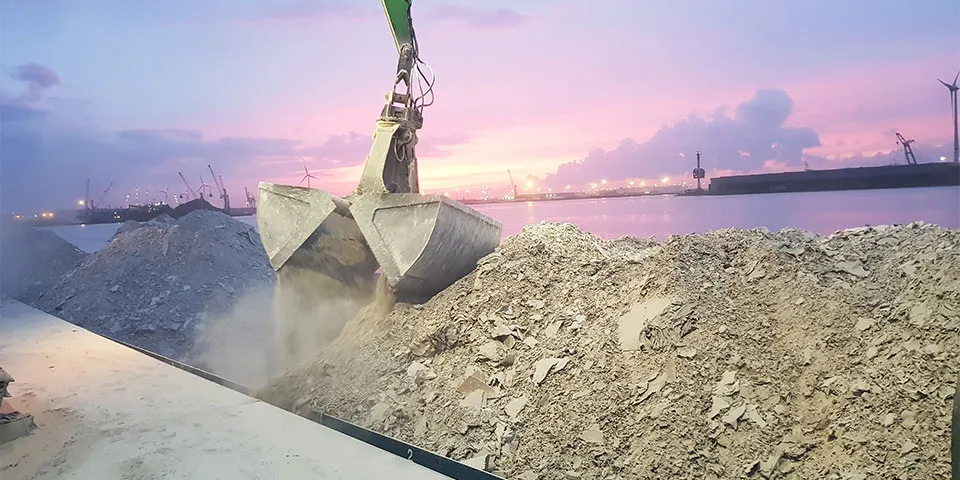
With two sites just across the border, one in Cologne and the other in Kallo in the Port of Antwerp, Canadian-origin New West Gypsum Recycling is well placed to serve the Dutch market too. The company recycles plasterboard into new plasterboard using its own patented system. And the whole process takes just a few hours, says Maarten Hendriks, managing director for Europe.
“In every country where we operate, alongside Canada these are Belgium, France, Germany, Norway and the United Kingdom, we work closely with the largest plasterboard manufacturer,” Hendriks explains. “In Belgium, France and Germany, that is Saint Gobain, in the UK Siniat and in Norway Knauf. We usually have our plant close to the manufacturer, or even on the same site. This means we can be sure that our recycled material is used straight away to make new plasterboard. That can happen just a few hours after the lorries have unloaded discarded plasterboard at our site.”
Gypsum is an ideal material for recycling, Hendriks says. “In fact, only iron and gypsum are 100% recyclable. All other materials, such as glass, paper and plastic, can never be turned back into exactly the same material. Their quality declines with each cycle. That is not the case with gypsum. It can be reused indefinitely to make new gypsum with exactly the same composition.”
Not very circular
It is no wonder, then, that Hendriks is astonished, or, to put it bluntly, angry about the fact that discarded gypsum is also spread over farmland in the Netherlands to improve soil quality. “For years, we have been working to put an end to this practice. Just as you would not want plasterboard to end up in landfill, it makes no sense to spread such a valuable material over fields. That is not sustainable, is it? What does that have to do with a circular economy?”
Because, once again, apart from plasterboard with insulation bonded to it or coated with aluminium or laminate, New West Gypsum Recycling can process all plasterboard into new raw material. And as Germany closes its coal-fired power stations one by one, demand for recycled gypsum is only increasing, Hendriks observes. “Plasterboard used to be made in large quantities from flue-gas desulphurisation gypsum, a by-product of coal-fired power stations. But supplies are dwindling. Our volumes have doubled since then. Fortunately, demand for recycled gypsum is growing in more and more countries.”
Close cooperation with plasterboard manufacturers also means NW Gypsum can advise them on the best way to produce their products, so they are genuinely Cradle-to-Cradle and NW Gypsum can continue recycling them in the future. “Ideally, governments would require plasterboard to be fully reusable or recyclable,” says Hendriks. “Because if you really want to build circularly, you have to be able to take everything apart easily.”
Question about this story? Ask your question
Keep following this
Get an email when a new story is published. No account needed.
- SubjectNews







