












GP Groot and StoneCycling introduce bespoke facing brick made from demolition rubble
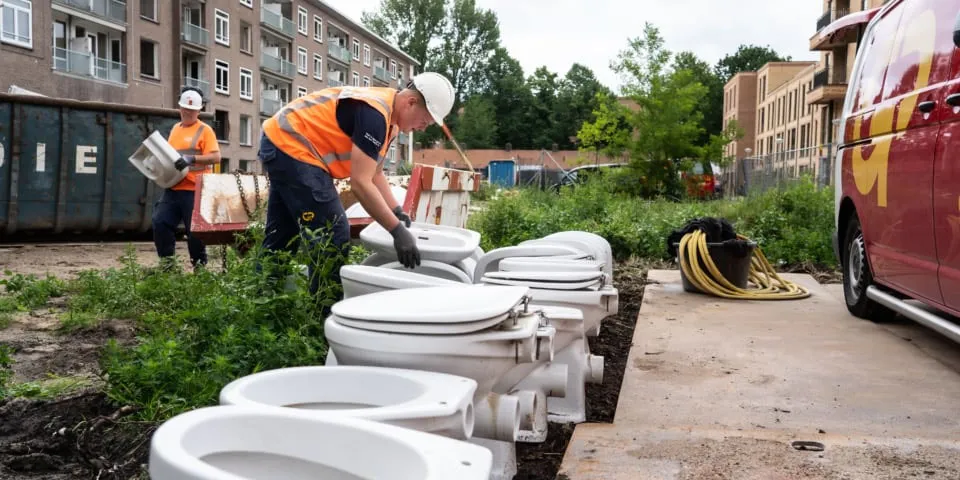
If the Netherlands is to be fully circular and carbon-neutral by 2050, companies in the construction sector need to work closely together now to make even greater reuse of materials possible. GP Groot and StoneCycling are setting a good example, introducing a new facing brick made from crushed sanitary ware, roof tiles and bricks.
GP Groot and StoneCycling are involved, on behalf of housing association Eigen Haard, in a major demolition and new-build project in Amsterdam. Together with DOOR Architecten, the association has developed an ambitious plan for the project.
Client gets its waste back as a new product
The plan centres on reusing some of the material released during the demolition of the buildings on Kramatweg and Akbarstraat in the new-build project at Fridtjof Nansenhof. “That is where the idea and initiative for this first-of-its-kind project originated,” says Ronald Balvers, director of GP Groot recycling. “At GP Groot, we see waste as a resource. Our mission is to make material streams released, among other things, during circular demolition work suitable for reuse or to process them into raw materials for new products. We do this with our subsidiaries within the GP Groot Groep, as well as with external partners such as StoneCycling. This helps us keep demolition and new-build costs under control and significantly reduce CO2 emissions. It also allows us to expand our range of products made through upcycling.”
From circular demolition to infinite reuse
StoneCycling develops and produces high-quality building materials from waste, using recycled raw materials that it selects itself. In this case, the approach is different: a new product is being created based on the available materials and the requirements of Eigen Haard and the architect. StoneCycling co-owner and director Ward Massa says: “This commission has really challenged us, because we usually develop products based on choice, rather than on the available waste. So, instead of using raw materials we have selected ourselves, we are now working with the material streams supplied to us through this project. This requires a different approach from us, but also from the architect and the client. After all, the final result is not yet entirely known in advance. That is unique. The collaboration with GP Groot is too. Together, you assess which materials are suitable. GP Groot then carries out circular demolition and processes them into high-quality raw materials. We turn these into a high-quality product that meets all the requirements and wishes. That really captures the imagination. What is demolished on site is used again on site. That makes the story behind the new buildings very special.”
Both Balvers and Massa see the project as a learning process, and are keen to find out what opportunities it could offer for other projects and product development. “We want to know whether returning materials in this way on a one-to-one basis works. The collaboration with GP Groot is also interesting. We are both companies that are keen to take on challenges like this. And that is what this is about: just getting on with it.”
“And looking behind the scenes at each other’s businesses leads to new ideas,” Balvers adds. “You learn from each other. Ultimately, that helps speed up the process of turning waste into raw materials. This new facing brick is a great example. This is how we move from circular demolition to infinite reuse, with the result that we will eventually no longer need virgin raw materials. And in this project, Eigen Haard gets its waste back as a new, sustainable product of very high quality.”
Question about this story? Ask your question
Keep following this
Get an email when a new story is published. No account needed.
- ThemeCircular construction and demolition
- SubjectNews







