












Glass wool recycling plant under construction
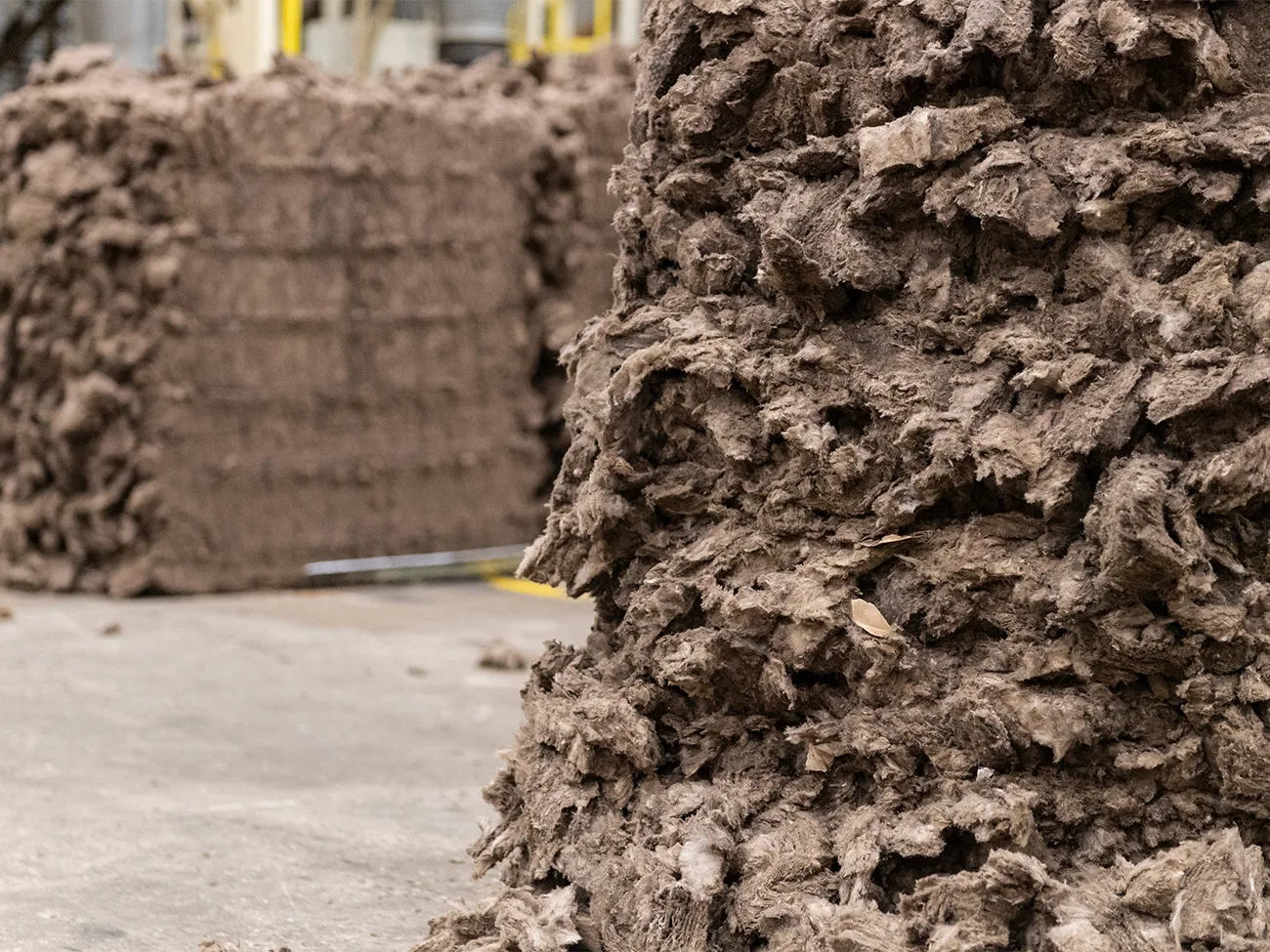
Reducing energy losses starts with insulation. Glass wool is therefore a product with sustainability in its DNA from the outset. Knauf Insulation now wants to take the next step and close the glass wool loop completely. At its site in Visé, it is launching a recycling project to turn glass wool recovered from demolition and construction sites into new glass wool. The pilot plant currently under construction will be able to process 5,000 to 7,000 tonnes of glass wool.
Knauf Insulation places great emphasis on sustainability. In its 2010-2020 strategy, ‘For a better world’, the manufacturer pledged to recycle 70% of its own waste. It now plans to build on that commitment with a new investment. Circular Economy Manager Western Europe Marc Bosmans says: “Our glass wool contains up to 80% recycled material. That may be enough to operate sustainably today, but we are convinced that more will be required tomorrow. We need to be able to prove to consumers that our products are not only recyclable, but are actually recycled. On top of that, competition for cullet is increasing. That is why we are taking the lead now, to master the technology for recycling glass wool and help build a carbon-neutral future.”
A different approach is needed on construction sites
The potential is certainly there. The only official figures available are from France, where 70,000 to 80,000 tonnes of glass wool waste are generated each year. That would put the volume for the Benelux at 10,000 to 15,000 tonnes. “The recovery drive Europe wants to unleash will only increase those figures. There is enough material, so what needs to change is the culture on construction sites. Glass wool should be collected separately to avoid impurities that hamper efficient recycling,” says Bosmans. This is hardly happening anywhere at present. Then there is the logistics. “All this brings additional costs, while prices for incinerating construction and demolition waste here are still relatively low. They hover around €160, compared with €160 to €220 in the neighbouring Netherlands and an average of €400 in Germany. That does not change the fact that we can feel the market is ready for this. The desire to build a sustainable society is stronger than ever among all stakeholders.”
Finding the right combination of technologies
Glass wool recycling also presents technical challenges. Bosmans says: “This is mainly due to the wide variety of materials we can expect.
The composition can vary enormously depending on the age of the glass wool. We will also have to adapt our production processes accordingly. So it is no coincidence that the recycling plant is being built in Visé. Our engineers have built up a great deal of process expertise there. Melting glass has been our core business for decades. We are convinced we can stabilise the process and optimise it to handle industrial volumes.” The recycling process will involve several stages. First, the material will be densified so that the glass wool waste can be collected in bales or big bags. The pilot plant will then establish the best melting process. “How many impurities can we tolerate in this type of recycling process in future without compromising quality?” The molten glass is then dropped into water to form small glass granules, which can in turn be introduced into Knauf Insulation’s processes.
Involving the entire value chain
“In fact, in recycling we apply the techniques we know from production, but in a completely different order. Once we have learned everything we need to learn at the pilot plant, we hope to move to continuous operation, increasing capacity by a factor of two to three. The key is to get the technology fully fine-tuned. Extended producer responsibility schemes or higher landfill charges could also help improve profitability.” Knauf Insulation is currently funding the investment on its own to get the pilot plant built. “Because we believe we can make it work. But we will sit down with the various government authorities. Material is needed to further stimulate the market. And we will need to involve the entire value chain,” Bosmans concludes.
Question about this story? Ask your question
Keep following this
Get an email when a new story is published. No account needed.
- SubjectNews







