












From strawberry greenhouses to industrial canopies: The growth story of Vermako
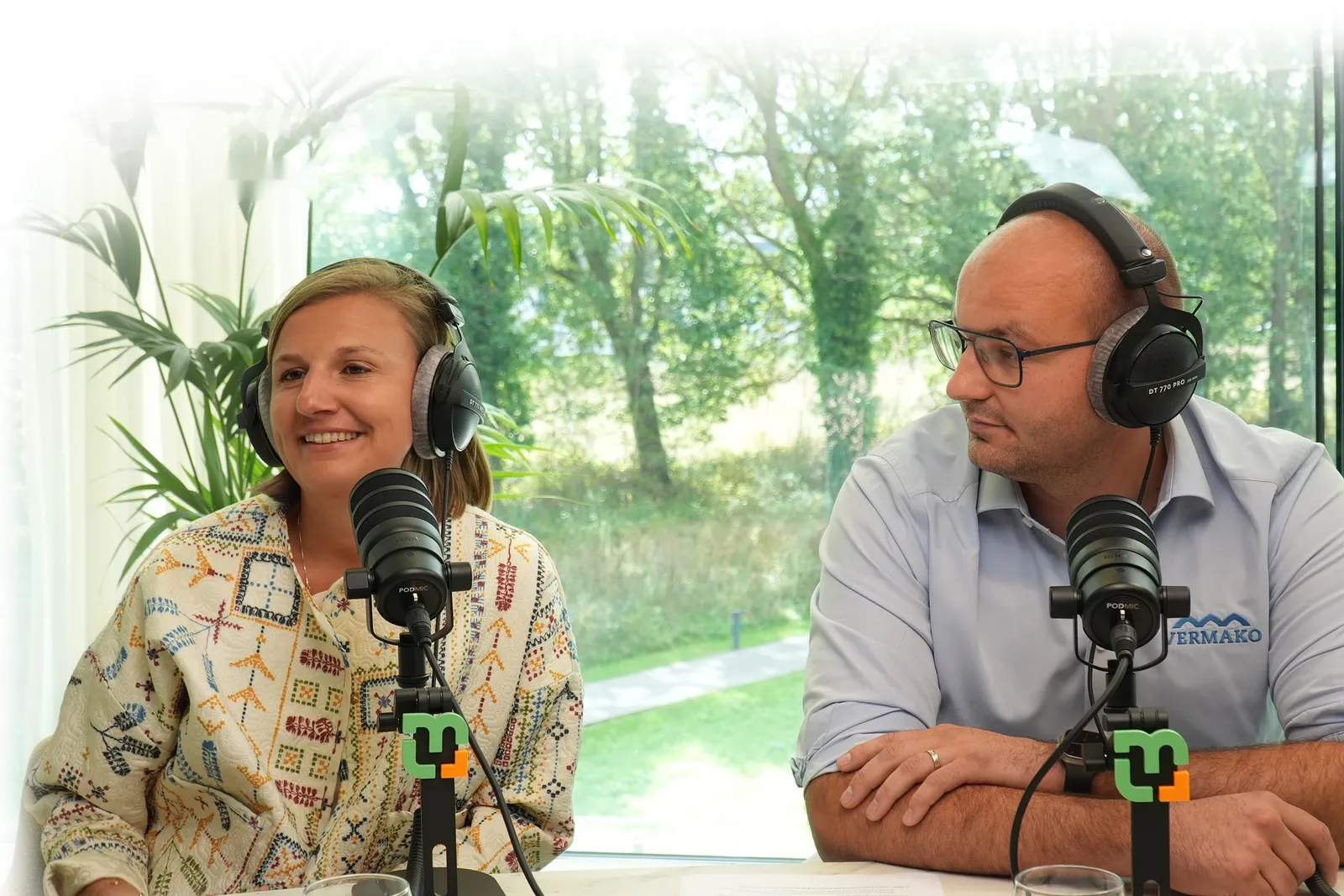
Speakers: Kim & Karl Maes (VERMAKO) | Moderator: Björn Crul
What began with a strawberry grower who could not find a suitable greenhouse and decided to build one himself instead has grown into a family business that now also delivers impressive industrial canopies. Behind this evolution lie important business decisions: diversifying to manage seasonal fluctuations, investing in in-house production and daring to seize new market opportunities.
In this episode of the Business Vlaanderen Podcast, moderator Björn Crul talks to Karl and Kim Maes, who have jointly been at the helm of Vermako since 2024. They explain how the company expanded from greenhouse construction into industrial projects, why they deliberately keep design, production and installation in-house, and how flexibility gives them a significant competitive advantage.
Using examples of completed projects, including a 20,000-square-metre canopy and a structure with a clear span of 65 metres, they show how technical expertise and a customer-focused approach go hand in hand. The conversation also covers the family business handover, the brother-and-sister partnership and their ambitions for the future.
Een zakelijke vraag aan Vermako Cover Solutions? Get in touch
Full transcript
All chapters (31)
- From strawberry growing to greenhouse construction and industrial canopies
- How Vermako grew out of strawberry growing
- From a greenhouse for himself to a commercial business
- The importance of customer focus and planning
- The challenges of a seasonal business
- Export as a way to smooth out production fluctuations
- Diversification into industrial canopies
- New market opportunities driven by changing environmental regulations
- How the new business line has contributed to growth and stability
- Entrepreneurship and the willingness to seize new opportunities
- Why business owners sometimes hesitate to diversify
- An industrial canopy for All Belgian Recycling
- Building while the customer’s operations continue
- Unexpected requests and practical challenges on site
- A 65-metre span with no support columns
- Dealing with setbacks and unexpected situations
- Vertical integration: designing, manufacturing and installing in-house
- The financial considerations and benefits of in-house production
- Less reliance on external suppliers
- Developing in-house production capacity
- Flexibility as a competitive advantage
- Employees’ knowledge, experience and involvement
- Preparing for the family business handover
- The decision to join the family business
- How a brother and sister divide their roles
- Balancing family and business
- When the handover became official
- A new generation at the helm
- The founder’s continued involvement
- Vermako’s plans for the future
- Closing: seizing opportunities in business
From strawberry growing to greenhouse construction and industrial canopies
Björn Crul Hello, listeners, and welcome to a new Business Vlaanderen podcast. Their father, a strawberry grower, was looking for a greenhouse that met his needs. When he could not find one, he eventually decided to build one himself. That solution for his own business gradually grew into a company that today builds not only greenhouses but also large industrial canopies. And it is now run by the second generation. Behind that growth are a number of decisions that will be familiar to many business owners. For example, what do you do with 40 employees when your core activity is highly seasonal? Do you build up a second line of business, outsource production or invest in more in-house production? And what happens when a brother and sister eventually take over the family business together? I’ll be talking about all of this with Karl and Kim Maes of Vermako. As I mentioned, they are the son and daughter of the father I just referred to, and they now run the company together. Welcome, both of you.
Karl Maes Okay.
How Vermako grew out of strawberry growing
Björn Crul Karl, I think we should start with your father’s story, as we touched on earlier. It all began with strawberries. How did it all start?
Karl Maes Yes, that’s right. Our dad was a farmer and grew and tried all sorts of things. He also had quite a few animals on the farm. But they eventually settled on strawberries, something they really enjoyed and which was also an interesting crop to grow. At the time, they were grown outdoors in the ground, without protection. So yields were highly seasonal and very dependent on the weather. They needed protection to make their income more reliable. They started looking for a canopy for the strawberries, but could not find what they wanted on the market. So he made it his winter job, or hobby, to build his own canopy, one that suited him better.
Björn Crul Did he have any experience or ideas at that point about how to do it?
Karl Maes No, not really. He had a rough idea in mind of what he wanted to achieve. And he had been very interested in metalworking and construction since he was young. In winter, he had some time to try things out. He made something, took it apart, then made something else, working towards his ideal version. Yes, it turned out well. I remember him saying it was very difficult. After his first greenhouse, he said, “I’ll never build another greenhouse, because it’s cold in winter and I’ve had to redo so many things.” In the end, though, he succeeded, and all that hard work paid off.
Read the full transcriptCollapse transcriptnog 29 hoofdstukken
From a greenhouse for himself to a commercial business
Björn Crul He managed to build his own greenhouse. And more than that, he then decided to do the same for other people. That’s really how the idea for the company began. When did it click that he could do this for other people too? It sounds like an interesting opportunity.
Karl Maes I think it was after his first growing cycle, or after his first harvest. He had already recouped all the money he had invested in the materials.
Björn Crul I imagine he thought, “Oh, this is interesting. It’s good business, actually.”
Karl Maes If it works for me, it should work for other people too. It was more his kind of thing as well. He enjoyed working with metal and building things more than farming itself. And he saw a business opportunity in something he was passionate about and enjoyed doing. He also had grower friends who were looking for the same thing. One became two, then three.
Björn Crul Did those growers come to him, or did he actively approach them and say, “Maybe I can help you”?
Karl Maes I think people talked about it a lot back then. Grower friends and colleagues would say, “This is what happened to me,” or “I’ve got one of those. How did it go for you? Do you have those problems too?” They would discuss it, let’s say, at the pub or after church. One thing led to another, and then my dad would say, “I’ll put up your greenhouse. We’ll do it this way.” Then he had to start investing, buying materials and plastic film. It had to be built, and the customer had to be satisfied.
The importance of customer focus and planning
Björn Crul Does the fact that your father was his own customer, or had been on the other side of the equation as someone who needed a greenhouse, still influence the way you work today? In other words, does it help you understand what the customer wants? Karl Maes: Yes, that has been very important in shaping our approach and upbringing. Understand what the customer wants and what they are asking for. That is still very important today. Planning is also crucial. The strawberry season starts in February and March, so the greenhouse needs to be ready by then. But the installations that follow ours also need to be ready. You need to put together a sensible and confident schedule, and work with the customer to decide how we are going to approach the job and how it needs to progress.
The challenges of a seasonal business
Björn Crul Okay, so that’s how your family got into the whole greenhouse business. But it’s inherently seasonal, tied to the time of year. What does that mean in practice? Why is this something we’re talking about? How does it play out day to day?
Kim Maes My brother has already explained it a little. A customer comes to us and says, “I’d like a greenhouse by a certain date, because I’ve bought plants and want to start growing them.” We then do our utmost to meet that deadline. But what you notice, and what my father noticed too, is that there are certain months, for example May, June, July and August, when the customer has no time because they’re so busy in their greenhouse.
Björn Crul Yes, that’s when the strawberries, or whatever they’re growing, need their full attention.
Kim Maes Yes, that’s when the work has to be done. So we noticed that production fluctuated. We had to push really hard to meet the deadlines. But then you have a few months when things are not very busy, and you have to adapt. You have to ask yourself: what are we going to do now? The production hall is there, so we can’t just leave it standing idle.
Björn Crul A company can’t go for months without producing anything. That’s not viable. But this is more than just planning cleverly or something like that. It’s fundamental to how the business is structured. When did it first sink in that you really needed to find a solution and manage this smartly?
Export as a way to smooth out production fluctuations
Kim Maes An opportunity came up in the early 2000s. We were involved in it, and it was about exports. A Dutch company wanted to grow roses in Ethiopia. They wanted 1.5 hectares of greenhouse built every week. It was a great opportunity. We only had to supply the materials. The greenhouses were then installed on site, and our production team could do repeat work, making a lot of identical components. That helped to even out the seasonal fluctuations.
Björn Crul But an opportunity like that doesn’t come along every week. So you eventually decided to broaden your business and build up a new division. What did that become?
Diversification into industrial canopies
Kim Maes We were able to serve the export market for ten years. But we saw a lot of competition from other countries, such as China and India, so we decided it was no longer working for us because we work to European standards. Another opportunity came up to cover materials that need to be kept dry. It started in horticulture, but growers themselves would say, “I want to store potting soil here. I’d like a greenhouse roof over certain silos so I can store things dry, or perhaps a processing hall for potting plants.” Then a supplier came along and said, “That’s interesting, the way you’ve done that. I have the same problem: my potting soil needs to stay dry, because I can’t load it when it’s wet. Who did that?” “Vermako did.” So they came to us too, and things took off. We then expanded into other sectors beyond horticulture.
New market opportunities driven by changing environmental regulations
Björn Crul The way you tell it, it sounds like a very logical and simple process, but of course it isn’t. It takes a lot of money and thought to explore. When did you decide it was really worth pursuing, and that the financial benefits would outweigh the cost?
Kim Maes It started in 2014 or 2015. That was when we began to notice environmental regulations changing. Industrial companies were facing restrictions on dust control, or requirements to collect rainwater and filter it differently. We kept our ears and eyes open and heard that, for example, if rain fell on an open greenhouse, you had to install a whole system to filter all that rainwater. Then at a social event, we discussed the idea of collecting it in a pit, as they do in horticulture. Someone said, “I don’t think I’d have to do that.” We sat down and asked: what do you need? How much space, how much clear space, would you need to work effectively? That person said they could recoup the cost of the canopy in about five or six years, compared with all those systems. So we said, “Let’s go for it.”
How the new business line has contributed to growth and stability
Björn Crul Looking back, that decision really did open up new financial opportunities and bring stability to the company. It’s clearly been a great success, wouldn’t you say?
Kim Maes Yes, because the greenhouse side of the business was still there and remained stable. There was sometimes seasonal work, but the industrial division also gave us production work and kept the business running. So we had more materials, more work and more turnover. That meant we could invest again in other ways to serve customers and design structures.
Björn Crul What do you think would have happened to the company if you’d never taken that step? If you’d remained greenhouse builders, or stayed active only in that sector? It’s obviously a difficult question, but it helps put the impact of that decision into perspective.
Kim Maes I haven’t really thought about it myself. When an opportunity comes along, we take it. But if that hadn’t happened, I think we’d probably be a smaller company. Maybe, Karl, you wouldn’t have been able to use your creativity and design skills. Greenhouses do have their limitations. With these canopies, when it comes to what you can build, the sky’s the limit.
Entrepreneurship and the willingness to seize new opportunities
Björn Crul This is a very specific question for your company, of course, but I think there’s a clear lesson here for other business owners. How would you describe it? What message does your own growth story have for others?
Karl Maes Yes, don’t be afraid. Give it a try. And once you’ve made the decision, commit to it and do everything you can to make it work and get it right. And yes, it usually works out well. I also remember that it originally started out very small, because we were producing greenhouses in series: one product, made a thousand or ten thousand times. The original idea was to make small kits for industrial warehouses. Then the idea grew and someone went out to market it, but that market was already full, or there was little room for new players. We already had the facilities and staff to take on more challenging projects. So we decided it was more interesting to work in the project market and make something tailored to the customer, where you can really add value for them.
Why business owners sometimes hesitate to diversify
Björn Crul Looking at the wider business community, I think there are a lot of business owners who don’t dare take that step, or are a little wary of diversifying. Why do you think that is? Or is that perception even accurate?
Karl Maes I think people like to work with what they know and what they’re good at. But as we said, we had to look for another opportunity because the Chinese were already there and the Indians were entering the market. They’re major global players too, building greenhouses in Africa, for example, and they can do it more cheaply.
Kim Maes I’d add one thing. I was brought up with the mindset that it’s either yes or no. And if it’s yes, go for it, take the leap, be brave, get on with it. I see a lot of people my age looking for security. They don’t really dare to take the plunge, but at worst you’ll have learnt a lot, and at best it’ll be a success.
Björn Crul Yes, you’re relatively young to be running the company, but even among your generation you can see a certain reluctance to take steps like this. That’s a shame, really.
Kim Maes Yes, it is.
An industrial canopy for All Belgian Recycling
Björn Crul That’s a great message. To give a more concrete picture of what your company does, perhaps we could look at a few specific case studies. The first is All Belgian Recycling, part of the construction company De Meuter. It’s located on the outskirts of Brussels and recycles construction waste. You built a huge industrial canopy for them. Tell us, what’s there today, and how did it come about?
Karl Maes I think we’ve built at De Meuter ten times now. The original request was to keep rainwater out of their sand bunkers so they could make concrete easily, or at least know how much moisture was in the sand. The request was simple: put a roof over my sand bunker so we can scoop out the sand easily with a bulldozer. That worked well, and it was perfect for them. It gave us a foot in the door. Then they asked: can you build bigger halls that trucks can tip into, and that we can fit with solar panels? So we got to work on that. We designed them together with the customer, taking the site into account too. The ground there is poor, so we had to design the connections in a very specific way. That worked out well too. Then he realised it was better to carry out his processing under a canopy as well. He had a spare corner on his two-hectare site where he wanted more canopies, and we built them in a few phases. Little by little.
Björn Crul And how big are we talking, in terms of area? How large is the canopy?
Karl Maes 20,000 square metres, yes, two hectares, with 10 metres of clear height so trucks can tip their loads underneath.
Björn Crul When a request like that comes in, is your first reaction, ‘Ooh, that’s a challenge’? Or do you immediately think, ‘We can do that, let’s go’?
Karl Maes Mostly the latter, because the greenhouse business had already got us used to working with large volumes and areas. We knew it was right up our street.
Building while the customer’s operations continue
Björn Crul How does that kind of customer relationship work? An industrial company obviously doesn’t want its operations to be at a standstill for months. That’s not an option. Especially in this case, where construction waste has to keep being delivered and recycled every day. So how do you keep operations going while the construction work is under way?
Karl Maes Ideally, we’d build it all in one go, with everything following neatly on from one stage to the next, and do as much as possible on the same day. But of course, that’s not how it works in reality. Sometimes the customer has an opportunity to unload a ship, or two ships, and the material has to go where we’re about to build the canopy. So you need to agree things properly. Make sure part of the site is cordoned off. We’ve learnt that red-and-white tape doesn’t mark out an area as clearly as barriers do. Sometimes you have to say: we really need the space up to that point. But you have to communicate well, and be a little flexible to keep the customer happy.
Björn Crul In practice, are the plans often changed during construction? Do you also have to be flexible in response to what the customer asks for?
Karl Maes As I said, sometimes the customer has opportunities that require us to do things a little differently. They always appreciate that. If we look after the customer, they look after us too. That’s an important part of how we do business: make sure the customer is happy and that the collaboration runs smoothly.
Unexpected requests and practical challenges on site
Björn Crul What’s the strangest request, or the most unusual one, you’ve had from a customer during a project like this?
Kim Maes We were discussing the schedule for when we could start assembling. The subject of concrete curing time came up. We said, ‘Yes, we allow 21 days for that.’ The customer asked, ‘Are those working days or calendar days?’ We just looked at each other.
Björn Crul So what you do is often a long way removed from their day-to-day reality. And that’s exactly where your expertise adds value. The key feature of a canopy like this is the distance between columns, with no supporting structure in between. To make that more concrete, what kind of distance between columns do you typically work with? Or what are the most impressive structures?
A 65-metre span with no support columns
Karl Maes That was 65 metres from column to column, with a clear height of 12 metres. It was for a port operator in Ghent that frequently unloads ships and mainly handles bulk materials before sending them back out on the road.
Björn Crul Are customers surprised when you tell them you can build something spanning that distance? To a layperson, 65 metres without support columns sounds impressive. Is it just as striking to people who work in the industry?
Karl Maes Yes, definitely. It’s grown little by little. We started at 35 or 40 metres. Then came the question: can you do 50, 60? Yes, we can. I remember that our limit used to be 60 metres, because we could make all the materials ourselves. For the 65-metre span, of course, we needed slightly heavier tubes or plates, which I had to have made externally. But the customer was very happy with it. It was exactly the solution he needed. He had an existing warehouse and access route, with one-way traffic across the site. If we’d had to put a column there, it would have disrupted everything and narrowed the route. It would also have been much less productive for him to store materials or unload there. So yes, that solution really helped the customer.
Björn Crul Canopies aren’t about showing off what you can do technically. Having that kind of clear span, with no columns in the way, brings real, practical value to the customer.
Kim Maes And the customer feels safer too. There are fewer columns to drive into.
Björn Crul Yes, so it brings a lot of practical benefits for them.
Dealing with setbacks and unexpected situations
Björn Crul These are success stories, of course, but I imagine things sometimes go wrong on a construction project. Can you give us an example of a project that didn’t go to plan?
Kim Maes That was more of an export issue. We’d shipped containers and everything was fine. We were on time, but the ship docked in Hamburg and a crane toppled onto some of the containers. The cargo fell off, so it was force majeure. Where was the container? Was it at the bottom of the sea? It was a bit chaotic. Then you have to act quickly and say: okay, we’ll make it again. That certainly gave us food for thought.
Björn Crul Do you learn lessons from that sort of situation? Is there anything you can take away from it as a company? Did you change anything about the way you work?
Kim Maes Well, that was a situation beyond our control. We adapted and reshuffled a project that was already in production, deciding to redirect those materials to help the customers who were in a difficult position. We also decided that we might adjust a software programme to make it easier to switch things around.
Björn Crul So it can be valuable to manage a project where something goes wrong from time to time.
Kim Maes Yes, that’s right.
Björn Crul That ties in with the mindset we were just talking about: give things a try, and you learn a lot along the way.
Vertical integration: designing, manufacturing and installing in-house
Björn Crul Now, if we step away from the construction site and look at the boardroom, at the company itself, I think the most important thing that makes Vermako what it is is that you do everything yourselves. In other words, you design, manufacture and install everything in-house. In management terms, that’s called vertical integration. What does that mean? Why did you take that step? Why do you want to keep everything in your own hands?
Kim Maes It really started with a healthy interest, a bit of passion, on my father’s part. He was genuinely interested in the technology, and he realised that he had people around him who understood it too. They got excited about a new machine and the chance to use it themselves and see the results. Karl and I grew up with that as well. Karl has a strong technical background and finds it really interesting. So that’s really where it came from.
Björn Crul You might think that sounds obvious, but that’s certainly not the case in your particular industry.
Kim Maes No, exactly. Take a greenhouse company in the Netherlands, for example. They usually have five employees: one person handles sales, another purchasing, and everything else is outsourced. We’ve earned a reputation in the sector as a company that can do everything in-house. At Vermako, we have it all under control. Customers don’t have to worry about finding someone to assemble or install the greenhouse. So that really is unique.
The financial considerations and benefits of in-house production
Björn Crul And what does that mean financially for the company? I can imagine it also makes you more vulnerable in some ways, because you’re taking on more, quite literally.
Kim Maes Yes, it is challenging.
Karl Maes We sometimes win projects thanks to our flexibility and the speed at which we can act. We’ve won a lot of projects that way. And yes, it does come at a price.
Björn Crul But that price pays off, because it also makes you more flexible and gives you more control over the whole process.
Karl Maes And it means we can do things differently from others. If we want to do something special in a corner of a greenhouse, for example, where we don’t want a post in the way of internal circulation, we can adapt the design. We can see that our colleagues sometimes find that less straightforward than we do.
Less reliance on external suppliers
Kim Maes And looking at how the world has been turning over the last three or four years, we can see that this also gives us an advantage. We’re not dependent on an embargo or a channel being closed.
Björn Crul Yes, because the mood of the times has suddenly changed so much. You have to take control yourself, and as Europe we need to try to think and act more independently again. But you had already been convinced of that and working that way for a long time.
Kim Maes Yes, it’s something that matters to us. The expertise is here. We know what we’re doing, and we want to hold on to that. And now it seems that, yes, it was a good choice.
Karl Maes When people visit and see everything that goes on behind the scenes at a greenhouse builder, they’re amazed by our warehouses and production hall. They’re proud to work with us. They say, ‘Oh, this is the Belgian manufacturing industry we’re supporting.’ It’s impressive to see.
Developing in-house production capacity
Björn Crul You’ve been working this way for years. When did it all begin?
Karl Maes Let’s go back in time. It started in the cowshed on the farm.
Björn Crul So this mindset was there right from the start of the company.
Karl Maes Yes. My dad first put the tubes through the cowshed, with one end outside for bending the tube and the other for drilling. Then he built a warehouse and started setting up more productive operations. One machine, two machines, three machines. Always so we could do more ourselves and, above all, deliver on our promises.
Flexibility as a competitive advantage
Björn Crul When you tell other people that you do everything yourselves, do you find it inspires them? Or does it make them a little nervous, as if to say, ‘I’d never do that’?
Kim Maes It depends a bit on who you’re talking to.
Björn Crul That’s always the case, of course.
Kim Maes I mainly try to point out the benefits. If you’re on a site and it’s pouring with rain and there’s a lot of mud, we can react quickly and say, ‘Okay, they need a machine there.’ If it comes to it, Karl or I will take it there ourselves. But if another company is doing it, they first have to call the hire company and ask whether one is available.
Björn Crul So the competitive advantage you have from this is evident every day. And those are the benefits you need to highlight if you want to convince people.
Kim Maes Exactly.
Björn Crul But is it realistic for everyone in your sector to work this way?
Kim Maes I don’t know. I can’t really speak to that. It also depends on whether those other companies have the right people around them to make it work.
Employees’ knowledge, experience and involvement
Björn Crul I think that’s something you really focus on.
Karl Maes Yes, we have that experience. Some people have been with us for fifteen or twenty years and have made almost every part of a greenhouse or canopy. That know-how really is here, and it’s something to be proud of.
Kim Maes We also want to involve people when, for example, we buy a new machine or make a new investment. We really want several people to know how to use the machine, and you can see them grow in confidence. They say, ‘Wow, I get to learn this now. I’ll be able to work with it.’ They’re proud of it.
Karl Maes Making videos and sending them to their mum or dad.
Björn Crul So it’s a real asset internally too, helping to strengthen cohesion within the company.
Karl Maes Yes, it creates a sense of involvement.
Preparing for the family business handover
Björn Crul Okay, I think the fact that we can discuss these management decisions with you says something in itself. As I said, you’ve been at the helm of the company yourselves since late 2024. So, of course, we need to talk about that too. How did it happen? When was the first step towards the handover taken? And how did you experience it?
Karl Maes I’d known since I was a little boy that I wanted to do it. But of course, there are four of us at home. The first steps were taken while I was still in higher education. So I suppose that was ten years ago now.
Kim Maes In 2017, the four children, the two sisters and two brothers, and our parents took part in a process. We were told, ‘Look, everyone, a handover takes seven years on average.’ I thought, ‘That’s a long way off.’ And in the end, the actual handover did take place seven years later, in 2024. It’s a process that needs time to mature. When I was younger, I wasn’t sure that I wanted to do this.
The decision to join the family business
Björn Crul And when did that shift happen? When did you start thinking, ‘Maybe I could do this’?
Kim Maes After graduating, I first went to work somewhere else. It turned out there was an opportunity there too. Then you hear, ‘We’re looking for someone at Vermako with your degree, someone who can do this and that.’ And you think, it’s silly to look for someone else when I can probably do it too. Then you get involved, things start to take shape and you feel proud to be part of it.
Björn Crul And now the two of you are at the helm. What role do the other two, your brother and sister, play, or how do they feel about it?
Karl Maes They’re happy that we’re carrying it on. They each have their own successful business, which also gives them a lot of energy. I think we’ve all found our niche.
How a brother and sister divide their roles
Björn Crul Okay, and how do the two of you divide the roles between you? It’s not always easy for a brother and sister to work together. How do you approach it?
Kim Maes My role is to make sure people know Vermako, together with the marketing team. And, with the sales team, to convince customers and potential customers to choose us. And the technical side?
Karl Maes That’s my area, from the initial plan through to handover. I also handle after-sales service. Mainly the technical side, really.
Balancing family and business
Björn Crul And can you still be a family as well as business leaders? Can you sometimes talk about something other than the company, for example?
Karl Maes Yes, absolutely.
Björn Crul Okay, that doesn’t sound difficult. That can only be a good thing, as I think it’s a challenge for many people.
Karl Maes Yes, that’s right. We’ve always seen it that way too. The company was always part of the conversation around the kitchen table. At family gatherings with relatives or friends, it was always about the company. And we’ve noticed that...
Kim Maes Then you want to try to handle things differently. The big advantage is that we don’t involve our partners in it.
Karl Maes That’s an advantage. Kim Maes: Then you can tell them, ‘This is how my day went,’ or ‘I had a bit of bad luck with that.’ Or if you don’t feel like talking about it, you can say, ‘Not now.’ You don’t have to. And at family gatherings, we make a conscious effort to enjoy the weekend properly, as brother and sister, not as colleagues.
When the handover became official
Björn Crul So you can still switch roles. The handover took years and was completed in 2024. Then comes the moment when you formally take on responsibility. What was that like? When did it first sink in that it was now up to us?
Kim Maes It was quite special. You go to the accountant, and a pile of contracts is laid out on the table. You sit on one side, with your parents opposite you, and then you have to sign. Someone from the bank is sitting beside you, saying, ‘Okay, I’ll just call to arrange the transfer of the funds.’ And then you say, ‘You can transfer it.’ And you think, ‘Okay, it’s under way.’
A new generation at the helm
Björn Crul And since then, are there things you do very differently from your father as managing director? Or are there things that have mostly carried on as before?
Karl Maes We do a lot of the same things, but naturally the perspective is a little different for someone who started a business in 1989 and someone starting out in 2024. And we have a whole team behind us. That’s a major difference too. Dad grew steadily, starting with one employee, then two, and eventually reaching the size we see today. We’re starting out with 45 employees.
Björn Crul Yes, of course, you’re responsible for all those people.
Karl Maes Yes, that’s important. But we’ve been working in the company for a while, and we know everyone. There are even people who were there when I was born who still work here. Björn Crul: They’re still there, okay.
Karl Maes I have a good relationship with them. Yes, we do feel responsible for them.
Kim Maes I’ll speak for myself here. One thing I consciously want to do differently is to have a life outside Vermako too. To set aside an evening for something like a hobby.
Björn Crul Something your father perhaps wouldn’t have done straight away.
Kim Maes His hobby is Vermako.
The founder’s continued involvement
Björn Crul Does he still have a role in the company, or does he still come in?
Kim Maes Yes, he still comes in enthusiastically to advise and support us. It does help. We’re glad to have him.
Björn Crul So you don’t feel that it gets in the way or anything like that?
Kim Maes No.
Karl Maes He’s our knowledge bank. We actually gave him a title: knowledge bank, advocate. What did we call it? Driving force. That was a lovely thing to write. He was quite taken with it.
Vermako’s plans for the future
Björn Crul You’re still at the beginning of your journey as business leaders. So, to wrap up, let’s look ahead. What do you hope to achieve? Where would you like Vermako to be in ten years or so, for example?
Karl Maes Above all, I want Vermako to remain a strong name in the sector. Do what we say, say what we do. And, above all, to be proud in ten years’ time of the path we’ve taken. We should have grown a little in our activities, and personally too.
Kim Maes Perhaps we can come back here in ten years’ time and tell the podcast listeners about what we’ve achieved.
Closing: seizing opportunities in business
Björn Crul That would be a great goal. I hope we… It’s a lovely thought to end on, because unfortunately we have to stop here. It’s certainly been a very inspiring story, and I hope other entrepreneurs can take something from it. It’s a story that began with an entrepreneur who couldn’t find a solution to his own problem, so he built one himself. But above all, it’s the story of a company that dares to look further afield, beyond the confines of what it does, and sees opportunities. Thank you very much, Karl and Kim Maes of Vermako, and thank you for listening.
Companies in this story
Keep following this
Get an email when a new story is published. No account needed.
- SubjectNews
- CompanyVermako Cover Solutions







