












From 2021, you will be required to produce biogas and compost
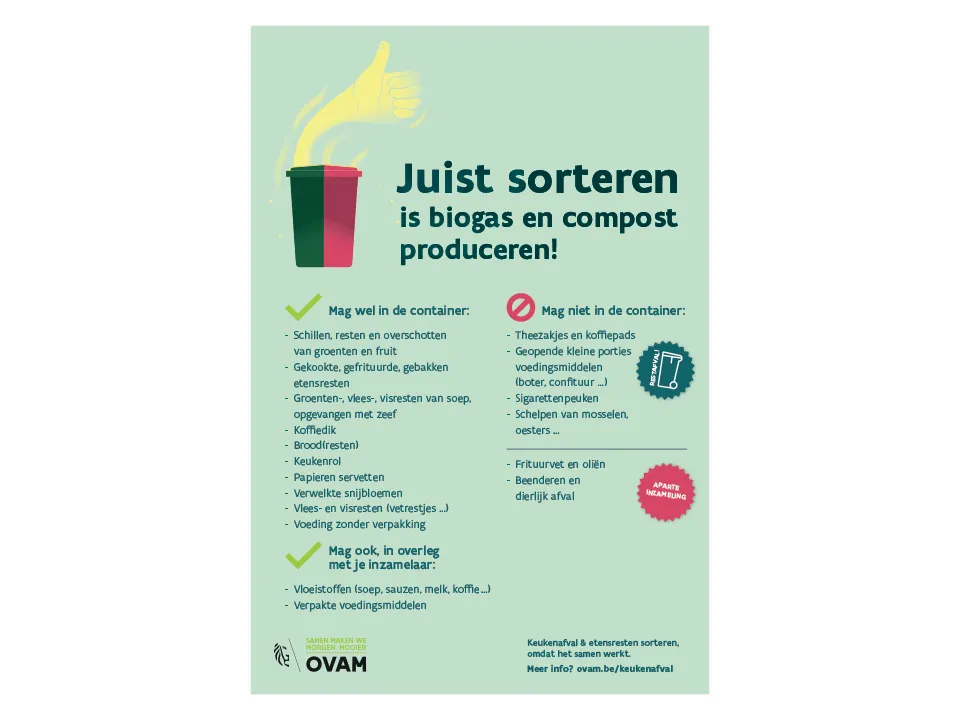
About half of businesses’ residual waste consists of materials that can still be recycled. This means there is plenty of potential to reduce the amount of residual waste we incinerate. From 1 January 2021, the Flemish legislature is therefore targeting kitchen waste and food scraps. Most businesses will have to arrange for these to be collected separately from the start of next year, giving them a second life as biogas or compost.
The requirement to collect kitchen waste and food scraps separately forms part of European Framework Directive 851/2018. This requires businesses and households to separate their organic and biological waste at source by 31/12/2023 and recycle it, or have it collected separately for recycling. OVAM spokesperson Jan Verheyen says: “Households have been doing this for some time through the collection of fruit, vegetable and garden waste (GFT), or by being encouraged to compost at home. Businesses were already required to keep their green waste separate, and this is now being extended to kitchen waste. Our decision to move faster has a lot to do with the analysis of business residual waste. This shows that about half of it could actually be given a second life. At present, around 35,000 tonnes of kitchen waste and food scraps from businesses in the hospitality and catering sectors, including schools and healthcare, are collected separately in Flanders. That is a third of the total in these sectors; the other two thirds still go into residual waste. That is a shame, when you consider that this causes unnecessary CO2 emissions and that these materials have so much potential.”
Implementation in two phases
But where do kitchen waste and food scraps go? Verheyen says: “By collecting them as a separate stream, we can produce compost and biogas. The biogas can then be used as green energy by households and businesses. The compost helps improve soil health.” There are plenty of benefits, then, to making this compulsory. However, the requirement will be introduced in two phases. From 1 January 2021, it will apply to businesses where hot meals are regularly served or prepared at least once a week:
• Educational establishments with more than 300 pupils
• Hospitals and psychiatric hospitals with more than 25 approved beds
• Residential care centres with an approved capacity of more than 30 beds
• Prisons
• Armed forces barracks with more than 100 employees
• Businesses and institutions with more than 100 employees
• Restaurants, brasseries and hotels serving more than 50 meals a day
• Function rooms and multi-purpose halls with a capacity of more than 250 seats
• Catering businesses
“This will already bring a significant part of the market into scope. From 1 January 2024, the requirement will apply to all businesses. However, we are making an exception for the smallest businesses, as we do with PMD. If you produce less than 80 kg of kitchen waste a week, you can still use the local GFT collection service,” Verheyen adds.
Support from collectors and processors needed
OVAM is counting on the IHM’s to get businesses on board. “Businesses must enter into a contract with an IHM for this separate collection. They therefore have an important role to play in raising awareness among and informing their customers. We are providing the necessary communications material on our website to alert their customers to the requirement and make clear what can and cannot go in.” OVAM will assess the success of the campaign and the new requirement by looking at what ultimately remains in business residual waste. “Flanders aims to reduce business residual waste by 15% by 2022. We are not setting targets for the separate collection of kitchen waste and food scraps. Prevention remains the main priority. For example, Cirkeltips offers businesses guidance on how to get started. At the same time, we want to ensure that materials that can still be put to a useful purpose no longer end up in residual waste. Ultimately, this is the most environmentally and economically sound way of working,” Verheyen concludes.
Question about this story? Ask your question
Companies in this story

Keep following this
Get an email when a new story is published. No account needed.
- ThemeImproving waste collection and transport
- SubjectNews
- CompanyOVAM







