












Frisian waste and resources company nominated for King Willem I Prize
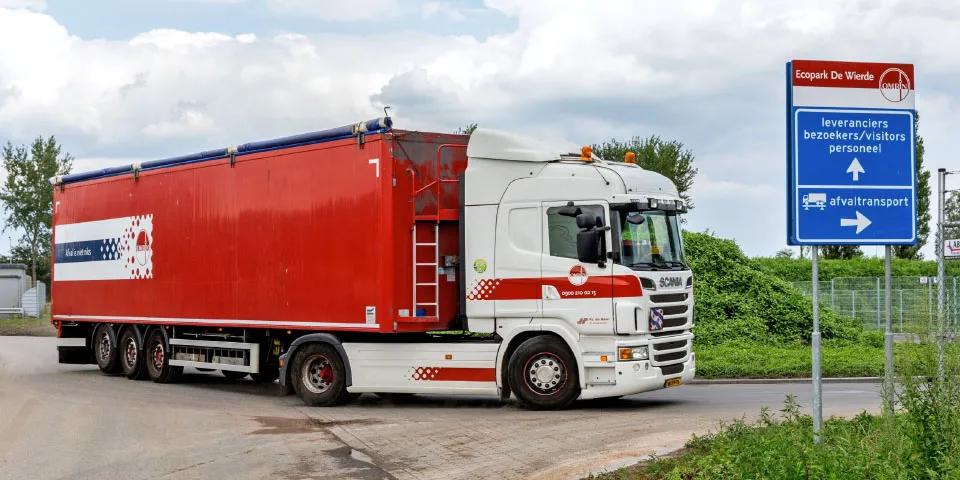
‘Source separation where necessary, post-separation where possible’
Frisian waste collector and processor Omrin is one of 12 companies nominated for the prestigious King Willem I Prize in the SME category. Omrin previously won the title of ‘Most Sustainable Company in the Netherlands’, awarded by Stichting Nederland CO2 Neutraal. How have the Frisians managed to get so far ahead?
What’s in a name? Perhaps the secret behind Omrin’s success lies in something very simple: its name. Omrin means ‘cycle’ in Frisian. And a name like that naturally brings certain obligations. On top of that, the waste company from Leeuwarden has a very clear mission: it “aims to be a leading player in waste collection, resource recovery and sustainable energy production.” The reason is that “the world’s population is growing and resources are becoming scarcer. We must use what we have sparingly. Omrin therefore dreams of a circular economy, a system in which we reuse resources and products as much as possible.”
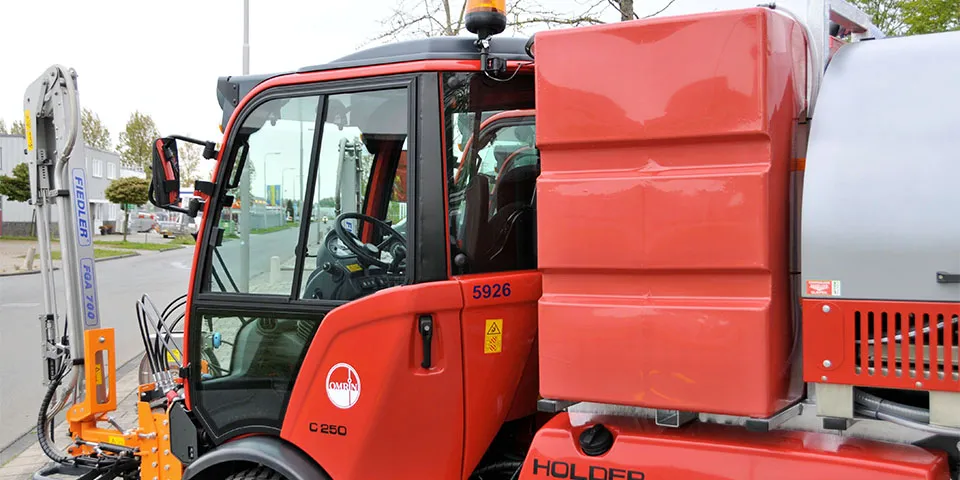
The entire fleet runs on self-produced green gas.
So much for the fine words. Omrin appears to take its mission seriously and put its money where its mouth is. Not only has it already won an award for sustainability and become the only recycling company nominated for the Netherlands’ leading business award, the figures also show that Omrin is serious about its mission. Across the rest of the Netherlands, an average of 50 per cent of collected waste is made suitable for reuse. The Frisians manage to make no less than 71 per cent of the waste they collect suitable for reuse. The target for 2020 is 75 per cent. The waste company also generates a third of Friesland’s sustainable energy: 25 per cent electricity and steam, and 8 per cent green gas.
Separation technologies
Omrin can point to these impressive results because it collects waste from more than 175,000 households in 12 Frisian municipalities, 4 in Groningen and more than 8,500 businesses and institutions. This makes it the largest waste collector in the northern Netherlands. It also processes household waste from almost 800,000 households in 18 Frisian municipalities, 2 municipalities in Groningen, 6 municipalities in North Veluwe, 6 municipalities in South Holland and many businesses. Omrin’s motto? “Source separation where necessary, post-separation where possible.”
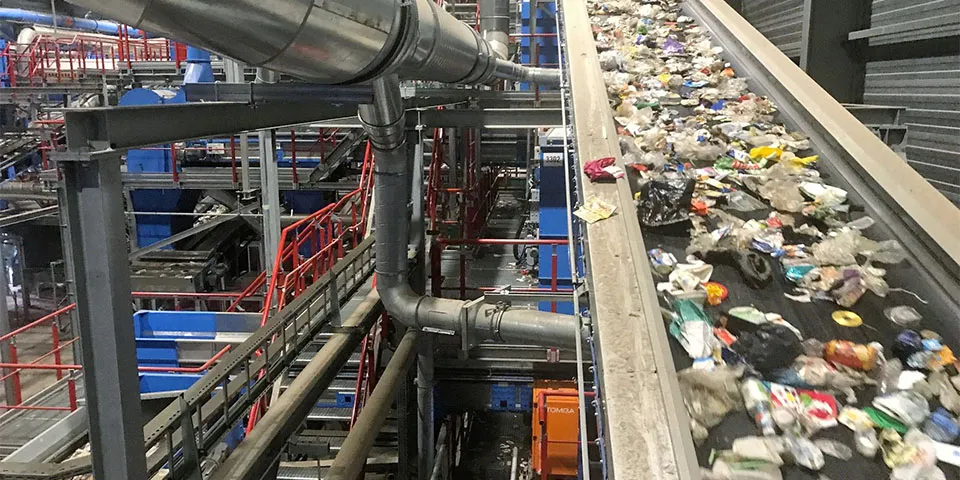
The Plastics Sorting Plant at Ecopark de Wierde.
Omrin uses smart separation technologies and high-tech energy plants to achieve this. In 2011, for example, it opened its own Reststoffen Energie Centrale (REC) in Harlingen, which generates green electricity for 50,000 households. In Heerenveen, Omrin opened a gas upgrading plant at its own Ecopark De Wierde, where its self-produced biogas is converted into green gas. Omrin produces around 14 million cubic metres of green gas in total. One million cubic metres is used to power its own fleet, while the rest is fed into the Liander network. This output is enough to supply around 10,000 households with gas each year.
The same ecopark has been home to its own Sorting and Processing Plant (SBI) since 2002. In 2009, it was adapted to enable the post-separation of various types of plastic (Plastics Sorting Plant) and, in 2015, it was modified again to allow post-separation of beverage cartons as well.
Omrin also operates a chain of 7 charity shops under the name Estafette, where 2.4 million kilos of ‘waste’ are given a second life every year. The shops attract half a million customers each year.
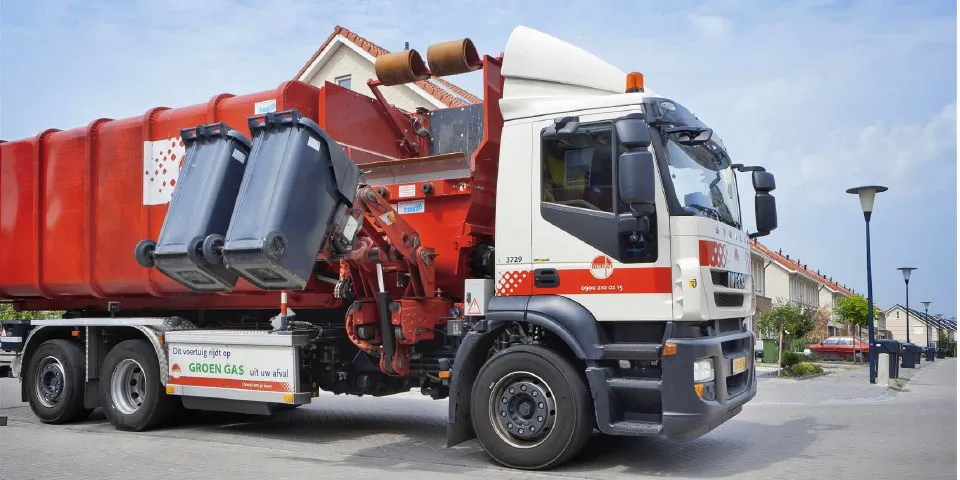
Source separation is the foundation of these strong figures.
Waste containers
Omrin’s ultimate goal is to close the loop completely. In Friesland, it is well on its way. The company recognises that it cannot do this without the public’s support. Omrin therefore raises awareness among the Frisians every day about the need to separate waste.
Omrin combines source separation with effective post-separation. The SBI and KSI in Heerenveen recover as many reusable waste particles as possible from the mixed waste, almost fully automatically. According to Omrin, in 2019 this amounted to no less than 15 kilos of reusable plastic per resident, twice the national average. Omrin supplies reusable resources to the processing industry, which uses recycled plastic, for example, to make new waste containers. Organic waste goes to its own anaerobic digestion plant to produce green gas. The remaining waste is burned at the REC in Harlingen to generate green electricity.
The jury of the King Willem I Prize nominated Omrin for the business award, which is presented every two years, in recognition of its exceptional results. The awards ceremony was due to take place on 18 May, but has been postponed until the autumn because of the coronavirus crisis.
King Willem I Prize
Since 1958, the King Willem I Foundation has presented the King Willem I Prize every two years in various categories. The foundation is named after King Willem I (1772-1843), the ‘Merchant King’, who was known for his commercial acumen. During his reign (1814-1840), he took initiatives to restore economic prosperity, founded trading companies and acted as an investor.
The King Willem I Foundation is governed by a board whose members are involved in and have an understanding of the business community. Her Majesty Queen Máxima is the foundation’s honorary chair.
Question about this story? Ask your question
Keep following this
Get an email when a new story is published. No account needed.
- SubjectNews







