












First: Competitors join forces to collect commercial waste in cities
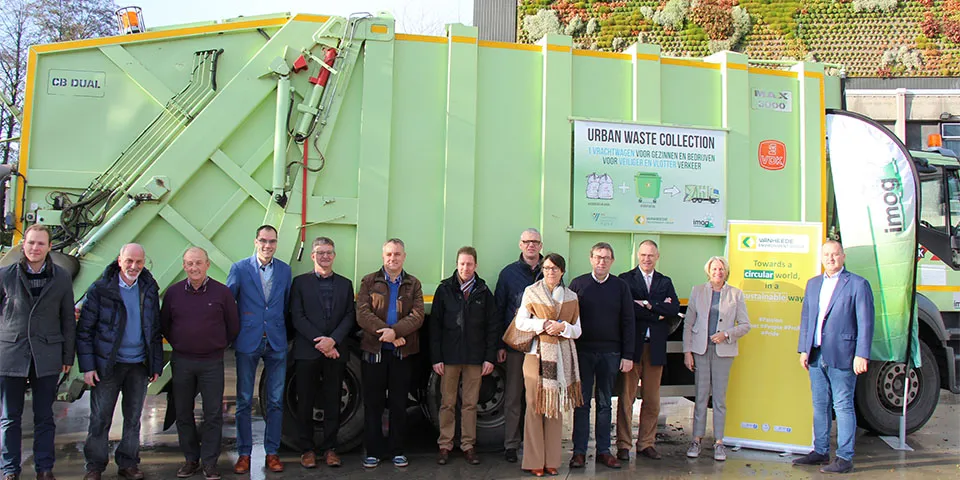
In the Urban Waste Collection project, VIL examined how commercial waste collection in cities could be made more efficient. The project identified the main bottlenecks and developed two pilot schemes in which competitors worked together to collect commercial waste in different regions of Flanders.
Businesses operating in cities generate different waste streams, often in substantial volumes. Collecting this commercial waste is becoming an increasingly challenging task for waste operators: local authorities are imposing more and more restrictions to keep heavy vehicles out of their city centres.
Lack of clear rules and consistency
From a logistics perspective, waste collection is becoming increasingly difficult. Waste companies face a proliferation of rules imposed by local authorities, each with its own local requirements: time windows, low-emission zones, bans on heavy goods vehicles in city centres, traffic circulation plans, and so on. The lack of consistency and rapidly changing rules are proving to be the operators’ biggest pain points.
A milestone in Flanders
During the project, these pain points were investigated further with 13 companies involved in waste collection in cities. Nine potential solutions were put forward, ranging from ‘hubs on the outskirts of cities’ and ‘multimodality’ to an ‘Uber concept for waste’. Workshops and analysis identified the ‘neutral’ or ‘white van’ concept as the most viable option. This concept was then developed further through a pilot in which competitors worked together to collect urban waste: a milestone in Flanders.
Two pilots
Project participants SUEZ and Renewi developed the ‘Collecting together for you’ pilot project. The aim was to collect PMD wheelie bins from businesses in East Flanders jointly, using their own vehicles displaying a shared logo.
Imog, Vanheede and A3 Verhuur also tested the white van concept. In this pilot, a single vehicle was used to collect residual waste from both households and businesses in Waregem.
“At Imog, we have been committed since our foundation to addressing societal issues such as reducing emissions, collecting waste streams more efficiently and in a more environmentally friendly way, mobility problems and road safety. We therefore found the pilot with Vanheede and A3 Verhuur in Waregem very positive. This is certainly not the end point for us. We are already planning how to build on this in the future,” said Johan Bonnier, Managing Director of Imog.
A unique form of collaboration
Direct competitors joining forces to serve each other’s customers in a particular geographical area, based on the locations of their depots, can be considered a milestone. It makes collection rounds shorter and more efficient. Project leader Ludo Sys agrees: “The forms of collaboration attracting the most interest, and offering considerable potential, are those that would have been completely unthinkable until recently. Both pilots show that attitudes are changing in this area too.”
Project participants: Bebat, Imog, Inovim, Ivago, Ivbo, MCA Recycling, Mirom, Recupel, Renewi, Stad Genk, Stad Mechelen, SUEZ and Vanheede Environmental Services.
This project is supported by VLAIO, the Flemish Government’s Agency for Innovation and Entrepreneurship.
Question about this story? Ask your question
Companies in this story
Keep following this
Get an email when a new story is published. No account needed.
- ThemeImproving waste collection and transport
- SubjectNews
- CompanyBebat vzw
- CompanyRecupel







