












Family business Riwald continually innovates and invests
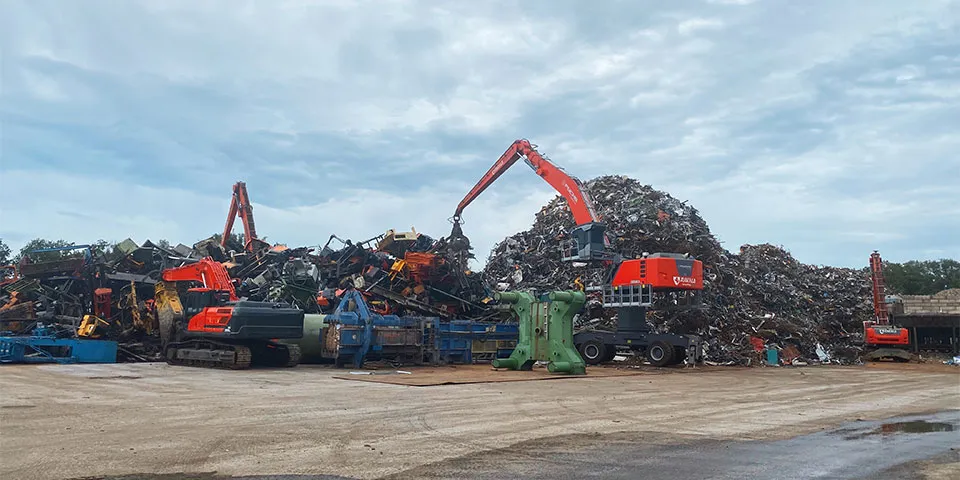
At its site in Almelo, Riwald Recycling manages to recycle almost 100 per cent of the waste streams it receives. The family business, founded by brothers Huzink, started out with a small scrap trailer but has grown into what may well be the most innovative metal recycler in the Netherlands. That is no reason to stop innovating or thinking about how things can be done better and, above all, more sustainably. “During the crisis, demand fell, but product quality had to improve. We anticipated that. And now it is the standard.”
Gesticulating animatedly and striding purposefully, Ewald Huzink walks across the vast site of Riwald Recycling in Almelo. “Look around you. Everything here is well organised, clean and tidy. This is our standard,” says the managing director. And it has to be said, he is right. Naturally, metal is piled high across the site, but the areas between the various heaps are almost clinical in appearance. The machines and handling cranes are all painted in the company’s red, and it is striking how much the company is trying to switch to electric power. The handling cranes sort the metal into neatly swept bays. Along the edges of the site are covered sheds housing various machines, many of them designed in-house, which separate plastic from copper pipes and extract stainless steel and aluminium from the various waste streams. Almost everything is done by machine, and there are hardly any people to be seen, apart from those operating forklifts, wheel loaders and handling cranes.
Granulator
Huzink strides across the site. “Look, we are constantly investing in the future here. This is a unique high-tech granulator. It separates ferrous from non-ferrous material. Combined with the waste separation plants connected to it, we can separate and sort virtually everything that comes in here by material type. This granulator is unique: it is number fifteen in the world, and there are four in Europe.” Riwald has made it a real challenge to produce the purest possible end product, because that brings in more money. “I’d say that almost nothing leaves this site that cannot be reused. And we’ll have those last few per cent sorted within a few years too,” says Huzink. Every so often, he runs his hands fondly through the bins of granulate in different grain sizes and points out how pure the screened material is, before continuing at a rapid pace. “We are also investing in a green future by using electric cranes wherever possible. They are environmentally friendly, quieter and ultimately save costs too.” The two Huzink brothers go to great lengths: they drive 100% electric cars, and the buyers drive electric vehicles too. Sustainability comes first.
Fire detection system
We walk through another shed, with conveyor belts, screening plants and a number of further in-house-designed sorting systems that produce an exceptionally pure aluminium granulate, before heading back outside. Huzink points to grey storage tanks further across the site. “They are full of fire-fighting water. See that piece of equipment on top? It’s a fully automatic fire-fighting robot. A thermal camera continuously scans the part of the site where waste materials are stored. These mainly come from municipal recycling centres and include electrical appliances. The camera monitors possible temperature variations 24 hours a day, 365 days a year, to prevent fires from starting. If necessary, the fully automatic fire-fighting cannon is activated. Fires are common in these waste streams, which may still contain batteries. “It is becoming increasingly difficult to insure yourself against that. That’s why we invested in this fully automatic fire detection and fire-fighting system. We are the first metal recycler in the Netherlands to do so, and we are leading the way.” Riwald holds monthly fire drills and also has its own fire engine to minimise all risks as far as possible. Huzink says: “Continuity is very important to us, and prevention is better than cure.”
We walk past the storage tanks, and Huzink continues. “In 2011, we built the large granulator and its connected separation lines, right in the middle of the crisis. Many people said, ‘That sustainable recycling they want to do will never work…’. But now, almost 10 years later, we are leading the way. The market only became aware of more sustainable recycling in 2015/2016. By then, we had already been working on it for around five years. “What really makes us unique is how we have turned metal recycling into an almost fully mechanised process,” Huzink continues. “I always say: ‘This is a factory.’ And look around you: you’ll see a well-organised company where sustainability comes first. “Many companies and public authorities holding waste streams often have no idea what we can do with them,” says Huzink. “That is another challenge for us: to show them all the possibilities sustainable recycling has to offer.”
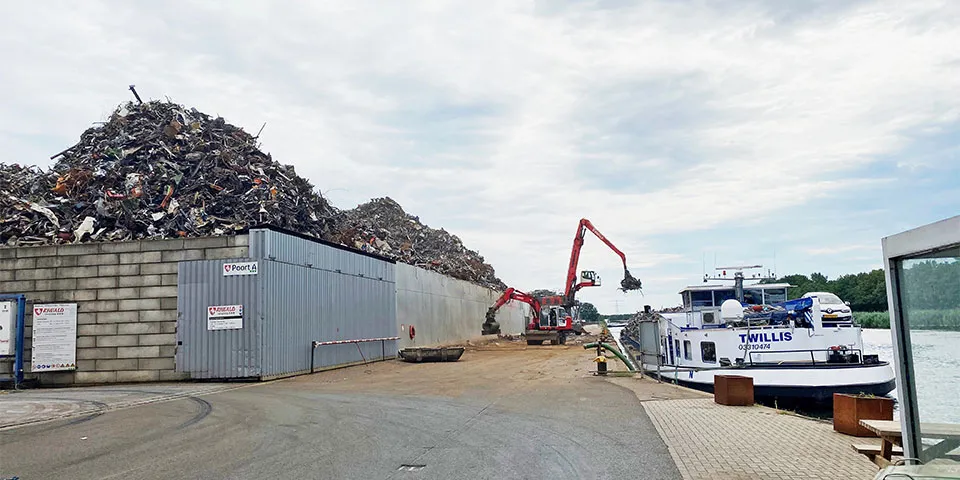
Two sites
As well as Riwald Recylcing in Almelo, the company has a second site in Beverwijk, located at the seaport. This gives Riwald nationwide coverage for waste suppliers. It has also closed the loop by processing waste streams from the companies supplying them through to processors and smelters around the world, which use the pure recycled material streams to produce new steel grades and non-ferrous alloys.
A Riwald Dakar Team has competed in the world’s toughest rally since 2012. In 2019, Riwald introduced an entirely new and unique concept together with its Czech partner MKR Technology: a hybrid off-road truck. The project is supported by the partners, ZF Friedrichshafen, Renault Trucks, Hendrickson, AxleTech, Eurol. With the hybrid truck, Riwald hopes to make rallying more sustainable too.
Question about this story? Ask your question
Keep following this
Get an email when a new story is published. No account needed.
- ThemeRecovering metals and creating value
- SubjectNews







