












EPR study wins Student Recycling Award 2022
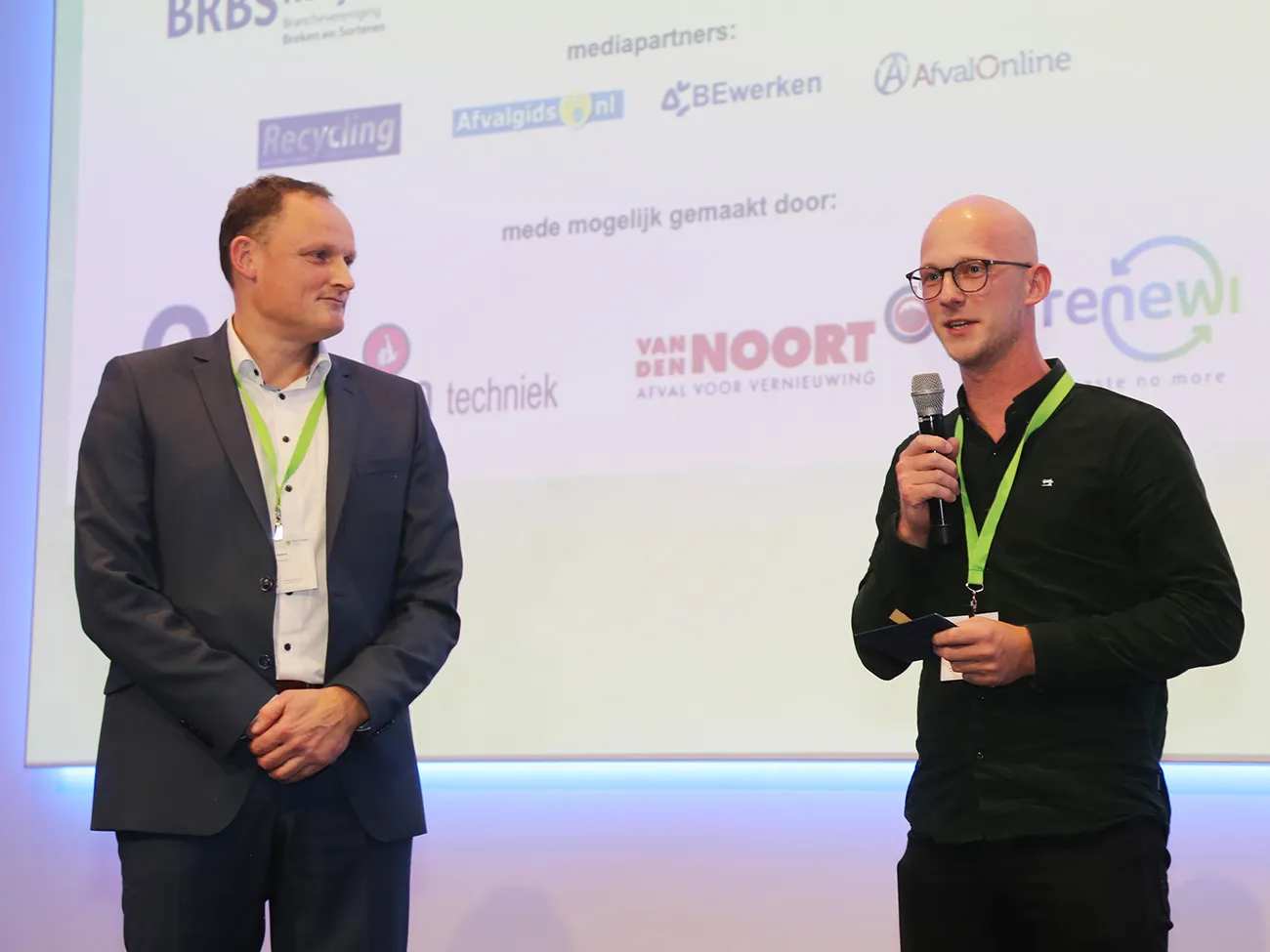
BRBS Recycling is driving research into more and better recycling. Its members are investing heavily in ways to keep discarded materials in circulation. At the same time, BRBS Recycling is also investing in the next generation, having established the annual Student Recycling Award for this purpose. This year’s award went to Thomas Hobé of Utrecht University. His study of how quality assurance systems for Extended Producer Responsibility (EPR) work raises important questions.
The Student Recycling Award is an incentive prize for university and university of applied sciences students, presented at the annual Recyclingsymposium. Last year, the Student Recycling Award jury noted that a great deal of good research into circularity is being carried out in the Netherlands. More and more entries focus not only on recycling, but also give prominence to other R-strategies in the hierarchy. This is a positive development and certainly something to evaluate for future editions. Although they differed in subject, approach and execution, the 2022 entries were quite closely matched, according to the jury. Thomas Hobé ultimately took home the award.

Striking the right note
Hobé studied Sustainable Business and Innovation at Utrecht University and, as he tells it, came across a number of circular economy courses by chance, which led to some interesting internships. “I found the subject so interesting because I could see opportunities to solve problems,” says Thomas. “So I started looking for a thesis topic in the circular economy. My supervisor, Walter Vermeulen, pointed me towards Extended Producer Responsibility (EPR). The subject was completely new to me and quite complicated, but I was willing to take on the challenge. We had many discussions, and Vermeulen knew how to strike the right note. I could share my thoughts, and he told me what he considered important. We got on very well, and my thesis gradually took shape. The aim was to examine how quality assurance systems function in the Dutch EPR-driven recycling industry.”
Interesting insights
“After immersing myself fully in the subject, I realised I needed to get out into the field,” Thomas continues. “What are people’s experiences with the systems currently in place? That sometimes took some effort, because not everyone was initially willing to be open. But once I was ‘in’, I gained some great insights. It was fascinating to hear what really goes on behind the scenes.” While writing his thesis, Thomas also had the opportunity to work for professor emeritus Jan Jonker. “I still work for him today. Together with Vermeulen, he introduced me to the world of the circular economy and how we can make the transition. As a result, I was drawn into the subject from several angles, both the circular economy and EPR. I even started to see it as a hobby, and really enjoyed working on my thesis.”
Assessment framework
Based on numerous interviews and research, Thomas concludes that although independent audits of EPR are carried out, the Netherlands could be more ambitious and circular in setting requirements for quality assurance. “European EPR legislation requires producers and importers to pay an independent organisation to organise take-back and collection, as well as processing,” Thomas explains. “At present, it is a financial instrument that mainly affects the downstream end of the chain, when it should cover the entire chain. That is something for the future. The EPR system means that a number of independent parties are responsible for the entire chain. It also means they have power and can set requirements for collectors and processors. I described and analysed those requirements for the five statutory EPR streams. I developed an assessment framework, based on literature on corporate sustainability, management systems and the circular economy, that organisations can use. Following it enables collectors and processors to incorporate the triple P (People, Planet, Prosperity) into their business operations, while also moving towards higher-value retention options (the R-ladder), and therefore a more circular economy. All of this is based on continual improvement.”
Eco-design
EPR may seem like a well-designed and widely supported recycling system, but it could be far more effective, Thomas argues. “Ultimately, we are aiming for a circular economy, and EPR can help us achieve that. Among other things, I propose encouraging eco-design by requiring a financial system for it to be established within EPR by the government. For example, a supermarket that puts reusable packaging on the market would pay less than one that sells non-reusable packaging. A recycling company that pursues higher-value retention options in its processes would receive an additional reward. Another recommendation, albeit a more radical one, is to shift VAT from labour to raw materials, so that recycled products do not become more expensive. All in all, I really enjoyed working on my thesis. It is a huge honour that some organisations have already started putting my insights into practice. It is incredibly motivating.” The Student Recycling Award jury also saw Thomas’s thesis as an opportunity to raise the entire market segment to a higher level, and would hate to see the study disappear into political filing cabinets under a pile of dust. Thomas received the Student Recycling Award 2022 at the 10th Recyclingsymposium in Gorinchem. Along with a cash prize, he was also introduced to one of the EPR implementing organisations, helping his ideas to be put into practice. His thesis has also led to him working every day to drive the transition to a circular economy. “My thesis has led to a great role at Federatie NRK. I am also talking to various organisations about implementing EPR in a way that supports a corporate sustainability approach and ultimately helps us move towards a circular economy. It is the crowning achievement of my work.”
Question about this story? Ask your question
Keep following this
Get an email when a new story is published. No account needed.
- ThemeCircular construction and demolition
- SubjectNews







