












Dutch producer of smart waste bins and compaction modules conquers the world. A solution for litter and waste placed next to containers
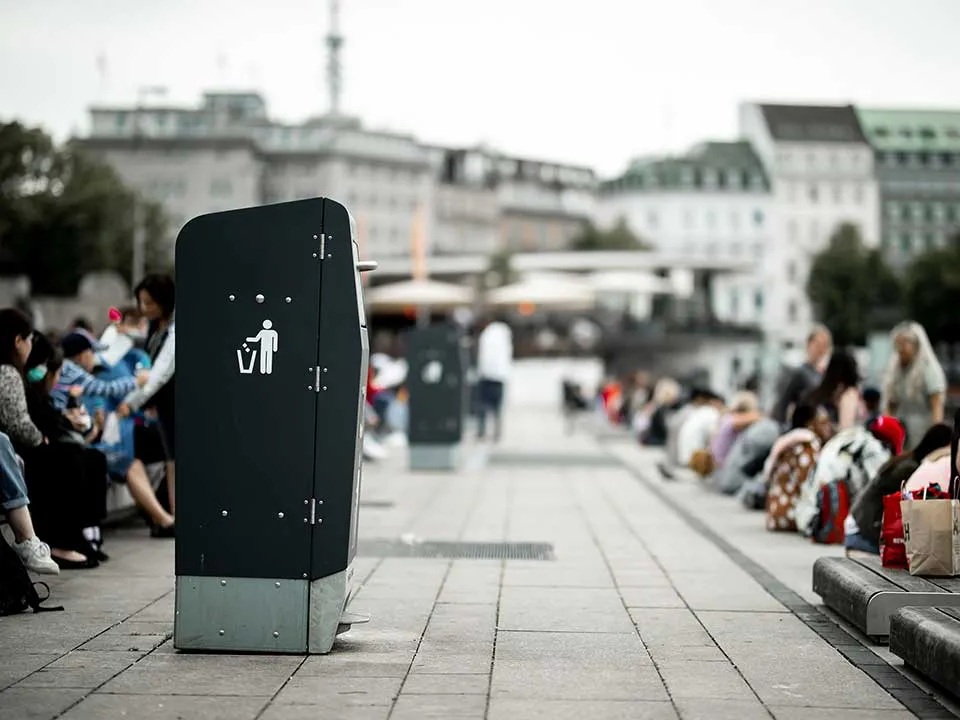
Because people are at home much more as a result of the coronavirus measures, the amount of household waste has risen sharply.
In the big cities in particular, this has led to an enormous increase in the amount of waste left beside containers: underground waste containers fill up sooner, so people simply put their rubbish next to the bins. That in turn means extra deployment of waste collectors and extra trips by refuse trucks, and therefore higher costs for municipalities. There is a solution.
"We make underground compaction modules that fit all existing underground waste containers," says Theo Kik, managing director at Mr. Fill, the Dutch producer of self-compacting waste bins, smart waste bins, smart sensors and even a Smart City Manager platform. "As a result, up to five times more waste fits into the 180 thousand containers the Netherlands has, which not only helps to reduce litter, but also allows waste collectors to do their work many times more efficiently."
Thanks to its modular design, Mr. Fill's underground compaction module, called Heavy Harry, can be built into any new or existing underground waste container. "This allows municipalities to increase their current waste capacity without enormous investments," Kik explains. "The underground compaction module runs on 230V and can be charged wirelessly. And nothing changes in the appearance of the public space."
Mr. Fill has made agreements with various container manufacturers so that they prepare their containers for the installation of a compaction module, but the module can also be fitted into existing underground containers. "The advantage of that is that you don't have to dig a hole or build a new concrete pit," Kik explains. "And once our compaction module is installed, your container is immediately smart too: it knows how much waste it contains, what the waste weighs and when it needs to be emptied, and it communicates with your smartphone via the Smart City Manager app. And you have more compaction power. All of this lowers waste collection costs and reduces your CO2 emissions. After all, you need to make four times fewer trips."
Safety
According to Kik, the compaction modules meet the highest safety requirements. "When it compacts, the lid of the container closes automatically. And there is a safety device that detects movement on the compaction plate. So if a living creature should unexpectedly end up in the container, the press will never start, and an employee of the waste collector receives an alert on their smartphone that something is moving in that particular container. You can then act extremely quickly. It is a patented system, which we are the only ones in the world to offer."
Mr. Fill developed the Smart City Manager platform to collect all kinds of data via the sensors in the containers, making collection more efficient, cheaper and more sustainable. "But other sensors that municipalities use can also be read out via Smart City Manager," Kik explains. "And our own sensors fit on any waste bin, not just ours. This allows municipalities to make existing waste bins smart within the same platform. Our sensors also measure temperature. With that information you can work predictively. If the data show, for example, that 5 per cent more rubbish is thrown away at a temperature of 20 degrees, you can take that into account in future. You might then have to deploy more staff if you know it will be 20 degrees next week."
Mr. Fill in Dubai
In addition to underground compaction modules, smart sensors and the Smart City Manager app, Mr. Fill also builds above-ground self-compacting waste bins in its own factory in Culemborg. And this has not gone unnoticed. After European cities including Amsterdam, London, Vienna, Hamburg, Brussels, Berlin and Bergen, Mr Fill will soon supply almost 1000 smart, self-compacting waste bins to Dubai. They will be deployed on the Expo site of the world exhibition Expo Dubai 2021. Theo Kik: "We are the only Dutch party there that, after a test lasting almost a year, is allowed to place its product in the streetscape. The bin contains a sound module, a kind of Holle Bolle Gijs, to motivate the public in all languages to put their waste in the bin. In the end we did not win that tender on price, but purely on sustainability and quality. It has to be that way, because those bins are used intensively 365 days a year."
Question about this story? Ask your question
Keep following this
Get an email when a new story is published. No account needed.
- SubjectNews







