












Diederik Samsom visits Recycling Kombinatie REKO as part of work on European rules for tar-bound asphalt
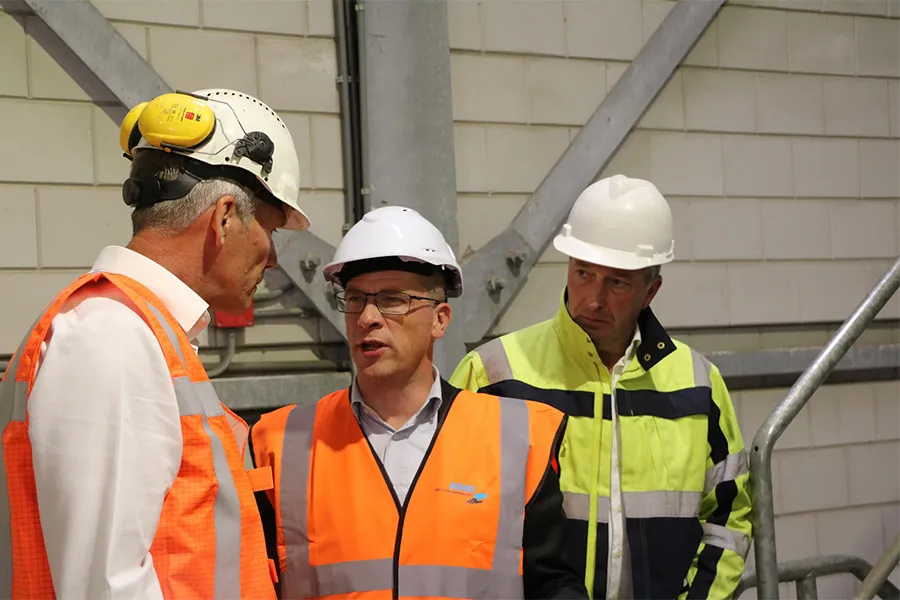
On 23 June 2023, Mr D. Samsom, head of cabinet to European Commissioner Frans Timmermans, paid a working visit to the Dutch sector of thermal treatment plants for tar-bound asphalt (TAG). A meeting at Recycling Kombinatie REKO in Rotterdam concluded with a tour of the plant. Mr Samsom was briefed on Dutch policy for TAG, and discussions covered how the European Commission could further support this example of “non-toxic recycling” and how other EU Member States could benefit from it. Mr Samsom expressed understanding of the sector’s efforts to better align the CLP Regulation and the EWSR.
Supporting the clean circular economy
The Dutch sector of thermal treatment plants is a European leader in the circular “non-toxic” processing of TAG. Thermal treatment of TAG completely burns off polycyclic aromatic hydrocarbons (PAHs) and all other (potentially toxic) organic components in the asphalt, leaving mineral resources such as gravel, sand and filler, which are used as clean construction materials in, among other sectors, the asphalt and concrete industries. This enables more than 2.5 million tonnes of construction materials to be reused in an environmentally responsible way each year, reducing the need for primary materials. The thermal treatment plants use the heat released by burning the tar in their own operations and to generate electricity and/or heat for third parties.
Amending European legislation
The unclear wording of the EWSR threshold for the concentration of benzo[a]pyrene (BaP) above which asphalt is considered “tar-bound” creates a situation where asphalt containing more than 1,000 mg/kg dry matter of tar is classified as hazardous waste under the CLP Regulation and the Waste Framework Directive, but can be freely traded in Europe as a green-list waste. This means hazardous waste re-enters circulation, with all the associated adverse effects on occupational health and the environment. This discrepancy in EU legislation was explained to Mr Samsom. He underlined the European Commission’s commitment to ensuring clear legislation.
The thermal recycling sector wants the EWSR and the CLP Regulation to be fully aligned, and for the limit of 50 mg/kg dry matter of BaP specified in the EWSR to apply to the tar component in asphalt, rather than to asphalt as a whole.
Semipermeable borders
The discussion addressed the importance of so-called semipermeable, or partly permeable, European borders for a specific waste stream. Borders should be open to countries with smart and innovative recycling processes, in this case the thermal treatment of TAG, and closed to countries where the waste in question is still put to low-grade use, in this case without removing the tar component. These processes may be more expensive, but are necessary to meet the “non-toxic recycling” target adopted in Europe. Companies can invest in these technologies only if they are assured of sufficient volumes and a market for the output. Without semipermeable borders, these hazardous waste streams will be sent across the border for lower-grade applications, where they will continue to pose a risk to the environment. Dutch policy for TAG therefore provides a good example for other waste streams for which smart and innovative recycling into clean materials is possible in the Netherlands or elsewhere. To avoid reliance on a national scheme such as the one the Netherlands has introduced for TAG, it would be preferable to establish a notification requirement at European level under the EWSR for these situations, in support of the non-toxic circular economy.
Question about this story? Ask your question
Keep following this
Get an email when a new story is published. No account needed.
- SubjectNews







