












Asphalt recycling with a CO2-neutral footprint at Famenne Enrobés
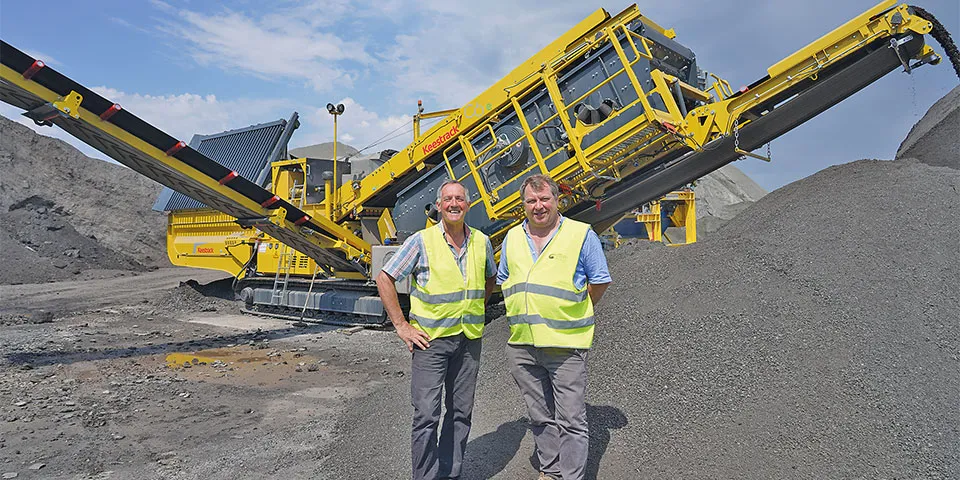
In the beautiful region around Marche-en-Famenne, Famenne Enrobés produces and supplies hydrocarbon-bound road surfacing materials for the road sector. At a single site, the company employs 15 people and operates offices, an asphalt plant, an asphalt recycling facility and its own laboratory. Installed in 2004, the asphalt plant has a production capacity of 320 tonnes/hour.
To process reclaimed asphalt, the company uses a mobile, electrically powered, three-deck Keestrack C6e screening plant in combination with two mobile, electrically powered primary and secondary roll crushers. In 2019, it decided to replace its existing screening plant with the electrically powered Keestrack C6e fine screening plant. An all-electric drive was chosen in the search for a more environmentally friendly and cost-effective solution for recycling hydrocarbon-bound road surfacing materials. The compact design, which allows the plant to be transported as a single unit, was also an important factor, as the fine screening plant is sometimes used at other sites.
Mr Patrick Noiset, director of Famenne Enrobés, explains the fully electric asphalt recycling process (recycling hydrocarbon-bound road surfacing materials). Up to 50% of the asphalt in the binder course can consist of high-quality recycled asphalt produced at the asphalt recycling facility. For roadworks in Belgium, the surface course always consists of 100% new asphalt, as the Walloon Region’s standard specification, Qualiroute, currently does not permit recycled material in wearing courses.
The asphalt recycling facility is 100% electrically powered and connected to the mains electricity supply. The specific configuration of this application makes it possible to produce top-quality asphalt (0-11 mm) in a closed loop. The process comprises primary crushing (pre-sizing), recirculation through a secondary crushing stage and the final separation of the fractions. This is achieved using the Keestrack C6e and 2 static, electrically powered asphalt crushers.
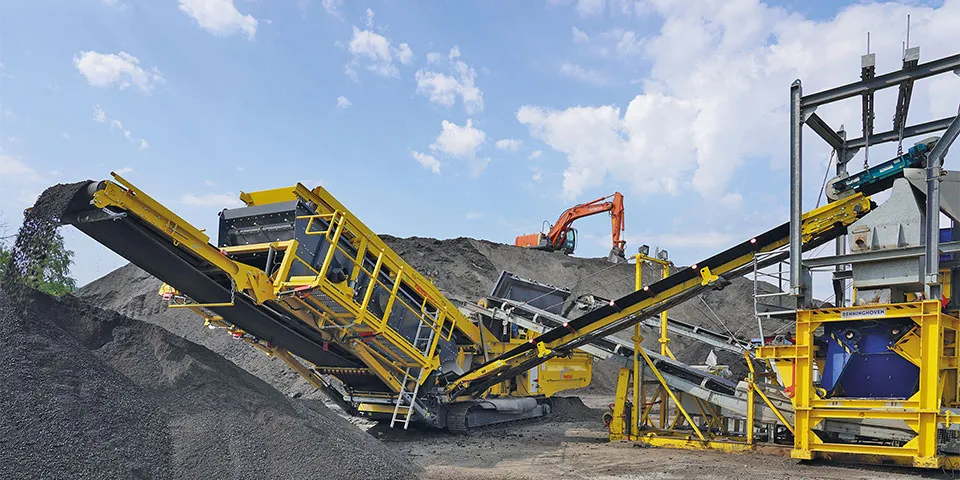
The primary roll crusher is fed by the wheel loader and produces a coarse fraction that is directed to the C6e feeder. The 11/40 mm fraction is then conveyed back to the secondary roll crusher, creating a closed loop that produces a very specific 0-11 mm aggregate. The roll crushers produce a perfectly graded end product because the asphalt is crushed to precise specifications, preserving the properties of the aggregate and separating it from the tar without producing excess fines. The asphalt recycling facility has a production capacity of 100 tonnes/hour.
With its own integrated laboratory, Famenne Enrobés can monitor the production process down to the smallest detail. Particle size and bitumen content are closely monitored through continuous checks during the recycling process. This ensures a consistent, high-quality end product.
“The ability to connect the C6e fine screening plant to the mains electricity supply was essential for Famenne Enrobés. We want to produce with a CO2-neutral footprint,” says Patrick Noiset.
The ability to run the C6e fine screening plant on its own diesel engine and integrated generator set, and to transport it as a single unit, is also a major advantage, as the machine is set up at other sites 3 to 4 times a year. In addition to these benefits, the electrically powered C6e requires less maintenance when connected to the mains, because the diesel engine is not used. Electrically powered components consume less hydraulic oil, reducing maintenance costs and the environmental risks associated with leaks.
Having met all the environmental criteria, Famenne Enrobés chose the Keestrack C6e fine screening plant. François Bricheux, a recently retired Keestrack employee, explains the economic benefits of the electric plug-in screening plant. “A modern diesel-hydraulic fine screening plant consumes an average of 14 l/hour. This C6e consumes just 9 l/hour when running on its own diesel engine and integrated generator (33% less). When the screening plant is connected to the mains, it consumes 27 kWh (energy cost savings of approximately 70%).”
Question about this story? Ask your question
Keep following this
Get an email when a new story is published. No account needed.
- SubjectNews







