












A second life for electric car batteries
Car manufacturers are already doing a great deal to reuse batteries
The number of electric cars on Dutch roads doubled over the past year, and growth is continuing at a rapid pace. Manufacturers expect to sell at least 65 thousand new electric cars in 2020, taking their market share towards 15 per cent. This increase also means a sharp rise in the number of end-of-life traction batteries. But there are good solutions.
Under the Battery Management Decree (Bbb), car manufacturers and importers are required to take back both starter batteries and the traction batteries of hybrid and electric cars at the end of their useful life. By participating in the collective scheme, for which they pay a management fee, they transfer responsibility for fulfilling this obligation to Auto Recycling Nederland (ARN), a partnership between BOVAG, RAI Vereniging, Stiba and FOCWA.
In practice, ARN arranges the collection and processing of end-of-life traction batteries with a negative residual value. These are mainly Li-ion batteries.
ARN says that 90 per cent of the traction batteries processed in 2018 were reused. They begin their second life in applications such as lighting columns for runways, or in recreational boats, enabling them to sail with zero emissions. They are also already being used as buffers for storing energy from solar panels in residential areas.
Energy storage systems
For example, ARN supplies traction batteries to the Peter Ursem car dealership. Staff first check whether the cells still carry a charge, so that the traction batteries can be dismantled safely. The batteries cannot be returned to the automotive industry, as they have been rejected for use there. But there are many opportunities for reuse elsewhere. One notable application is storing solar energy. Reusing traction batteries is also a good solution for supplying electricity in remote areas. Arnhem-based company Time Shift energy storage is also an ARN partner and processes end-of-life batteries. The company develops energy storage systems using the old batteries, which are then supplied to energy companies.
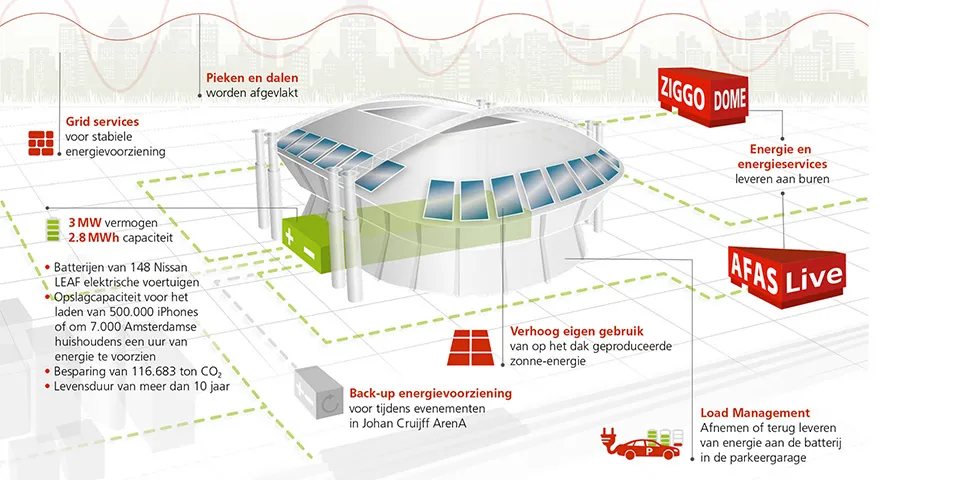
This has led to some impressive examples of reuse. Old Nissan Leaf batteries, for instance, are used in the basement of the Johan Cruijff Arena to store energy generated by 4,200 solar panels on the Arena’s roof. A notable feature of the project is that all the energy from the solar panels is distributed to the batteries using direct current.
Another initiative is a sustainable neighbourhood where 33 family homes, completed in the summer of 2019, generate more energy than they use. Net energy consumption is zero thanks to excellent insulation and smart storage of heat and cold in the floors. Energy from the integrated rooftop solar panels is stored in domestic batteries, which together form a large energy buffer. The surplus is shared among residents. And 9,000 solar panels have been installed on the roof of Nissan’s European distribution centre, together with old batteries that serve as an energy buffer.
Another example is Pampus island, where ARN is running a pilot using second-hand car batteries as a key part of the island’s energy supply. The batteries store solar and wind energy, and the stored green electricity can be used at a later time. This gives the batteries a worthwhile and sustainable second life. Once a battery pack is genuinely ‘empty’, it can be recycled. ARN says it can reuse more than 50 per cent of the materials in a traction battery.
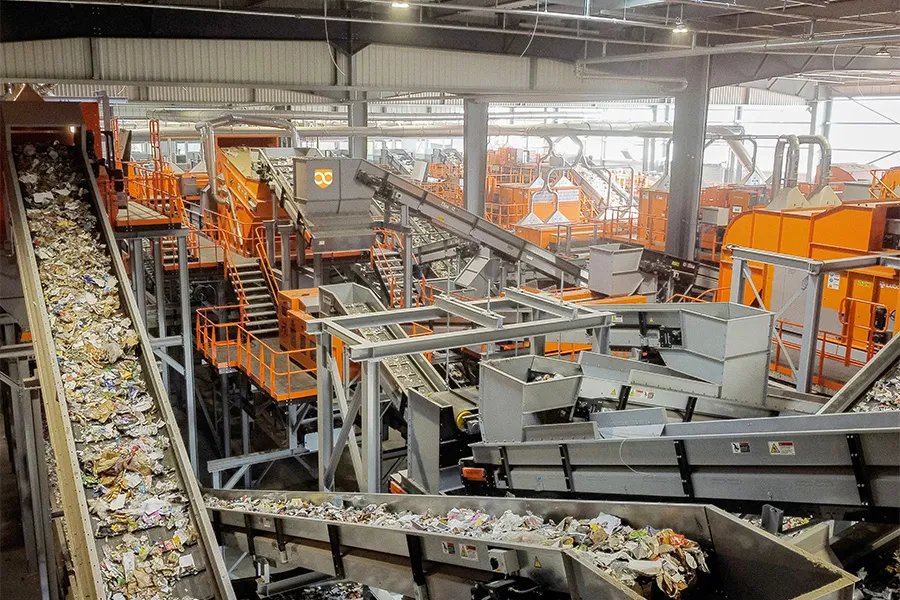
Battery Repair Centre at the Peter Ursem car dealership.
Power banks
Despite ARN’s pioneering role, car manufacturers are also taking steps to give batteries a second life. Hyundai, for example, is working with Finland’s Wärtsilä to reuse batteries, while Volkswagen has unveiled ‘power banks’ for electric cars. These are early examples of flexible charging stations incorporating used car batteries. The advantage of a ‘power bank’ is that it can be installed in places where electric cars cannot normally be charged, such as festivals or events in remote locations. The power banks themselves can be charged from the electricity grid, as well as using solar and wind power.
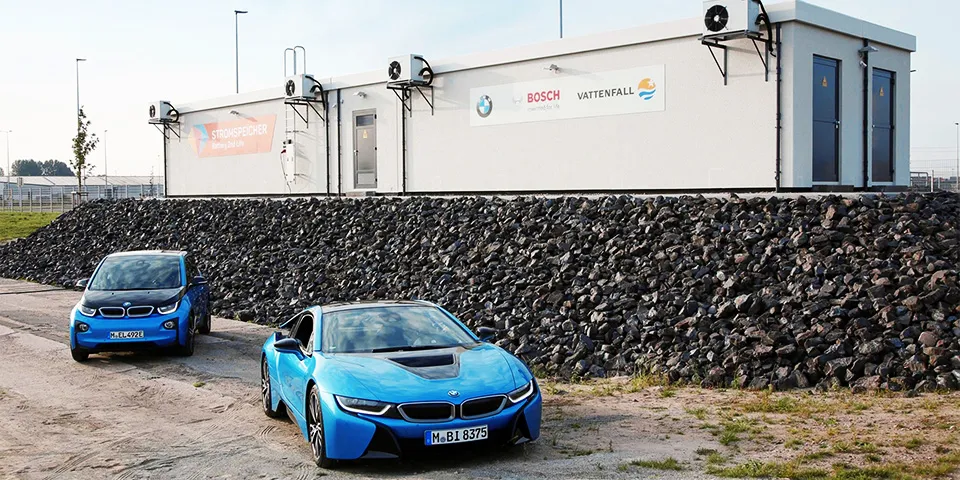
BMW has teamed up with Vattenfall and Bosch to build a facility near Hamburg using 2,600 battery modules from more than 100 electric vehicles. It has a power output of two megawatts (MW) and a storage capacity of 2,800 kilowatt-hours (kWh). Vattenfal uses the stored energy to keep the grid frequency stable at 50 Hz.
Question about this story? Ask your question
Keep following this
Get an email when a new story is published. No account needed.
- ThemeCircular processing of electronics and batteries
- SubjectNews







