












A material handler does not have to be a converted wheeled excavator
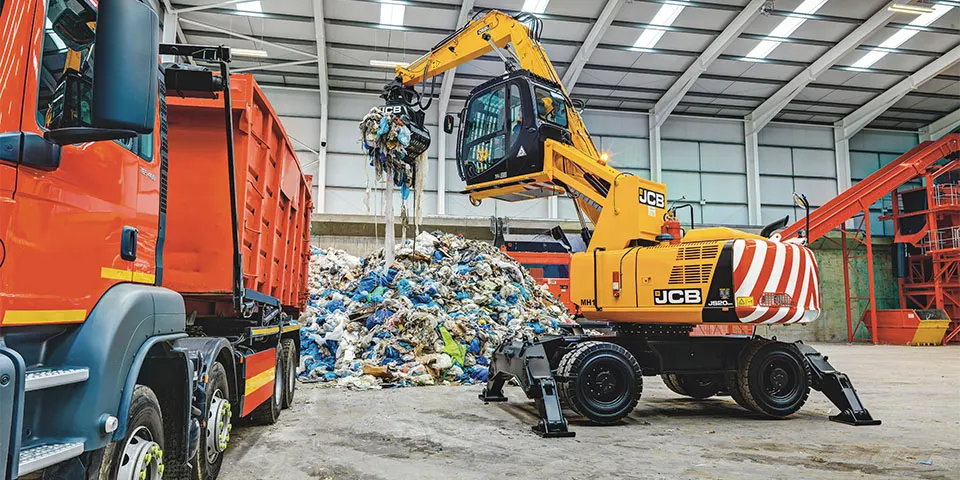
As stable as a crawler excavator
Material handlers are sometimes converted excavators. Not so at JCB, which launched the JS20MH as a purpose-built material handler. The machine has been on the market for about five years and is performing to the full satisfaction of many recycling companies in the Benelux. But that was not immediately obvious. Gregor Grootjans, product specialist at JCB, explains.
“When JCB began developing the JS20MH in the UK, we on the continent did raise an eyebrow or two,” says Grootjans with a laugh. “Why add a dedicated material handler to the range when you already have excellent excavators and wheeled excavators that are easy to convert? But, in all honesty, the JS120MH has become a genuine material handler, with features you cannot achieve with a converted wheeled excavator.” Grootjans is referring, among other things, to the undercarriage. Unlike an excavator, whose chassis is designed for earthmoving, the JS20MH’s slewing ring is in the centre and its stabilisers are attached to the chassis rather than welded onto it. This gives JCB’s material handler a level of stability that, according to Grootjans, is comparable to that of a crawler excavator. “Stability is an important selling point. One of our major customers, which operates several JS20MHs at its sites, initially preferred crawler excavators. But after a few trial runs, they were won over.”
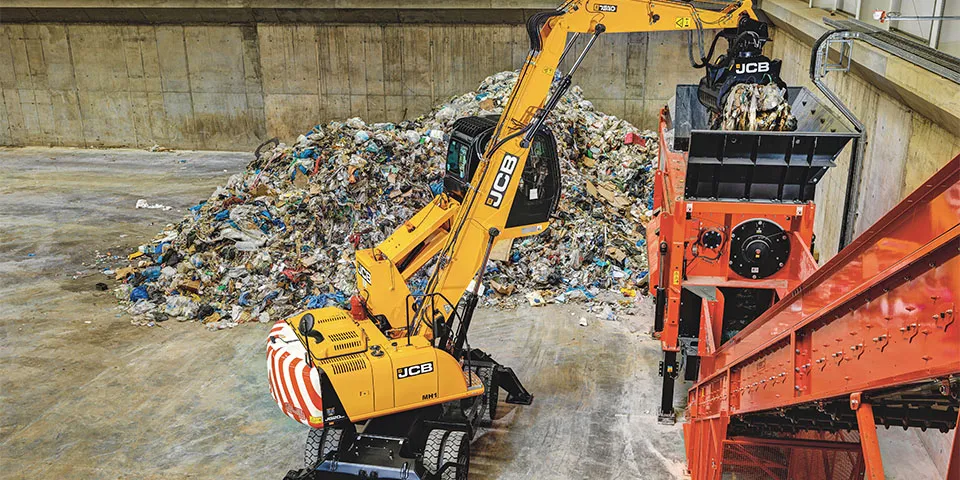
JCB’s material handler has an adjustable-height cab.
Fuel-efficient
Another advantage is the smaller engine. Grootjans: “A 20-tonne excavator normally has at least a 175 hp engine. The JS20MH has a 125 hp engine. It does not need more, because you never drive it on the road. And it makes quite a difference to fuel consumption. You can certainly say that this machine has exceptionally low fuel consumption for its capacity. JCB’s material handler also has an adjustable-height cab, and customers can choose between a straight boom with a dipper stick or a swan neck, and between a standard grab or a demolition and sorting grab. JCB designed the JS20MH with a simpler specification. “Fewer buttons and options,” explains Grootjans. “You don’t need them for material handling. So let’s keep it simple.” And if anything does go wrong, JCB’s service department is on hand in no time, the product specialist assures us. “A major advantage is that at JCB we use as many components as possible from other models and have our own engine. Parts are therefore always readily available, which prevents extended downtime.”
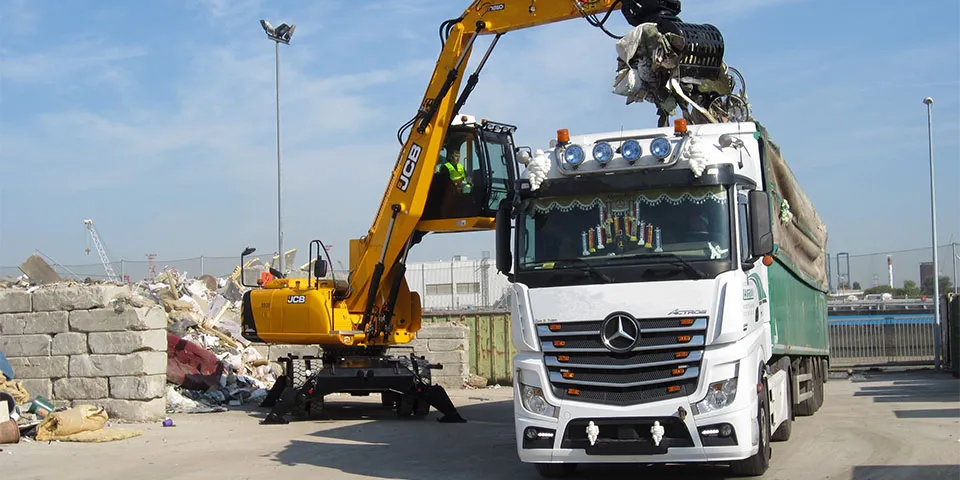
Customers can choose between a standard grab and a demolition and sorting grab.
Never satisfied
Despite JCB’s quintessentially British character, the company always pays close attention to the Benelux, according to Grootjans. “Operators in the Benelux use machines differently, because some applications are simply different from those in other countries. We are quicker to push the technology to its limits. When I get to test machines, for example, I start by grading a surface. Anyone can dig a hole. But you only really get a feel for how a machine handles when grading. It was the same with the JS20MH. It came off the trailer and within half an hour I had written down a good number of improvements. And the team in the UK got straight to work on them. That attitude fits JCB’s mission: ‘Jamais Content’ … Always striving to do better.”
Question about this story? Ask your question
Companies in this story
Keep following this
Get an email when a new story is published. No account needed.
- ThemeSmarter use of machinery and plant
- SubjectNews
- CompanyJCB







