Perfection in recycling
Text and images Keestrack
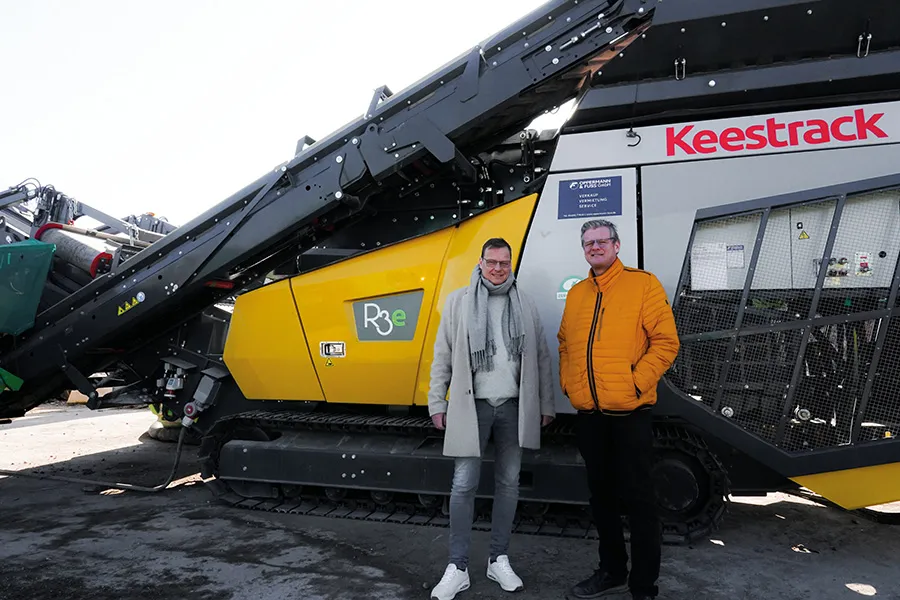
From demolition waste to sustainable building materials through fully emission-free electric crushing and screening
The German company Büscher comprises several businesses, including a concrete plant, recycling centre and skip hire service. In 1961, Büscher made concrete like everyone else, using gravel, sand, cement and water. Today, it has changed the recipe, completely replacing sand and gravel with 100% recycled construction and demolition waste to manufacture prefabricated load-bearing and non-load-bearing internal wall elements.
Büscher received a great deal of demolition waste, which it would normally recycle into aggregates for road construction, like many other recycling companies. As this material was difficult to sell and available in large quantities, brothers Wolfgang and Hans-Jürgen Büscher looked for a solution. They came up with the idea of using the material as a raw material for prefabricated concrete elements. It was an excellent, sustainable idea, but persuading specialists and authorities that it could be the way forward proved difficult.
Technical approval
The company not only proved that it was possible, but also obtained technical approval from the Deutsches Institut für Bautechnik (DIBt). The German Federal Association for Building Materials authorised the use of up to 100% recycled aggregates, including type 3 crushed sand, in prefabricated load-bearing and non-load-bearing internal wall elements in exposure classes XC1 and X0 (dry). It took eight years of scientific research to demonstrate that a house can be built sustainably using entirely recycled materials, and at lower cost. It took just 4 months to build a complete three-family home made from 75% recycled concrete and demolition waste. Pipes and electrical wiring are all integrated into the paint-ready prefabricated elements, so no plastering is required.
The perfect example of a circular economy
Now, in a first, the first house has been built using 100% recycled natural mineral substitutes in its load-bearing and non-load-bearing internal wall elements. And when it is time to demolish it, it will be recycled into new concrete using the Büscher method. A perfect example of a circular economy! Prof. Dr.-Ing. Wolfgang Breit of the Technical University of Kaiserslautern concludes: “The quality is good because Büscher has taken the right measures to ensure the acceptance of construction and demolition waste, process the material and use it in prefabricated concrete elements.” The main advantage of this certified production process is the efficient use of resources. The company uses low-cost demolition material that is available locally in large quantities to produce a sustainable, climate-neutral product with lower CO2 emissions. It also saves on transport costs by reusing material that is already available. “We want to make our process widely known and would be pleased if other concrete plants, recycling companies and anyone else interested in sustainable construction using secondary building materials got in touch. No expensive raw materials are used, which also makes the end products cheaper. It’s a genuine win-win situation,” says Thomas Overbeeke, Operations Manager at Büscher.
Crushers and screens with Zero-drive technology
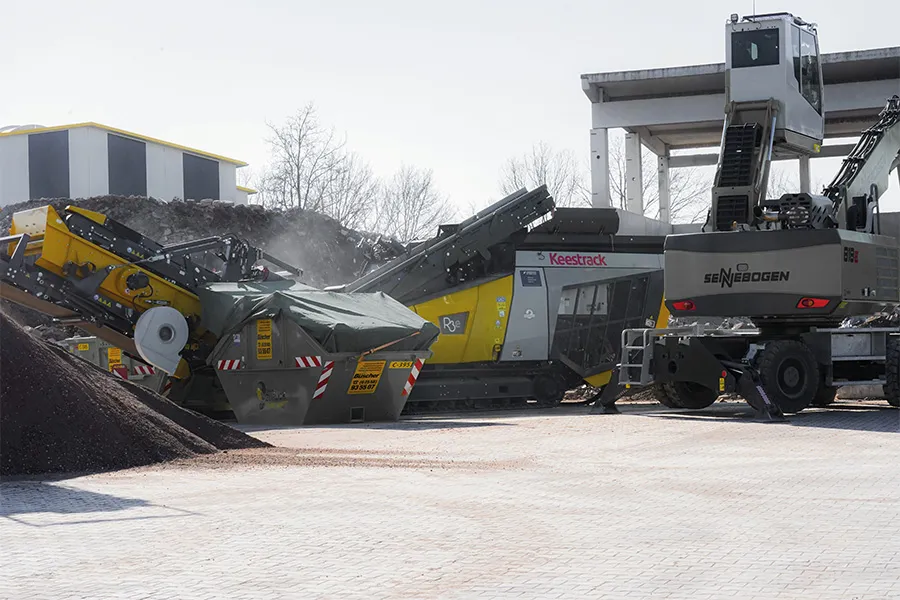
This minimises the environmental footprint and helps us work towards a circular economy. That is also why Keestrack crushers and screens with Zero-drive technology are used. The Büscher site is equipped with solar panels that generate up to 323 kW/h of electricity. This green energy powers the concrete plant as well as the Keestrack R3e ZERO impact crusher and K4e ZERO screen. Both Keestrack machines are fully electric, have no combustion engine and operate with net-zero emissions. Energy consumption is approximately 152 kWh. Operating and maintenance costs fall dramatically because there is no combustion engine on board.
R3e ZERO
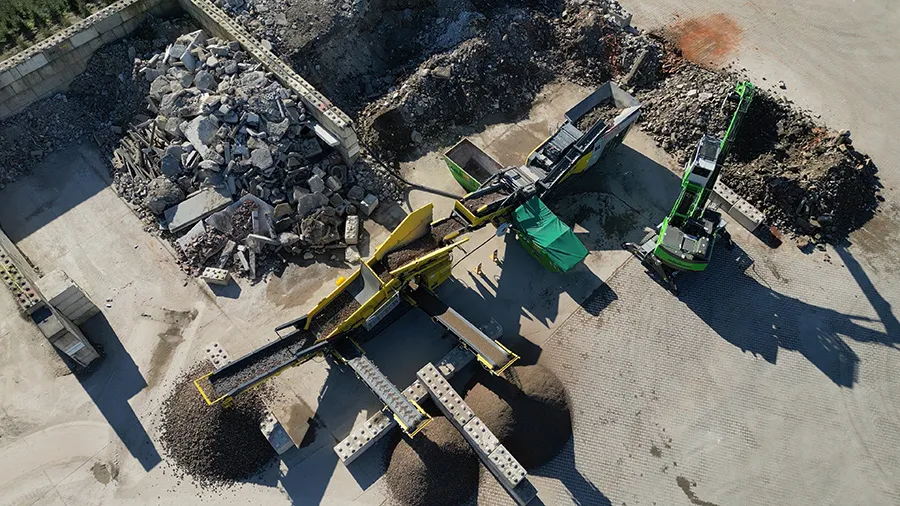
The R3e ZERO impact crusher, with pre-screen, closed circuit with recirculation conveyor and post-screen, produces aggregates to a defined size. The installed wind sifter removes contaminants such as plastic, wood and paper, while the overband magnet separates metals. The R3e supplies power to the connected K4e ZERO via its 125 A plug-out connection.
K4e ZERO
The K4e ZERO screen has a maximum capacity of 350 tonnes/hour. Its screen, equipped with a standard heavy-duty apron feeder and hydraulically adjustable screen angle, delivers particularly high screening performance. At Büscher’s recycling site, the conveyor belts for the fine and middle fractions were positioned on the same side of the screen to improve access for the wheel loader.
Remote control
Both Keestrack machines at Büscher are equipped with remote controls, allowing the crusher and screen to be operated from the excavator. They also feature an integrated water spray system and Keestrack telematics.
Question about this story? Ask your question
Keep following this
Get an email when a new story is published. No account needed.
- ThemeCircular construction and demolition
- SubjectScreens & crushers