Efficiency comes as standard with aeromechanical conveying
Text and images Robbe Industries
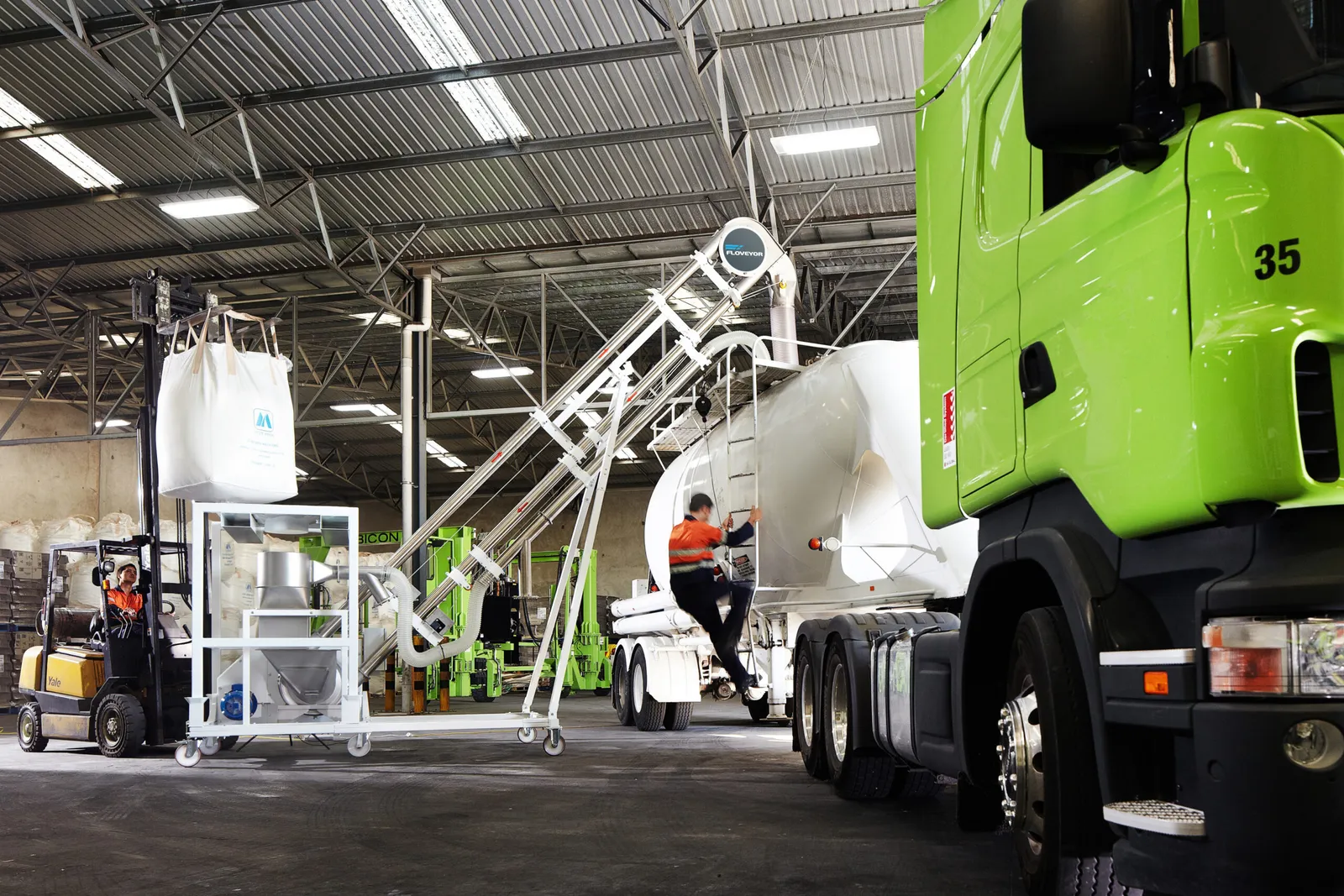
Loading, unloading, packaging and repackaging are near-continuous operations in the construction and recycling industries. Some material streams are easier to handle than others, but to streamline processes involving more challenging or abrasive products, Robbe Industries has increasingly turned to Floveyor in recent years. The Australian brand’s equipment uses the principle of aeromechanical conveying, enabling almost any dry product to be transported efficiently, safely and reliably.
The partnership between Robbe Industries and Floveyor dates back to 2018 and initially focused mainly on the chemical and food industries. These sectors process a wide range of powders, flakes and granules, often subject to stringent safety and hygiene requirements. “When conventional elevating and conveying solutions such as screws or pneumatic systems cannot meet those requirements, Floveyor equipment offers a very interesting alternative,” says Cedric Pollet of Robbe Industries. “The same applies in the construction and recycling sectors. It can be an extremely efficient solution for minerals, cement and plastic granules, among other materials.”
Aeromechanical conveying
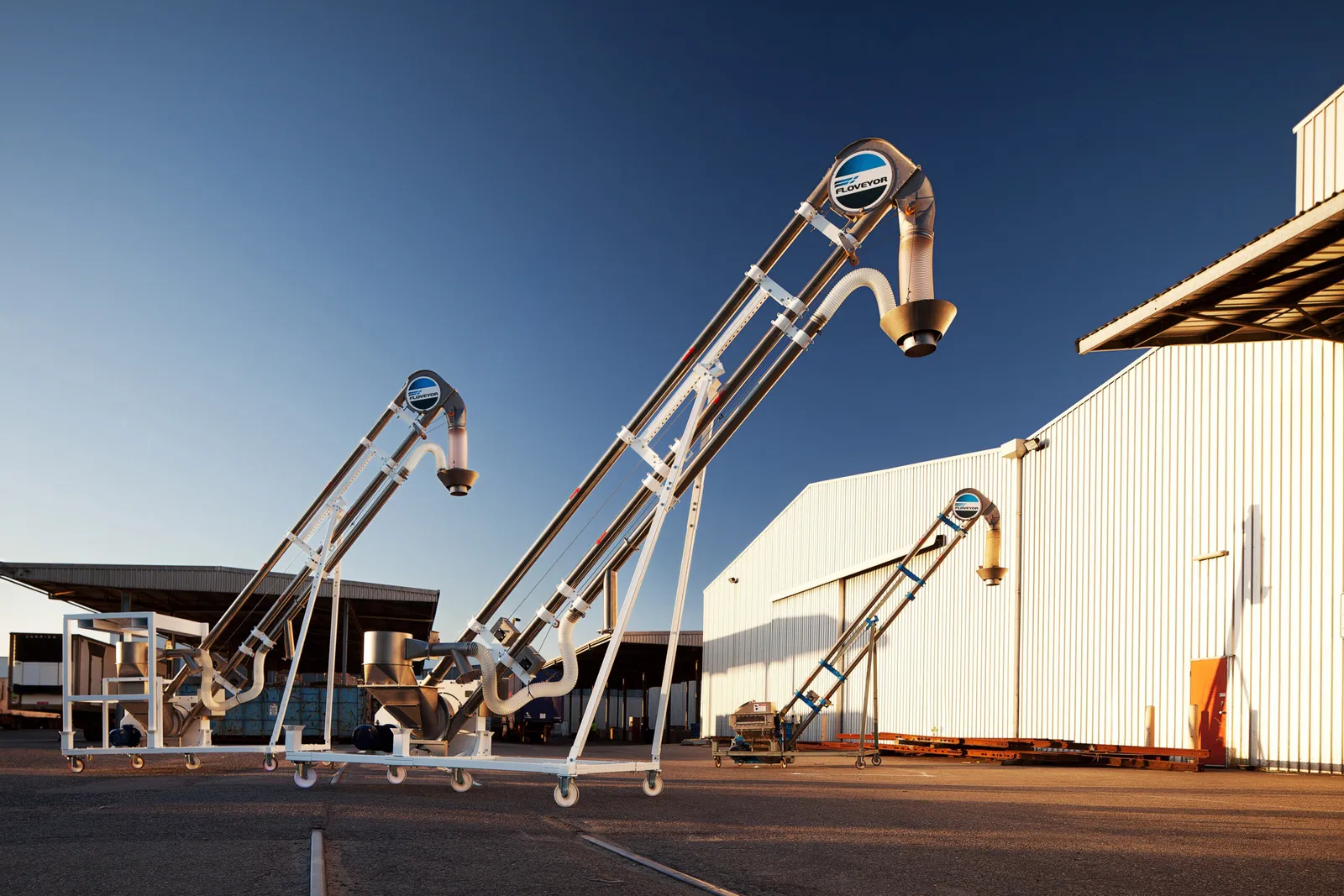
Floveyor equipment uses a closed tube system containing a steel cable fitted with a series of evenly spaced discs. The cable rotates at high speed, creating an airflow between the discs that fluidises and draws in the material. This enables products to be conveyed up to 18 m high and around bends of up to 90°. The equipment is suitable for almost all dry materials with a particle size of up to 25 mm. Another advantage is that aeromechanical conveying carries no risk of product degradation, damage or segregation. “Rather than pushing the material along, the system creates a vacuum,” Pollet explains. “This allows the material to be conveyed smoothly, quickly and at a consistent rate. That makes it suitable for handling fragile or cohesive products, as well as abrasive material streams such as cement. Since there is no friction, the risk of wear is significantly lower. This can have a considerable impact both on operations and maintenance.”
Conveyor or truck loader
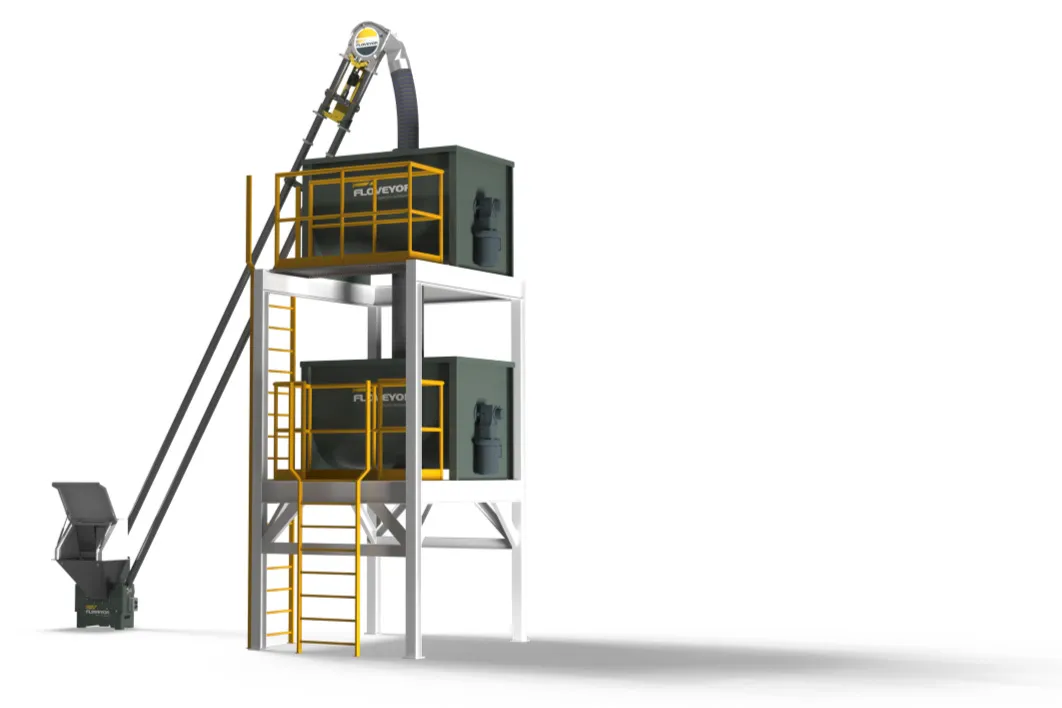
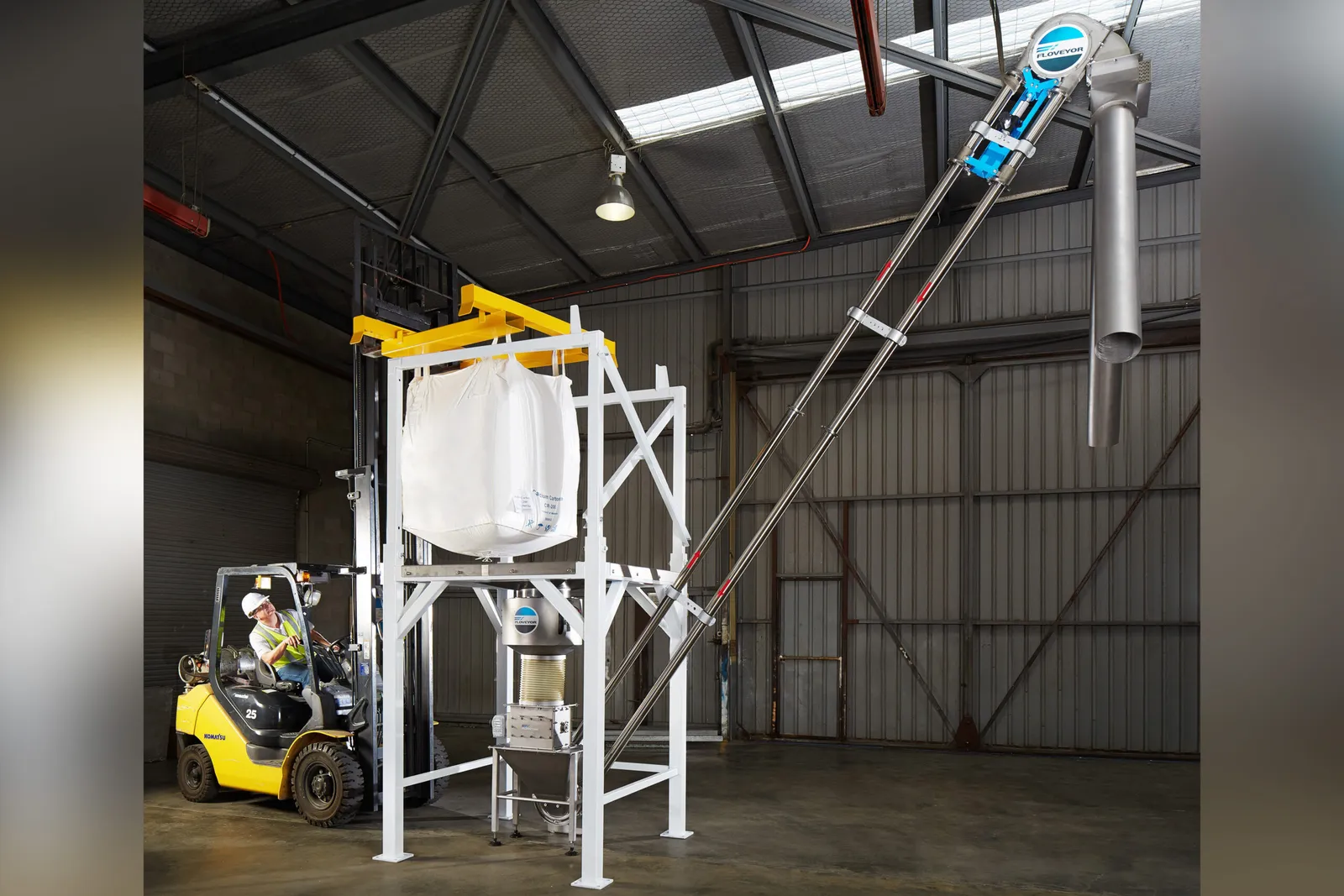
Floveyor equipment currently has two main applications: as a conveyor or as a truck loader. “We use the conveyors mainly as components in bag-filling stations and big bag unloading systems. The truck loaders are suitable for loading products into all types of trailers and tankers. Particularly in this latter application, where much of the work is still done manually, they deliver a clear improvement in speed, efficiency and safety. Depending on the product, loading rates of between 25 and 55 t/h can be achieved. The risk of product loss is virtually nil, and operators no longer need to carry out hazardous tasks. The enclosed design also minimises dust emissions.” According to Pollet, efficiency is one of the key advantages of the aeromechanical system. “That also applies to energy consumption. With a screw conveyor, you may quickly need a 36 or 40 kW motor to achieve a throughput of 30 t/h, whereas a Floveyor can do the job with a 5 kW motor. Then there is the space requirement. Unlike a screw conveyor, Floveyor stands out for its elegant, compact design.”
Tailored to the application and product
To meet the needs of different sectors, Floveyor’s range is divided into six product groups. “For conveyor applications in the construction and recycling sectors, the entry-level Avida model will generally be sufficient,” says Pollet. “For truck loaders, we mainly look at the Robusta and Endura models. There are also plenty of options when requirements include, for example, wet cleaning or ATEX compliance.” Robbe Industries also always provides a customised infeed station, and the complete unit can be supplied as a mobile system or integrated into a more complex installation. “We regularly carry out demonstrations and product tests using our own test units,” Pollet adds. “This allows us to ensure that we can always propose the most suitable solution.”
Question about this story? Ask your question
Keep following this
Get an email when a new story is published. No account needed.
- SubjectEquipment