












Work Matters: debate among employment experts
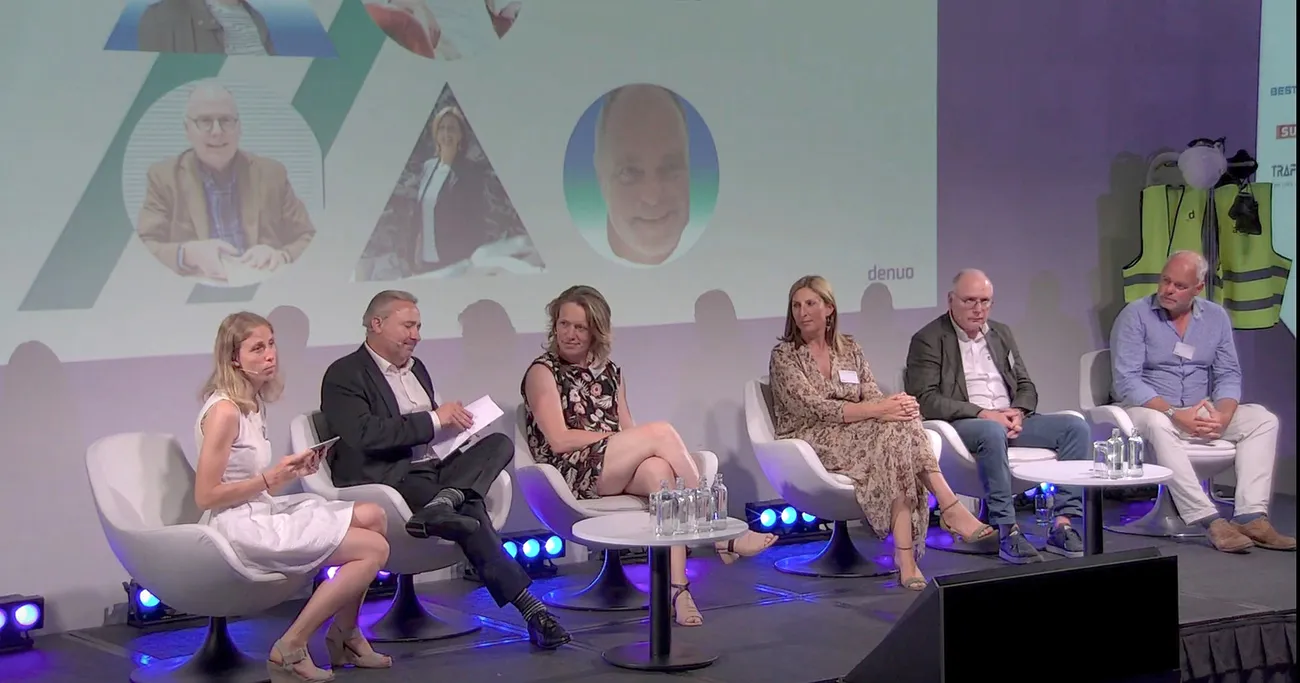
At Denuo’s Work Matters event, we brought together a group of experts to discuss the challenges and solutions relating to the current labour shortage in Belgium.
Below, we summarise the key messages from this inspiring debate.
Diversity and inclusion
The experts first considered diversity and inclusion as a solution to the labour shortage. Liesbeth Driesen, Director of the Employers Directorate at Actiris, began by explaining that diversity is no longer an option, but a necessity if we are to take account of the population of our country in all its diversity, particularly in Brussels. She pointed out that diversity boosts a company’s profitability, creativity and productivity. Employers have everything to gain from introducing such a policy within their company.
But, as Els Vanneste, HR Manager at Galloo, explained, this requires a cultural shift. In Els’s words: “We think women are better suited to care work and men to more technical and physically demanding jobs, but that’s our culture, not our nature. Business leaders will have to realise this, but culture takes time to change. We can change it in small steps.” This change is already evident, with some women now driving bulldozers or working as welders, something that would have been almost unthinkable in the past. Els went on to explain that we need inspiring role models to change this culture, and that is the aim of the ‘Women in Recycling’ project. We need role models not just for white-collar staff, but also for blue-collar workers, as women remain seriously underrepresented.
Interregional mobility
The discussion then turned to mobility within and between regions, and even between countries. The talent crisis is particularly acute in Flanders. Arne Theylaert, Director of Services at VDAB, spoke about the importance of interregional mobility and cooperation with Le Forem and Actiris to fill jobs in provinces with unemployment rates of between 2 and 0%. He explained that, to achieve the target of 80% employment by 2030, we need fresh talent and therefore need to recruit outside Flanders. Yves Magnan, Director General of Products and Services at Le Forem, explained that Wallonia has reactivated its language programme to train Walloon jobseekers in Dutch so that they can work in Flanders.
Unfortunately, Yves Magnan and Liesbeth Driesen acknowledge that physical mobility remains a problem, particularly for companies located in industrial zones that are poorly served, or not served at all, by public transport. There is a need for collective transport to companies.
Galloo also recruits many French workers because of the shortage of local labour. They no longer even need to speak Dutch. The company has adapted, making all work instructions and documents available in French. Another difficulty is that working arrangements and conditions differ from one country to another. A crane operator in France works 35 hours, while a crane operator in Belgium works 38 hours. Salaries are also not aligned. Yet these people work at the same site, which is neither logical nor fair. Els expresses the somewhat utopian hope (but you have to be able to dream in order to achieve great things) of a unified European Union when it comes to employment conditions, to make it easier for workers to move between countries.
Social mobility
Attracting talent is one thing. Retaining and developing it within the company is another. In this respect, social mobility can be seen as both a crucial challenge and a solution to filling vacancies.
Ortwin Magnus, Vice-President of ABVV Metaal, stressed the importance of the work done by the social partners, who have concluded a collective labour agreement on sustainable work in joint subcommittee 142.01 (metal recovery). Among other things, they have set up a mentoring course to train employees to mentor a new colleague. For ABVV Metaal, lifelong learning is essential, and workers must be able to upskill throughout their careers.
Yves Magnan reminds us that the perfect candidate no longer exists, so companies need to be flexible and hire people who can be trained on the job. This is known as work-based learning. Liesbeth Driesen added to this message, explaining that, as we can no longer find highly qualified candidates with relevant experience, we need to invest in training junior staff in-house. This is what the professional mobility ladder is about. Arne Theylaert said, “recruitment is an investment”. He believes that social secretariats have a role to play by offering development and career plans for employees, particularly to small and medium-sized enterprises that lack the resources to organise this internally. For roles requiring greater skills and experience, he recommends prioritising internal recruitment through career plans. New recruits with plenty of talent can start at the bottom of the ladder with good prospects for the future.
Els added that employees need training not only for their jobs, but also in general work skills and work ethic, taking a broader approach. She called on partners such as VDAB, Le Forem and Actiris to provide practical support to help employees progress and offer them social and psychological guidance.
In short, our sector wants to give people with the right motivation a chance. Attitude matters more than qualifications. Ortwin Magnus brought the debate to a close with the story of a woman who had climbed the social ladder in our sector. She had worked as a sorter in metal recovery for 16 years. Having completed her rounds, she wanted more responsibility and variety in her job. A vacancy came up at the company to drive one of its large bulldozers. Colleagues made many comments to discourage her, telling her that this was not a job for a woman. But she found the courage to apply, completed the training, passed her test and got the job. Ortwin says that when he sees her, she is highly motivated and extremely happy in her work. She is a real asset to the company, and there are many more stories like hers to be found in our sector. They should serve as examples to inspire other people and companies.
Question about this story? Ask your question
Keep following this
Get an email when a new story is published. No account needed.
- ThemeCircular business under changing regulations
- SubjectDenuo







