












Will a ban on artificial turf pitches send our tyres back to the furnace?
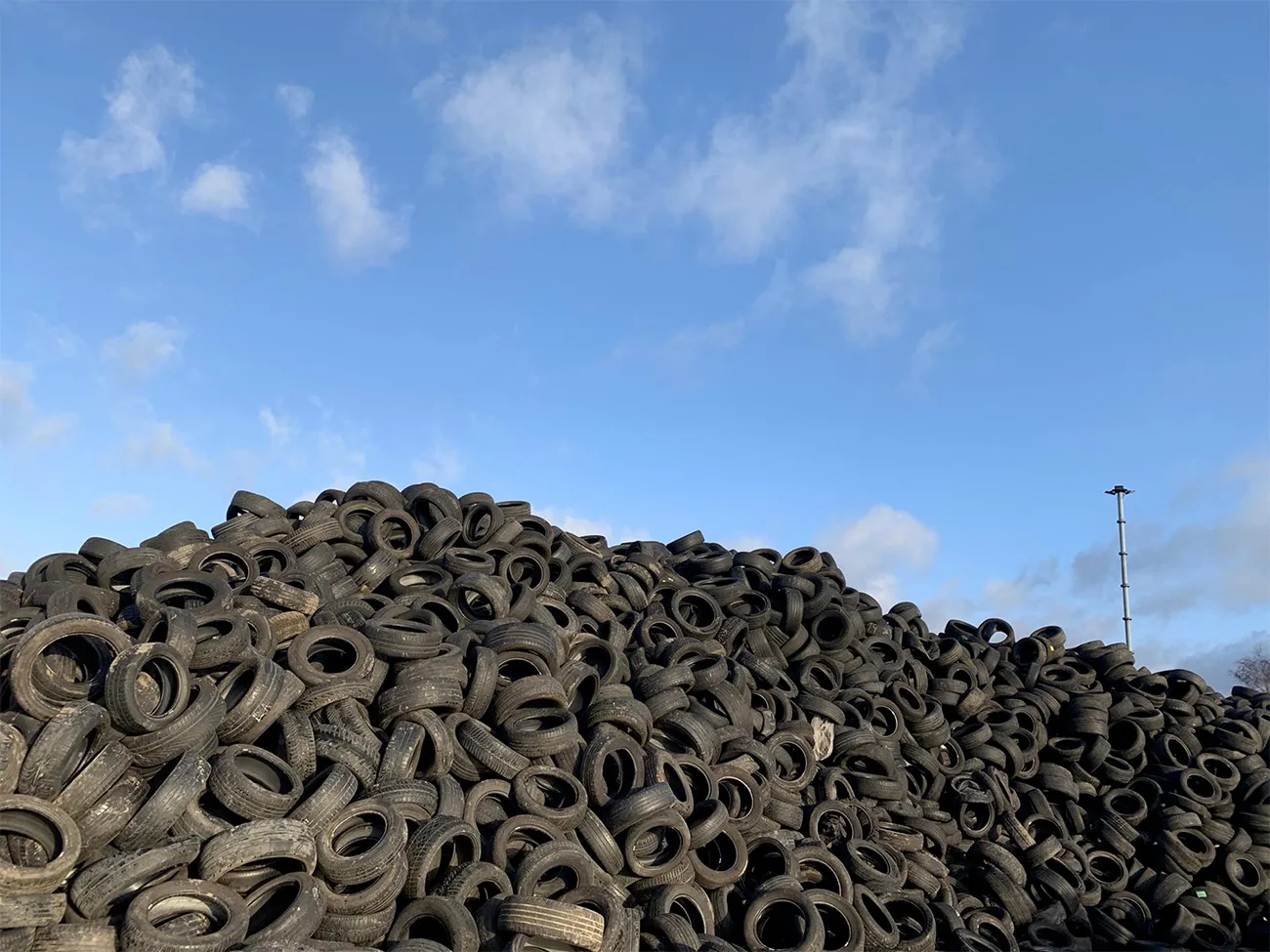
Between 2014 and 2018, the Belgian car fleet grew by more than 300,000 passenger cars.
This trend has not only led to more congestion on our roads, it also means that collectively we wear out thousands of tonnes of tyres. In 2019, a total of just over 90,000 tonnes of waste tyres were generated. But what exactly happens to these tyres?
Waste tyres: how does the system work in Belgium?
In Belgium, tyre producers (and importers) are subject to a legal take-back obligation, which means they are responsible for accepting tyres free of charge once they are worn out or damaged. In Belgium, the management organisation Recytyre is responsible for administering this take-back obligation. However, Recytyre’s responsibility is limited to tyres from the replacement market, in other words, worn tyres replaced by a garage or tyre centre, and tyres from the original equipment market.
To ensure the system runs smoothly, consumers currently pay a contribution to support the collection and subsequent processing of tyres. Recytyre relies on a network of more than 40 private operators, which collect tyres from more than 4,000 collection points (garages, tyre centres, etc.) and process them.
First priority: reuse
The first step in the processing chain takes place after collection. Tyres that are still suitable for reuse or retreading are first sorted manually and set aside. This sorting is a legal requirement in Belgium.
In practice, however, these tyres are often sorted out by the collection points themselves before a collector comes to pick them up. Such tyres are typically sold by garages as ‘second-hand tyres’. While these practices are positive in themselves, they mean that these tyres fall outside the Recytyre system and, unfortunately, do not contribute to the current recycling figures. What is more, the target of 10% for reuse and retreading has not been met for years. Most of the tyres reported as reused within the Recytyre system are generally reused outside Europe, often in African countries, where tyre safety standards are considerably lower.
Recovering valuable materials
Tyres that can no longer be reused are mainly recycled to recover the various valuable materials they contain. These materials fall into four main categories: rubber (natural and synthetic), chemical fillers (carbon black and silica), reinforcing materials (steel and textile fibres), and chemical components (curing agents and antioxidants).
To recover these materials, tyres are mechanically reduced in size at a shredding plant, where they are torn and shredded into smaller pieces. In Belgium, only collectors and pre-processors operate. Pre-processors carry out an initial size-reduction stage, shredding tyres into smaller pieces that are then sent to final processors in and outside Europe. The required fineness of the material depends on the end product or application for which the tyres are used. The vast majority of tyres are processed into rubber crumbs or granules. These have a wide range of end markets, including moulded products (rubber wheels, bins, etc.), playgrounds, athletics tracks and shock-absorbing mats. The main end market for these rubber granules is infill for artificial turf.
Finally, many tyres are still burnt in Europe for energy recovery. Rubber has a high calorific value, which means it can be used as a fuel, also known as tyre-derived fuel or TDF, to replace fossil fuels. Another reason why a third of waste tyres in Europe are still burnt today is simply that existing markets for recycled rubber are becoming increasingly saturated.
Will even more tyres be burnt in Europe soon?
Belgian operators are feeling the effects too. In recent years, and especially in recent months, they have seen processing prices rise dramatically. This trend will only intensify in the years ahead. The European Chemicals Agency (ECHA) has proposed far-reaching restrictions on the use of certain granules to tackle microplastic pollution in Europe. One consequence will be a ban on the use of rubber granules in artificial turf.
All this shows that it is five minutes to midnight for our waste tyres. Innovation and research are urgently needed to find high-value markets and applications for recycled rubber. More support is also needed for research into using recycled rubber to produce new tyres, but given the complexity of a tyre, a 100% recycled tyre is not just around the corner. Alternative solutions are needed to bridge the gap. Otherwise, many thousands more tonnes of tyres risk ending up in incineration plants, and their valuable materials will be lost.
Question about this story? Ask your question
Keep following this
Get an email when a new story is published. No account needed.
- ThemeCircular business under changing regulations
- SubjectDenuo







