












PPWR: Europe’s new packaging rules explained by Xavier Lhoir
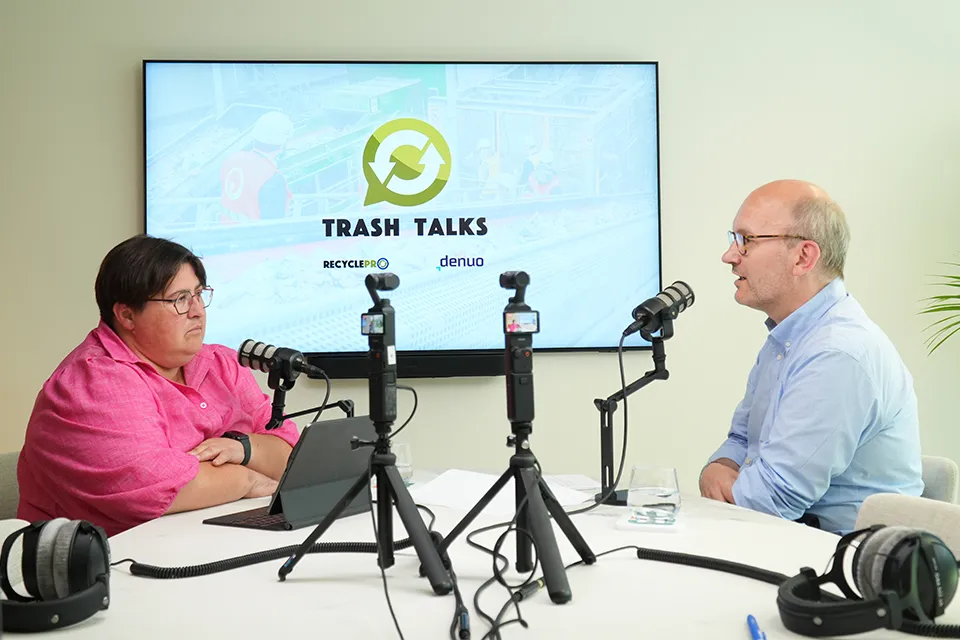
Host: Nele Roobrouck | Guest: Xavier Lhoir, Deputy Managing Director at Valipac
The Packaging and Packaging Waste Regulation (PPWR) brings the biggest reform of European packaging policy in years. But what do the new rules mean in practice for businesses, producers, recyclers and waste operators? In this episode of Trash Talks, Nele Roobrouck talks to Xavier Lhoir, Deputy Managing Director at Valipac. Together, they discuss the impact of the PPWR on recycling, reuse, recycled content and producer responsibility. What challenges lie ahead for businesses? Is Europe ready to meet its ambitious targets? And what role does Belgium play in this changing European landscape?

Full transcript
All chapters (28)
- Introduction to the PPWR and its impact on the sector
- What will the PPWR change in practice?
- The main targets for businesses
- More than just recycling
- Challenges for businesses
- Impact on different sectors
- Packaging that could disappear
- Implications for collection and recycling
- Recycling versus recyclability
- Missing rules and uncertainty
- Is there enough recycling capacity?
- Belgium’s position within Europe
- Reuse and recycled content
- Supply and demand for recyclate
- Who bears the responsibility?
- Monitoring at European level
- Time needed for new systems
- Lack of coordination between European regulations
- Preparations at Valipac
- Risks from delayed Delegated Acts
- Can companies meet all these requirements?
- Harmonisation is key
- Risks for Valipac
- The impact of e-commerce and competition
- Entry of new EPR schemes
- A figure policymakers should remember
- Policy recommendation: avoid gold-plating
- Wrapping up the conversation
Introduction to the PPWR and its impact on the sector
Nele Roobrouck Welcome to Trash Talks, the podcast where we take a close look at the challenges and opportunities in the waste and recycling sector. Today, we’re discussing an issue that will have a huge impact on businesses, recyclers, operators and producers in the coming years: the Packaging and Packaging Waste Regulation, or PPWR for short. With this regulation, Europe aims to make packaging more sustainable, boost recycling and drastically reduce the amount of waste. But the question, of course, is how achievable are these ambitions in practice? To discuss this, we’re joined today by Xavier Lhoir, Deputy Managing Director at Valipac. Welcome, Xavier. To start us off, how would you sum up your view of the PPWR in one sentence? Is it more of an opportunity, or do you see it as a challenge? And what is Valipac’s position?
Xavier Lhoir Thank you for the invitation. How do we view the PPWR? For us, it is a challenge, but it also builds on what we have been doing for the past 25 years. One advantage of the PPWR is that it is a regulation, so it brings harmonisation between Member States. Belgium is in a distinct position today, because we already have experience in recycling and in the take-back of commercial packaging. The PPWR sets the same minimum requirements across Europe. Of course, Valipac has that experience. We provide continuity, and we want to take the next step. In fact, the PPWR helps us at this level to ensure that continuity and create a level playing field across Europe.
What will the PPWR change in practice?
Nele Roobrouck Okay, this is already shaping up to be a very interesting conversation. But looking at the PPWR itself, I think many listeners may not know exactly what it means. What would you say the PPWR will change in practice for packaging in Europe, and therefore in Belgium too?
Xavier Lhoir The PPWR is essentially the constitution for packaging and packaging waste. We are moving to a regulation, having previously had a directive. A regulation will be applied strictly and directly across Europe. A directive had to be transposed into national legislation. So this is essentially an upgrade, and a major difference between the PPWD and the PPWR. The PPWR also sets and defines ambitious targets for prevention, recycled content, reuse and recyclability, in addition to the traditional recycling targets that have long been in place in Belgium and other Member States. We are also moving beyond talking about packaging in general. We distinguish between sales packaging, grouped packaging and transport packaging, with specific targets for each type. And one very important element for us is the new definition of a producer. We see certain differences in the definition, with concrete implications for adapting our system, which is already 30 years old.
Read the full transcriptCollapse transcript26 more chapters
The main targets for businesses
Nele Roobrouck You mentioned that the PPWR includes some very important targets. Which one do you think businesses will feel most strongly?
Xavier Lhoir There are several targets that matter to businesses. The first is prevention. For example, we need to ensure that businesses or Member States put at least 5% less packaging on the market by 2030. So we need to use less packaging. But we also need to ensure that more packaging is reused. For example, transport within a single Member State or within a single company must use reusable packaging only. Transport in Europe must also use at least 40% reusable packaging. There are also important targets for recycled content, because by 2030 plastic transport packaging must contain at least 35% recycled content. And there are strict rules on recyclability, which have been decided and approved but still need to be fine-tuned through the Delegated Acts. They are based on grades, with each grade representing a level of recyclability: grades A, B, C and D. Grade D is packaging made of material that is at most 70% recyclable, and this packaging will be phased out in 2038. So this will have concrete implications for businesses. The PPWR’s ambitions, its drastic reductions and its ambitious targets for recycled content and reuse will have consequences for businesses.
More than just recycling
Nele Roobrouck To sum up, can I say that this is not just about recycling and design, but also about reuse and, above all, reducing packaging?
Xavier Lhoir It is much more ambitious than before.
Challenges for businesses
Nele Roobrouck Let’s focus a little more on businesses themselves. What are the biggest challenges for a business that puts packaging on the market under the PPWR?
Xavier Lhoir First of all, they need to understand exactly what it involves. It is a very complex piece of legislation, and the vast majority of businesses do not know precisely what the targets are or what they mean in practice for them. So providing information is an important first step. That is why Valipac regularly organises workshops and webinars. We can see that it is a hot topic, because business attendance has risen sharply. It is still unfamiliar territory for many. So understanding the legislation is important. Then they need to prepare. Implementing new types of packaging will take time and require investment from businesses. Moving from single-use transport packaging, such as a single-use wooden pallet, to a reusable system needs to be carefully considered before businesses make an investment. And all of this needs to happen by 2030, the first major deadline.
Impact on different sectors
Nele Roobrouck So businesses will have to rethink their packaging fundamentally. But is that achievable for every sector? Or do you see clear differences, with some sectors finding it easier to implement than others?
Xavier Lhoir I think all sectors will be affected by the PPWR in one way or another. I would distinguish between packaging in general and food-contact packaging, where the targets are even more ambitious and complex. But all in all, every business and every sector will be affected. We are already seeing some businesses looking closely at implementation and preparing, while others have done nothing so far because of a lack of information.
Packaging that could disappear
Nele Roobrouck Is there a risk that certain types of packaging will simply no longer be economically viable?
Xavier Lhoir Economically viable? I don’t know, but some types of packaging will definitely disappear. That is because of the definition of recyclability. If they are less than 70% recyclable, they will have to be phased out by 2038. That is essentially Europe’s aim: to set strict rules that make certain types of packaging no longer permissible. I would like to add something, because while the PPWR will have consequences for businesses, it will also affect waste collectors. Because of the stricter reuse targets, businesses will have to switch from single-use to reusable packaging. This will apply to wooden pallets, for example, but we will also see certain applications in the plastics and metals sectors. We estimate that by 2030, the amount of single-use packaging placed on the market will fall by 20%. That means 20% less single-use packaging for professionals to collect, because it will be replaced by reusable packaging.
Implications for collection and recycling
Nele Roobrouck So you will actually be creating an alternative system, in which reusable packaging will also need to be collected. Pallets will need to be collected and returned to the site.
Xavier Lhoir But it also means adapting the existing collection system, through which we organise collection and preparation for recycling. We are moving from collection and preparation for recycling to preparation for reuse. This also means changing the way collectors work.
Recycling versus recyclability
Nele Roobrouck We just mentioned recycling. Recycling is not always straightforward at the moment. And when we look at the PPWR, we can see that it places a strong emphasis on recycling and recyclability. But how does that translate into practice? How far have we got, and will we be able to achieve this? We also know that plastic recycling is not always an easy sector.
Xavier Lhoir I would distinguish between recycling and recyclability. In terms of recycling, we currently achieve a 98% recycling rate. That is what we report annually to the Packaging Commission, so we are doing quite well. In terms of recyclability, based on current reporting, around 1% of packaging is considered non-recyclable. But in time, the European Commission will define specific rules through the Delegated Acts, which will mean that we need to change the way we assess this. We will have to use different definitions to assess the share of non-recyclable packaging.
Missing rules and uncertainty
Nele Roobrouck If, as you say, all this still needs to be set out in Delegated Acts and the targets also have to be met by 2030, does that mean some of the regulations are not yet fully in place?
Xavier Lhoir Yes, there are still some fundamental elements and details missing from the information we communicate to our customers and businesses, and from the implementation of our system. What information do we need to prove recyclability? We don’t know exactly yet.
Nele Roobrouck And the PPWR comes into force on 12 August, right?
Xavier Lhoir 12 August, yes.
Nele Roobrouck Okay, so there’s still work to do.
Xavier Lhoir A serious challenge for the authorities.
Nele Roobrouck And especially for the European authorities.
Is there enough recycling capacity?
Nele Roobrouck But when we look at recycling capacity in Belgium and Europe, is there enough capacity at the moment to meet those ambitions in terms of packaging recyclability?
Xavier Lhoir In general, when we talk about paper, cardboard, wood and metal, we think there is sufficient capacity. The challenge is plastics. Some of our plastics are currently recycled outside Europe. We do not have enough capacity, and the challenges are considerable. We are talking about the PPWR, but there is also the Waste Shipment Regulation, which sets ambitious targets.
Nele Roobrouck Yes, indeed, this regulation comes into force on 21 November.
Xavier Lhoir That is very short notice. Very short notice.
Belgium’s position within Europe
Nele Roobrouck So we can see that much higher targets are being set. We have talked about Europe, but what can we do as Belgians? Can Belgian companies also use this as a benchmark? Will they be able to meet these targets?
Xavier Lhoir We have 25 years’ experience in recycling commercial packaging waste, working with a PRO or waste collectors. That is a very important body of experience. But Belgium is also known for the quality of its waste streams. Cooperation between traders and recyclers runs smoothly because we can supply good-quality material. Belgium is also centrally located in Europe, between two major countries with recycling activities, and we also have experience with exports. We know that exports will be subject to strict new rules, but exporting other waste streams will still be possible. We also benefit from being close to the Port of Antwerp, from which we will still be allowed to export material further afield.
Reuse and recycled content
Nele Roobrouck Let’s take a closer look at reuse and recycled content. The PPWR places a strong emphasis on reuse and recycled content. But how realistic are those targets across Europe or in Belgium?
Xavier Lhoir We think those targets are fairly ambitious and will also be difficult to verify. But Belgium is already well advanced. When we receive the figures from our members, we know that 82% of the packaging placed on the Belgian market is already reusable. So the Belgian industry already reports more than 3 million single-use packaging equivalents. How we will monitor and verify Europe’s new targets in future is another matter. But the fact that Belgian industry is already using reusable packaging is a reality. We have been reporting these figures to the authorities for 25 years.
Supply and demand for recyclate
Nele Roobrouck Can we say, then, that there is currently sufficient supply and demand for recyclate? Or is it still too early to say?
Xavier Lhoir No, it is too early at the moment. Demand for recyclates is too low. We currently offer an incentive to promote the use of recycled content, and we pay that incentive on 1% of the quantities placed on the market. So that incentive certainly plays a part, but what we really value is the change in legislation. That legislation will ensure that, by 2035, all commercial packaging contains 35% recycled content. That would be difficult without legislation.
Who bears the responsibility?
Nele Roobrouck And suppose the market does not respond. There would inevitably be a cost, because we would not meet a European obligation. Who would bear that cost?
Xavier Lhoir But the PPWR is clear. It places responsibility on packaging producers. They must ensure that all their packaging contains 35% recycled content by 2030. That is their responsibility.
Monitoring at European level
Nele Roobrouck You said earlier that monitoring would be difficult. How will it work, then? Do we have any idea yet? After all, we have a single market. Packaging crosses borders.
Xavier Lhoir Yes, but we come from a situation in which a PRO is linked to a geographical area. We at Valipac operate in Belgium and monitor a number of targets for Belgian territory. Europe has defined a number of European targets. So who will monitor exports from one European country to another? We do not have enough information to do that. Nor is it necessarily our responsibility under the wording of the legislation. So that is still an open question which Europe and Belgium will have to answer.
Time needed for new systems
Nele Roobrouck But in principle, this legislation on monitoring only needs to be in place by 2030.
Xavier Lhoir Yes, okay, the results must be reported in 2030, but if we need to collect information, we have to develop a system, and that takes time too.
Nele Roobrouck More work for Europe, then. So, in effect, we currently have legislation, the PPWR, but policy is not necessarily keeping pace in a coherent way. There are still many gaps, and there are also risks. Looking at European policy, we have the PPWR on the one hand, but as we also mentioned earlier, there is a ban on waste exports. How can those two things be reconciled?
Lack of coordination between European regulations
Xavier Lhoir That is a difficult question, because we are seeing a lack of coordination at European level. Why do we have an export ban in 2026, but only a recycled-content obligation in 2030? The different departments at European level should have coordinated this much better. Then we would have come up with something that made more sense, but that is not the case today. So we are heading into a period in which we will lack recycling capacity, because the recycled-content target only comes into force in 2030. We will therefore have to store certain volumes of plastic temporarily and find alternative outlets.
Preparations at Valipac
Nele Roobrouck And are you already working on that at Valipac?
Xavier Lhoir We monitor the market closely, because this is crucial for us. Our goal and ambition is still to meet our recycling targets. But if there is no longer any demand for certain materials, we have no chance of meeting them. We have started a number of initiatives to secure outlets for certain difficult-to-recycle streams that will have a slightly lower market value for a period. Take big bags, for example. They are heavily reliant on exports. From November, they will no longer be allowed to go for recycling in Asia. What will we do with those 6,000 tonnes of big bags in Europe? Valipac has therefore taken on a proactive, temporary role, providing guarantees for the recycling of this difficult stream for a certain period. This benefits a range of stakeholders, not just us and our ability to meet our targets, but also our cooperation with operators and their customers.
Risks from delayed Delegated Acts
Nele Roobrouck Indeed, big bags are a very difficult stream. So you are essentially trying to put a measure in place to bridge the period from 2026 to 2030. Are there any other risks from conflicting measures that Europe is set to introduce?
Xavier Lhoir Risks, yes. The definition of the Delegated Acts is one. Until we have a clear definition of what is expected, it is difficult for us to communicate specific systems and expectations to our customers. So the longer it takes to define clear rules, the harder it becomes for us to communicate that information and for companies to secure certain investments.
Can companies meet all these requirements?
Nele Roobrouck Yes, because companies are currently being overloaded with additional requirements. We know what is coming. There are still legislative measures missing. Will companies, operators and producers actually be able to meet these requirements? Is there enough support?
Xavier Lhoir Yes, we see a risk, and our mission is to inform companies as quickly as possible once we have accurate information.
Nele Roobrouck In this podcast, we often end up discussing solutions and recommendations for the authorities. We are now in a situation where we know the PPWR is in place and will come into force on 12 August. Many Delegated Acts are still to come. But are there any measures that Valipac itself would say still need to be taken, whether through legislation or amendments, to make the PPWR workable?
Harmonisation is key
Xavier Lhoir We can dream, but the PPWR will not be amended by 12 August. So the PPWR as it stands today will become a reality in August. Harmonisation is key for us. We need to ensure that PROs such as Valipac interpret the legislation in the same way across Member States. That will allow us to set the same rules for our own customers, many of whom are active across Europe, so that they can apply the same rules in Belgium, France and the Netherlands. That is why we recently set up a coalition comprising Valipac and Fost Plus in Belgium, Citeo in France, Verpact in the Netherlands and Valorlux in Luxembourg. The aim is to compare our respective interpretations of the PPWR and ensure a degree of harmonisation in our national operations.
Risks for Valipac
Nele Roobrouck We now have new legislation. That also affects PROs, including you and Valipac. Do you see risks for Valipac? For Fost Plus? Let’s include Fost Plus in the discussion.
Xavier Lhoir I will talk about Valipac. For Valipac, yes, definitely. I think we have identified two major risks. First, the definition of a producer. We currently work with 6,000 customers and have a strong relationship with them. They know what information we ask for. Over time, the way they work with Valipac has become routine. The PPWR makes small changes, subtle differences to the definition, but with a major impact for Valipac. In the case of end users, companies that import certain goods, unpack them and use them in their own production process in Belgium, those companies are no longer responsible as importers. Their foreign suppliers become responsible and are classified as producers. Those foreign suppliers would have to join the Valipac system and report information to Valipac. That is difficult, because we will never be able to sign a contract with a coffee bean producer in Venezuela or other producers in China or elsewhere in the world. We estimate that we could lose up to 30% of our market share as a result. But even a 1% reduction in market share is not good for us. It means fewer resources to fund collection and recycling.
The impact of e-commerce and competition
Nele Roobrouck Can I take a brief detour to e-commerce? Does it have an impact on you?
Xavier Lhoir Less for us. It focuses more on consumer packaging, which is really Fost Plus’s remit. Another risk for Valipac is Europe’s vision of promoting competition between EPR schemes. Today, Valipac, like Fost Plus, has a unique position in the Belgian market. Competitors can apply for accreditation, but so far none have done so. With the PPWR, Europe wants to encourage competition between EPR schemes. We do not necessarily see that as a positive development, because we take a multi-material, multi-sector approach. We handle materials with a positive value, but also those with a slightly negative value or that are complex. Recently, in collaboration with producers, we launched a collection system for PU foam aerosols. This is a complex material for which specific collection channels need to be developed. In a competitive system, the focus will be on prices. Developing specific collection channels for difficult waste streams will be more challenging. That is the first point. Experience in Europe shows that competition has not necessarily produced positive results. We have seen this in Norway and other countries. Naturally, the focus there is on providing the best service at the lowest price. Whereas Valipac can offer a broader service in Belgium today and ensure a degree of cooperation between industry and government.
Entry of new EPR schemes
Nele Roobrouck So, from 12 August, foreign EPR schemes will be able to enter the Belgian market, but of course this depends on approval by Epribel. After all the back-and-forth, that will not happen before 4 November, if I understand correctly.
Xavier Lhoir No. A potential competitor can submit an application for approval to the Packaging Commission or Epribel, and they will assess it against a number of approval criteria. This means that even a competitor from another country will have to take the Belgian context into account in its application. Belgian producers will then be able to choose between different EPR schemes in Belgium. Under the current rules, we cannot fulfil our extended producer responsibility in Belgium through a contract with a foreign EPR scheme in another member state. They must be recognised or approved by the Belgian authorities.
A figure policymakers should remember
Nele Roobrouck So there are exciting times ahead until 4 November, but no doubt Valipac will submit a very good and strong case.
Xavier Lhoir Absolutely.
Nele Roobrouck In this podcast, we also often look at the sector and discuss policy messages. We ask about a figure that stands out. What is the defining figure you think policymakers should remember about the PPWR?
Xavier Lhoir I would highlight 90.6 per cent.
Nele Roobrouck That’s an excellent mark.
Xavier Lhoir It is an excellent mark, but it is actually the recycling rate we report to the Belgian authorities each year. It also reflects the reality in Belgium. Today, we have a central organisation, Valipac, with agreements across the entire Belgian industry. In a competitive system, I do not think we would still be able to report such a high rate tomorrow. The focus would be completely different, and we would prioritise the most profitable waste streams while setting difficult ones aside. So I think that figure is the result of Valipac’s consensus-based approach over the past 30 years.
Policy recommendation: avoid gold-plating
Nele Roobrouck That’s an impressive figure. If we were to go to a minister’s office, or a government asked us to approve a measure, what would be one or perhaps two specific measures you would recommend? Whichever government it is, Flemish, federal or Walloon, what should it introduce to ensure the PPWR succeeds or make it even better?
Xavier Lhoir The PPWR’s main aim is harmonisation, but local authorities can always impose additional requirements and targets. That is somewhat contradictory. We believe gold-plating must be avoided at all costs. Gold-plating guarantees that there is no harmonisation between member states and that one becomes more expensive than another because of specific government requirements. Avoiding gold-plating is crucial for our members. We already have sufficiently ambitious legislation. Belgium always goes beyond Europe’s baseline requirements. We can see this, for example, in the recycling targets. I think we need to pay close attention to how the PPWR is implemented and avoid as much additional gold-plating as possible.
Wrapping up the conversation
Nele Roobrouck The PPWR is here and comes into force on 12 August, but this conversation has shown that there is still a lot to do. Valipac and others in the business community are waiting for the Delegated Acts. This conversation may be coming to an end today, but there is still a long way to go, and the work is far from finished. So I expect we may need to sit down together again in a few months.
Xavier Lhoir I would be delighted to come back.
Nele Roobrouck What is clear today is that the PPWR is a crucial step towards a more circular economy, but it will also be a major and complex challenge for businesses, the sector, Valipac and EPR schemes. The ambition is high, but success will depend on practical feasibility and the right conditions. Many thanks, Xavier, for these insights. And as we know, ambition without feasibility remains on paper. The real test of policy is on the ground. Thanks for listening, and see you next time on Trash Talks.
Keep following this
Get an email when a new story is published. No account needed.
- ThemeMaking plastics and packaging circular
- SubjectDenuo







