












PODCAST: DIWASS in practice: what will change for businesses?

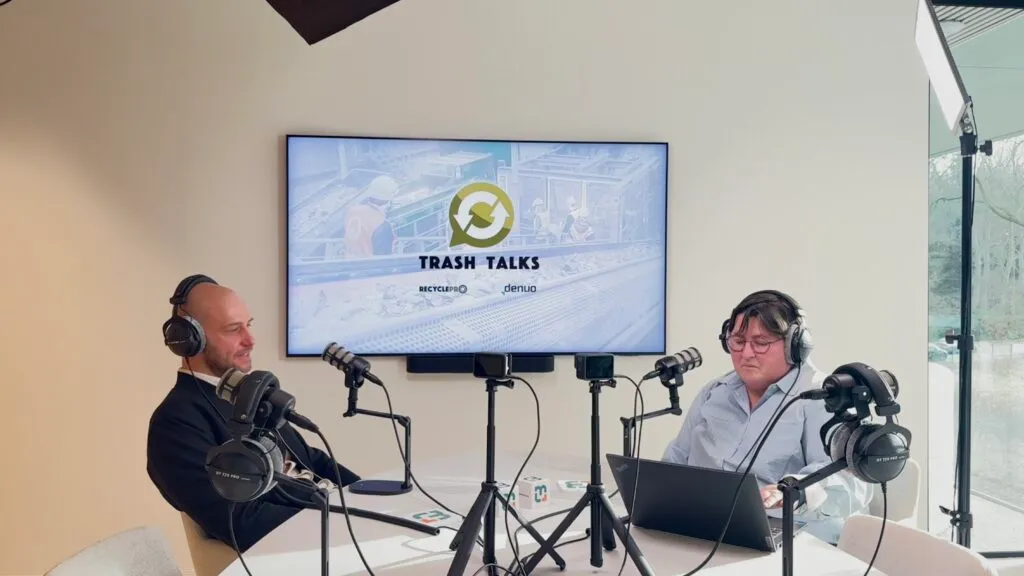
In this first episode of Trash Talks, Nele Roobrouck (Denuo) talks to Sebastiaan Laloo (Pionira) about DIWASS, the European digital system for cross-border waste shipments. They discuss what DIWASS means in practice, how the system is structured and what impact it will have on businesses in their day-to-day operations. They also cover implementation challenges, such as leadership, processes and training across the chain. Finally, they discuss the differences between the Belgian and Dutch approaches, the division of responsibilities around data and enforcement, and what businesses can already do to prepare.
Question about this story? Ask your question
Full transcript
All chapters (38)
- Introducing Trash Talks
- Digitalisation as an inevitable development
- Introducing the guest
- Explaining DIWASS
- Europe and the digitalisation of waste shipments
- DIWASS: structure and operation
- Implementation on the ground
- Digitalisation as an organisational challenge
- The role of software providers
- How Pionira’s DIWASS solution came about
- Timing and obligation
- Preparing for the deadline
- Preparing the sector and government
- Belgium and the Netherlands compared
- National differences within a European framework
- Harmonisation versus fragmentation
- Data and access
- Defining roles and data access
- Confidentiality of business information
- Data protection within DIWASS
- Staying vigilant
- The sector’s role
- The regular sector-policy question
- The importance of volumes and a gradual approach
- Policy measure to provide support
- Investment allowance for digitalisation
- Wrapping up the first part
- Bringing businesses along in digitalisation
- Value proposition and time savings
- Cost versus investment
- Reallocation of work
- What needs to be in place at the outset
- Process and supply chain involvement
- Training as the key
- Support and guidance from Pioniera
- Summary of recommendations
- Success criteria for Pioniera and society
- Closing remarks and a look ahead
Introducing Trash Talks
Nele Roobrouck Welcome to Trash Talks, the new podcast from Recycle Pro and Dynigo. In this series, we take you behind the scenes of the recycling and waste sector. What actually happens to our materials? How do we turn waste into tomorrow’s raw materials in an increasingly complex landscape? What challenges are businesses facing today? And how can we continue building a circular future? Find out here, on Trash Talks.
Digitalisation as an inevitable development
Nele Roobrouck Digitalisation is no longer optional, including in the waste and recycling sector. With DIWASS, Europe is taking a major step towards fully digital tracking of waste shipments. But what does that mean for businesses on the ground? Will traceability finally become workable, or is there a risk of added complexity?
Introducing the guest
Nele Roobrouck In this first episode of Trash Talks, the podcast from Recycle Pro and Denuo, I’m talking to Sebastiaan Laloo from Pionira. Sebastiaan is COO of Pionira, a well-known player in the digital market. Following the rapid growth of recent years, the digital Annex VII and its associated DIWASS connection mark the start of a new chapter for Pionira, with its European ambitions taking centre stage. Welcome, Sebastiaan. Let’s get straight into it. For anyone who hasn’t come across DIWASS yet, can you explain exactly what it is?
Explaining DIWASS
Sebastiaan Laloo Hi Nele, thanks for inviting me. DIWASS stands for Digital Waste Shipment System. It is the final piece of the new European regulation on shipments of waste, also known as the European Waste Shipment Regulation.
Europe and the digitalisation of waste shipments
Nele Roobrouck So Europe is taking another step towards the digitalisation of waste shipments. Flanders has been familiar with this for several years, as has the Netherlands. But what does DIWASS mean for businesses in their day-to-day operations? Can we say it will reduce the administrative burden, or will that burden simply shift?
Read the full transcriptCollapse transcriptnog 33 hoofdstukken
DIWASS: structure and operation
Sebastiaan Laloo Essentially, DIWASS has two parts. First, it is a central system where you can submit notifications, which the authorities can then process and approve. All the authorities involved can see the status of a particular notification. In addition, international shipments covered by Annex VII must be digitalised. In practice, this means a digital document is required: the digital Annex VII.
Implementation on the ground
Nele Roobrouck Okay. Looking at what this means on the ground, what are the biggest challenges in implementing it? As you know, our sector includes very large businesses as well as small and medium-sized enterprises. Can we expect the challenges to be similar, or are there barriers in some areas?
Digitalisation as an organisational challenge
Sebastiaan Laloo It’s important to emphasise that digitalisation is also partly about mindset. The question is: is my organisation ready for digitalisation? Are my people on board? That is very important. I see differences in this among both large and small businesses. The organisation’s leadership is a key factor. Do they support digitalisation, or do they say, “Look, it’s just another obligation”? Leadership is crucial because it creates buy-in within the organisation and gets people on board. You have to convince not only your own staff, but also your carriers, processors and treatment sites. You have to bring the entire chain along on a digitalisation project like this.
The role of software providers
Nele Roobrouck Businesses such as Pionira can, of course, lend a hand. What does that look like in practice? How do you approach a business, and what services can you offer?
How Pionira’s DIWASS solution came about
Sebastiaan Laloo How did things get moving on DIWASS? Customers started approaching us of their own accord. They said it was on their radar, but not yet high on their list of priorities. They asked us how we saw it. We had already developed and rolled out digital Annex VII documents for very specific customers and types of traffic. But now we have launched a new product that can be used much more widely and meet the market’s needs in full. It covers different types of waste organisers and different types of transport. A technical team has been working intensively on it over the past quarter to lay the groundwork. Pilot projects are now under way, and some businesses are already testing the new Annex VII.
Timing and obligation
Nele Roobrouck And when it comes to timing, when does a business need to be ready? When does the system have to be implemented?
Preparing for the deadline
Sebastiaan Laloo I recommend getting started now. Begin by gathering information. OVAM and the Dutch ILT are certainly doing their part by communicating what they know about the new EVOA and sharing updates. The first step is to find out more and map everything out. What types of traffic do I handle? Who is involved? What are my processes? Map all of that out and use it to develop an action plan. Which providers are involved? Who supplies my software? Can they support this? Once you have done that, bring your people on board and train them, and also inform carriers about what is coming. The deadline is 21 May 2026, but businesses can already take steps today.
Preparing the sector and government
Nele Roobrouck So businesses can start preparing now. Information is available on the websites of both the Dutch and Flemish governments. As a sector federation, we at Denuo are also trying to provide our members with enough information. And with a partner such as Pionira, we can build on that, of course.
Belgium and the Netherlands compared
Nele Roobrouck We have listeners in the Netherlands as well as Flanders. Looking across the border, can we already say whether DIWASS is being rolled out in the same way in Belgium and the Netherlands? Are you seeing any differences? Is one side moving faster or further ahead?
National differences within a European framework
Sebastiaan Laloo The great thing about a central system is that, sooner or later, it will bring uniformity across all countries. However, the implementing acts do allow the competent authorities to specify how organisations should connect to DIWASS. Flanders has said that notification procedures will continue to run through the EVOA portal, which will be connected to DIWASS. For Annex VII, users can connect directly via DIWASS or through their own software. The Netherlands has chosen to process both notifications and Annex VII directly via DIWASS.
Harmonisation versus fragmentation
Nele Roobrouck So we can hope that DIWASS will bring greater harmonisation across Europe, rather than a separate system for each member state.
Data and access
Nele Roobrouck Digitalisation also means collecting information. Data is often called the new gold. Who will have access to that data? And how will that work, including for enforcement purposes?
Defining roles and data access
Sebastiaan Laloo The regulations and implementing acts clearly define the roles. On the one hand, there are operators, such as waste collectors and aggregators. There are also the competent authorities, which are responsible for decision-making and approval. Inspection services also have access for enforcement purposes. Finally, the European Commission acts as the system administrator and oversees the proper functioning of the system.
Confidentiality of business information
Nele Roobrouck If roles are so clearly defined at European level, can we also say that business information is adequately protected?
Data protection within DIWASS
Sebastiaan Laloo It is a European initiative, and Europe is a leader in data protection. Think of the GDPR for personal data, as well as other data protection rules. There are technical measures, clearly defined roles, proportionality, retention procedures and authentication protocols. Everyone only gets access to the data they need for their purpose.
Staying vigilant
Sebastiaan Laloo You should always be able to question your government and remain vigilant about your rights, regardless of this initiative.
The sector’s role
Nele Roobrouck Absolutely. And as a sector federation, we will keep a watchful eye on that too.
The regular sector-policy question
Nele Roobrouck In every podcast, we ask a set of regular questions. Looking at this sector, what is the key figure you think policymakers should remember?
The importance of volumes and a gradual approach
Sebastiaan Laloo The key measures are the volumes and the number of documents created. Above all, I would say: don’t punish those who are making an effort but haven’t got everything right yet. Focus on the blind spots, those who are not doing it or refuse to do it, and make sure they come on board too. Digitalisation needs to happen gradually, not with a finger wagged at people from day one.
Policy measure to provide support
Nele Roobrouck If you could go to a government department today and pin down one specific measure to make DIWASS workable, what would it be?
Investment allowance for digitalisation
Sebastiaan Laloo What stands out to me, both at Pionira and from my experience as a consultant, is how much work businesses still have to do on digitalisation. A higher investment allowance specifically for digitalisation could be a major lever here. I still see many outdated systems, or no systems at all, even though digitalisation can create so much added value. It matters at a macroeconomic level too, because more efficient businesses are more resilient and contribute more.
Wrapping up the first part
Nele Roobrouck That’s a measure we’ll certainly take up with policymakers. It’s something we can raise as Denuo when we visit a minister’s office. We’ll definitely press for more attention to investment allowances for IT. Thank you for the suggestion.
Bringing businesses along in digitalisation
Nele Roobrouck: As you say, there are companies that are still a long way behind. They struggle with digitalisation. How can we make sure these companies are included and can move up a gear and become more efficient through digitalisation?
Value proposition and time savings
Sebastiaan Laloo: This is something Pionira has been saying for more than ten years. There is a clear value proposition for digitising administration and, for us, transport documents. It is very clear. There is the cost of paper, which is actually the smallest cost. The main cost is the time often spent preparing and managing paper documents. I think every organisation should work out exactly how much time is spent on a document. I think you will quickly find it takes fifteen minutes. Then compare that with the average staff costs for the specific person who has to handle the paperwork, and calculate the cost on an annual basis. When you then see how much our tool costs, both to set up and as a subscription, it is a very clear value proposition. And that applies to a lot of other software too.
Cost versus investment
Nele Roobrouck: That’s true, but of course, as a small business, you think: yes, that one person can manage. And then you compare that with the subscription cost involved. But really, you have to look at everything over the long term, so you can see that your staff costs are high, but that they effectively disappear because you also keep getting updates from you, and the system keeps moving forward.
Reallocation of work
Sebastiaan Laloo: It doesn’t necessarily have to disappear, but the work can be reallocated to more useful tasks. The time and money spent handling paper are a bit of a waste, and you are effectively putting a cost on that. I think that, especially in smaller SMEs, everyone has to be all hands on deck. We have experienced that too. And it’s always good when you can put people on more useful tasks.
What needs to be in place at the outset
Nele Roobrouck: So, for a company to be in a good position to implement the system and make it credible, we mainly need to ensure that investment has been made in IT, that the company has a good provider, and that the CEO and management give people enough time to get up to speed. Are there any other tips?
Process and supply chain involvement
Sebastiaan Laloo: It is often purely a matter of the process itself too. Think about how you can make things work as efficiently as possible. And yes, that often comes back to leadership. But specifically when it comes to digital documents, think about the parties involved, such as the transport operators and processors, and make sure everyone is on board.
Training as the key
Nele Roobrouck: So training will definitely be a key…
Sebastiaan Laloo: Internally and externally, yes.
Nele Roobrouck: Yes, definitely over the coming months.
Support and guidance from Pioniera
Sebastiaan Laloo: We are addressing that too, specifically when it comes to using our documents. There is always a section where we provide a little more information about the purpose of the specific document. So that is included as well.
Summary of recommendations
Nele Roobrouck: So, if we want to make sure our companies don’t fall behind, make sure you get information from the government departments and, of course, from industry organisations. Also make sure you allocate enough time to IT and work with a really good provider. But when will you, as Pionira, and the sector be able to say that DIWASS has been a real success story for us?
Success criteria for Pioniera and society
Sebastiaan Laloo: We already have that pillar in our product offering, with digital national and international CMRs. Annex VII fits in nicely alongside those. Of course, its success depends on customers embracing it. Customers who see the added value and are very happy with the administrative simplification we can deliver for them. Now, as a citizen, DIWASS will have succeeded if we achieve the regulation’s full objective: less exports to third countries and better circularity. That is good for the sector too, as it means certain waste streams stay here and can be processed here.
Closing remarks and a look ahead
Nele Roobrouck: Indeed, and that is also linked to other regulations, such as the export ban and others. We will no doubt come back to that in our podcast series. It is a very important issue. I’m glad we’ve been able to lift the veil a little on DIWASS today. Thank you for the conversation, Sebastiaan. And I’d like to get all our listeners interested in a new topic, namely conventional recycling. We face a lot of challenges there, including, presumably, the export ban. We look forward to seeing you in the next podcast.
Companies in this story

Keep following this
Get an email when a new story is published. No account needed.
- ThemeImproving waste collection and transport
- SubjectDenuo
- CompanyPionira NV
- CompanyOVAM







