












On trees and people
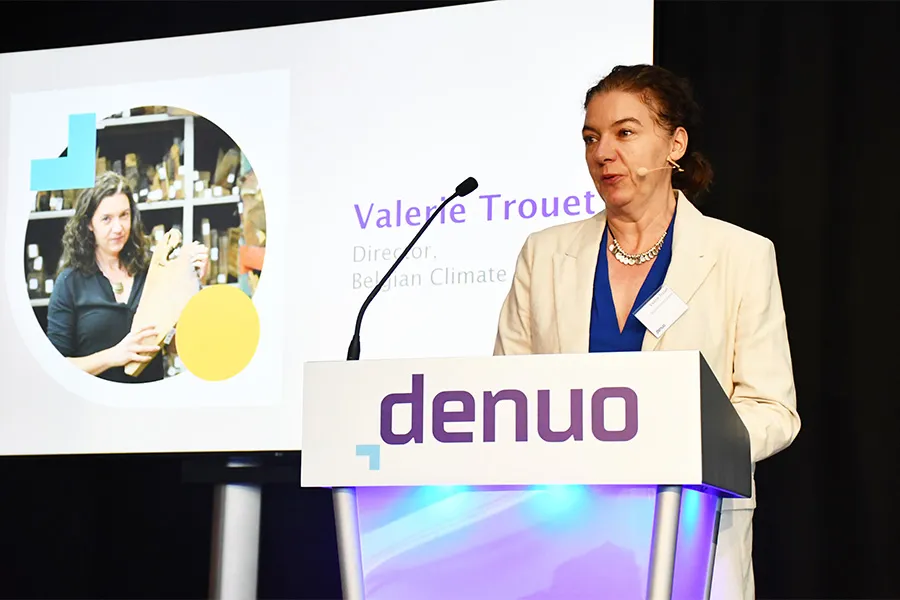
The Climate Event opened with a keynote by Valerie Trouet, scientific director of the brand-new Belgian Climate Centre. As a climate scientist, she was ideally placed to explain why we need to drastically reduce our CO2 emissions. Her message was clear. Humans are responsible for the rapid climate warming we are seeing today. “Every additional degree from now on will be locked into our system for the next 1,000 years. But because we are responsible, we can also determine what happens. And we have the technology, knowledge and capital to take action.”
Climate scientists can look back as far as 800,000 years to study the link between temperature and CO2. To do so, they have to drill 11 km down into the ice layers of Antarctica. Air bubbles in the ice tell the story of how the climate evolved naturally, with average CO2 levels of between 200 and 300 ppm. “Today, we are at 423 ppm, completely uncharted territory.” To find answers about the impact, Trouet and her team look not to ice, but to trees. “Dendrochronology only goes back 2,000 years, but that is more than enough. We can see how human history and the climate have become closely intertwined during this period.”
What climate history can teach us about the fall of Rome
Trouet focused on the fall of Rome and the significant role climate played in the process. “Living trees and archaeological wood tell us a story of successive dry and wet decades at the time. These conditions inevitably affected agricultural productivity and, in turn, society, since most of the population depended on agriculture for a living.” What lessons can we draw from this? “Warming is happening much faster today because of the greenhouse effect. The more CO2 in the atmosphere, the higher the temperatures. The latest IPCC report shows that temperatures rose by 1.1 °C over the past century, an unprecedented increase. What is more, climate change is global in nature. Nowhere in the world can you escape it.”
Building resilience
Humans are entirely responsible for this additional injection of CO2 into the climate system. “That also means we can take our fate into our own hands. The efforts we make over the next ten years will affect what happens over the next 1,000 years. That is an empowering thought. It is up to us to keep global warming below 2 °C.” A magic threshold. “Because this allows us to limit the consequences and damage. It gives us the chance to build resilience. Whether society falls like the Roman Empire or instead gets back on its feet and moves forward has a lot to do with how well we can adapt to these new climatic conditions. Limiting warming to just 1.5 °C would give us that breathing space.”
Question about this story? Ask your question
Keep following this
Get an email when a new story is published. No account needed.
- SubjectDenuo







