












Fire risk in the waste and recycling sector: who will put out the fires?
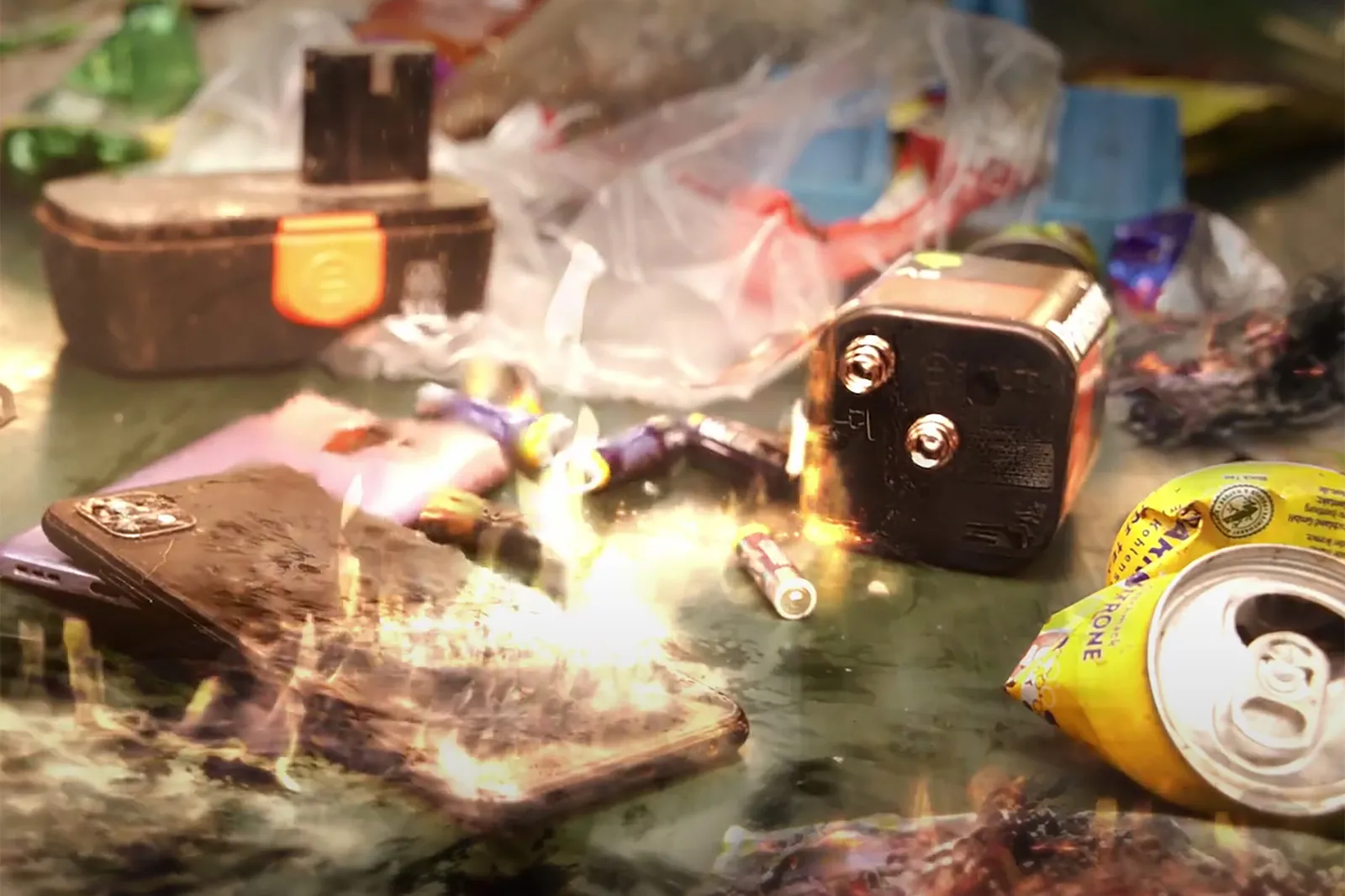
Summer means sunshine and warmth. But in the waste and recycling sector, it is hot all year round. Not because of the temperatures, but because of the growing fire risk posed by incorrectly sorted lithium-ion batteries. A musical greeting card in the paper bin, an electric toothbrush in the residual waste, an e-bike in the metal skip or battery-powered toys in the PMD bag… day after day, workers in our sector are putting their safety at risk, and the problem is only getting worse. What can we do to protect our people, our facilities and the circular economy?
Denuo has been campaigning against this problem for years. Together with our members, partners, fire services, producer responsibility organisations and other stakeholders, we have studied the issue in depth so that the sector can take preventive action. This led, in early 2025, to a set of best practices on fire prevention for our sector. It brings together measures companies can take to protect their staff, prevent or contain fires, and reduce risks to people, the environment and surrounding areas. There is no single miracle solution, but rather a combination of measures: from staff training and installing thermal cameras linked to sprinkler systems, to carefully compartmentalising waste storage areas. This guidance enables our more than 200 members to share experience and demonstrate that the sector is taking responsibility, even as the number of fires in our sector continues to rise. Alongside this guidance, other initiatives are also under way with the regional authorities to reduce fire risks in our sector:
- Collecting fire statistics;
- Awareness campaigns by Denuo, Bebat, Recupel and Fost Plus;.
- Discussions at federal level on product standards, to make products containing batteries safer for our sector.
What about Europe?
The problem does not stop at our national borders. The number of lithium-ion batteries in circulation is growing across Europe, and so is the fire risk. That is why our European umbrella federations, EuRIC, FEAD and FERVER, together with other partners, have issued a call to the European Commission. In a joint letter, they call for, among other things:
- The introduction of a deposit-return system for lithium-ion batteries;
- A ban on unnecessary, high-risk products, such as musical greeting cards, light-up shoes and disposable electronic cigarettes;
- A financial support mechanism for fire prevention and recovery in the waste and recycling sector.
The last of these is particularly crucial to the future of the sector. Belgium already has an extended producer responsibility (EPR) scheme for batteries, under which manufacturers are responsible for collection. But collection alone is no longer enough. Denuo is calling for this responsibility to be extended so that producers also fund prevention and safety initiatives. Only then can we organise battery recycling safely and with the future in mind.
Stronger together for safety and circularity
Denuo and its more than 200 members, active in waste collection, sorting, recycling and processing in Belgium, remain committed to tackling this problem. Our goal is to enable the recycling of high-quality materials as part of a safe circular economy. There is no miracle solution, but there is a range of complementary actions, supported by all players within and beyond our sector.
As a sector, we stand ready. But we cannot do this alone. With targeted investment in prevention, appropriate regulation and financial support, we can work together to ensure a safe circular economy.
Question about this story? Ask your question
Companies in this story
Keep following this
Get an email when a new story is published. No account needed.
- ThemeCircular processing of electronics and batteries
- SubjectDenuo
- CompanyBebat vzw
- CompanyRecupel







