












CO2: from waste to resource
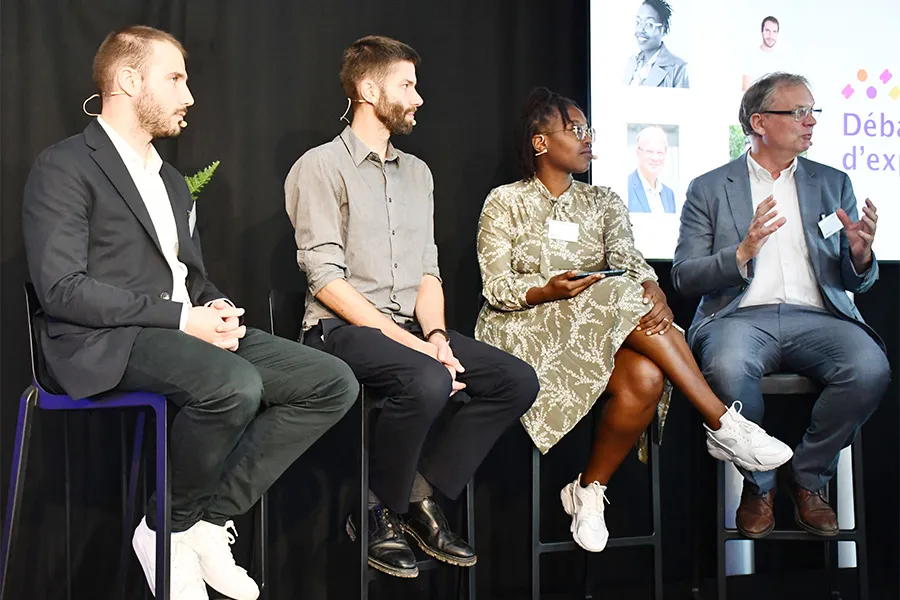
At the Climate event, Denuo wanted to explore further ways for the sector to reduce greenhouse gas emissions, as it had done in its CO2 study for Belgium’s waste and recycling sector. For example, can CO2 be usefully reused? Like so many other material streams, can it become a new resource rather than waste? That was the starting point for a first panel discussion with Baptiste Costa-Marina (business developer & analyst, Fluxys), Ariane Giraneza (climate policy manager, Bellona Europe), Jonas Van Bockhaven (change facilitator, Climate, The Shift) and Marc Van den Bosch (managing director, FEBEG).
Huge efforts will still be needed in the coming years if we are to meet Europe’s targets. By 2030, CO2 and other greenhouse gas emissions must already have been significantly reduced. A target of 40% below 1990 levels was put forward. “2030 is tomorrow,” warns Van den Bosch. “Especially when you consider that obtaining a permit for a wind turbine takes an average of six to eight years. By 2040, we will have to generate three times as much energy ourselves to meet demand and achieve our targets. We are therefore pleased to see so much progress in this area.” The waste sector is also making progress. In the Norwegian Northern Lights project, CO2 released by, among other things, waste incineration will be captured and stored beneath the North Sea. “It is a good example of what the waste and recycling sector can do with its emissions. At the same time, it is part of the solution. Denuo members also have a role to play in finding ways to recover valuable materials from end-of-life renewable energy technologies. Think of wind turbine blades or photovoltaic panels.”
Terminals and pipelines
So what is already happening in Belgium to capture and store CO2? Costa-Marini sees the North Sea as a key hub for such projects. Its depleted gas fields are ideal for storing surplus CO2. “Belgium does not have any of its own, but its central location gives it a natural role as a connector in Europe. It is up to us to help build the infrastructure needed to transport CO2 to those fields.” This will be done in two ways: by pipeline and by ship. It is therefore no surprise that Fluxys has selected the ports of Antwerp and Ghent for its two CO2 storage terminals. “They will be able to store 10 million and 6 million tonnes of CO2 per year respectively. In addition, the pipeline we are building with Equinor will be able to transport 40 million tonnes of CO2 per year. These efforts will enable us to reduce CO2 emissions by 15%.”
Making international cooperation a reality
The key to success in these projects? International cooperation, because pollution knows no borders. That is what Giraneza is calling for: “Governments need to take the lead and set the framework for decarbonising industry, with the EU at the forefront. It must build the pipelines to transport captured CO2 to gas fields. It is more efficient for the EU to take on this role, because we need to establish an entire value chain in the short term.” What can the Belgian government do? “An official consultation body with neighbouring countries to take on this coordinating role would be a step in the right direction. Strangely enough, there is currently no agreement with, for example, the Netherlands to transport our surplus CO2 there.” However, CO2 capture and storage must not come at any cost. “Every tonne of CO2 we can save counts if we are to stay below 1.5 °C, provided it can be put to a sustainable use again. The fizz in cola is too short-lived. The CO2 must remain in a product or activity for a long time,” says Giraneza.
We can no longer afford to wait
For Van Bockhaven, the time to act is now. “We can no longer afford to wait. The IPCC is therefore looking to businesses, as they can often move faster than governments. But the actions we take must be scientifically sound if they are to have sufficient impact. And we have to do it together, both within and beyond the sector, so that we can keep our feelers out for emerging trends.” Industry is making more and more commitments. Van Bockhaven cited the example of a company that felt Belgium’s targets were not ambitious enough. “They saw it as a competitive disadvantage, because they are counting on having enough renewable energy available to reach net zero. I would not have expected that two years ago, but it makes this a particularly exciting time. Something is happening.” The waste sector is also helping to raise the bar. “As the study also points out, it is so important to other companies in helping them reduce their Scope 3 emissions.”
Question about this story? Ask your question
Keep following this
Get an email when a new story is published. No account needed.
- SubjectDenuo







