












Can we find a solution for the 100,000 tonnes of nappy waste in Flanders?
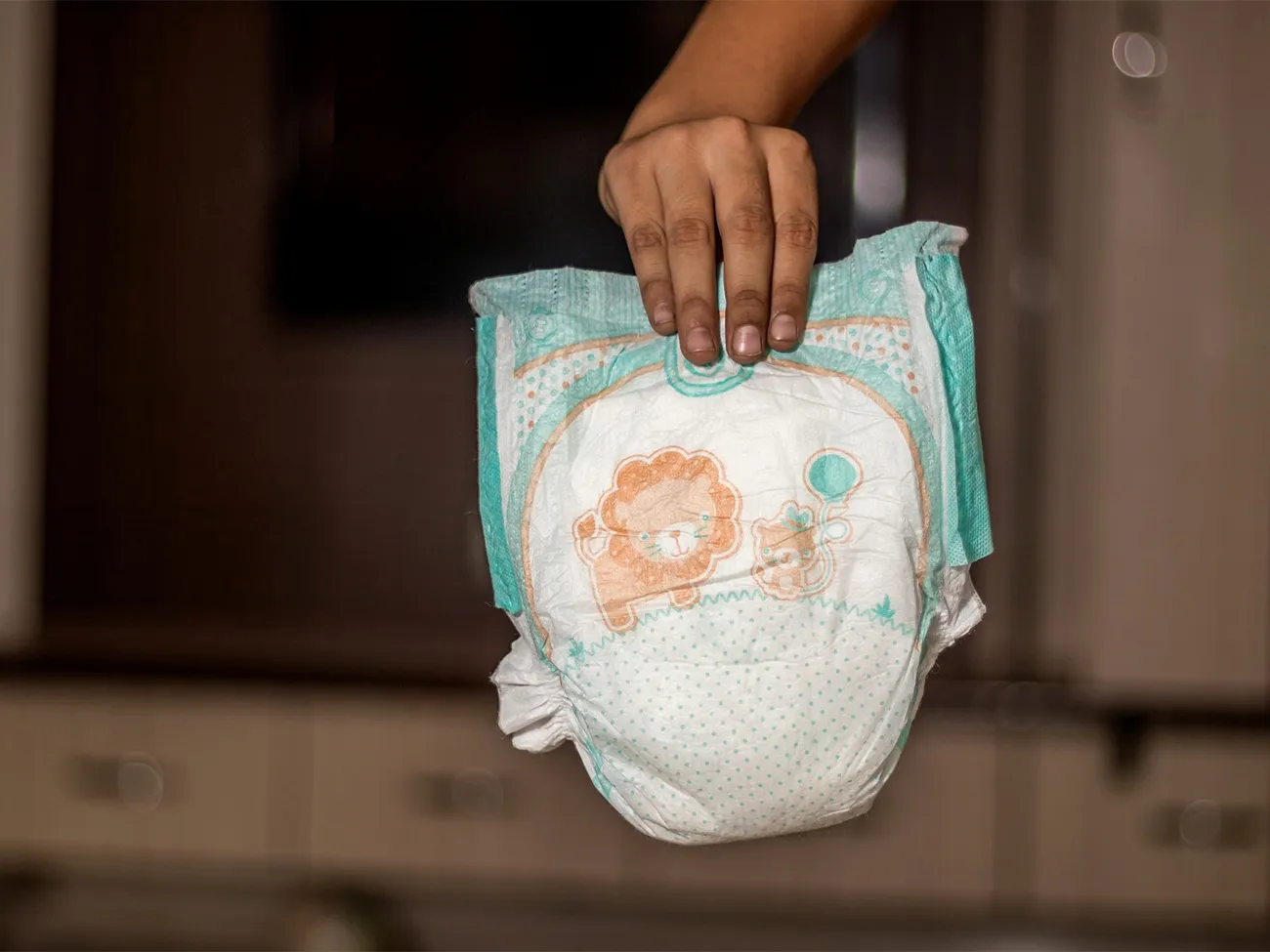
As part of its recovery plan, the Flemish Government is providing investment subsidies to develop Flanders into a recycling hub. One of the priority waste streams on the radar of Flemish Minister for the Environment Zuhal Demir is ‘nappies and incontinence products’. Why this particular waste stream? What are the options? And what specific action is being taken? Here is an overview.
Nappies, incontinence products and other hygiene products currently make up about 11% of our household residual waste. Across Flanders, an estimated 100,000 tonnes of nappy waste ends up in incineration plants each year. As the population ages, this volume is expected to increase further in the coming years.
Under the extended producer responsibility scheme, VLAREMA requires all producers of disposable nappies to submit a collective plan to the OVAM, setting out their commitments on ecodesign, reuse, recovery, recycling and awareness-raising.
This obligation remained in the background for many years. But with the circular economy in mind, the OVAM has taken up the challenge in recent years and is working with nappy producers, the recycling sector (Denuo), retailers (Comeos) and the knowledge centre VKC-Centexbel on a number of targets to make nappies more sustainable.
The OVAM has taken the following specific actions.
Study of the eco-efficiency of disposable and reusable nappies
The composition of disposable nappies has changed considerably over the years. The use of SAPs (Super Absorbent Polymers), for example, has made nappies much thinner. This has greatly reduced their volume, bringing environmental benefits. Further improvements in the eco-efficiency of nappies are held back to some extent because all major innovations in the sector are patented and therefore not adopted on a larger scale, representing missed opportunities.
The OVAM also examined, from a sustainability perspective, which type of nappy has the smallest environmental footprint: disposable or reusable. Given the large number of variables, such as age at which children become toilet-trained, wash-water temperature, and types of washing machines and tumble dryers, it proved very difficult to reach a clear-cut conclusion. Moreover, while a study of this kind (Life Cycle Analysis) offers valuable insight from a purely environmental perspective, it does not answer consumers’ questions about functionality and ease of use, which play a major role in nappy use.
Research into the recycling potential of disposable nappies
Nappies and other incontinence products contain many different fractions: fluff pulp, SAPs (Super Absorbent Polymers), PE (polyethylene), PP (polypropylene) and non-wovens. This mixture of materials makes nappies difficult to dismantle and recycle.
However, the biggest barrier to recycling nappies and incontinence products is the possible presence of medicine residues and pathogens, and the risk of liability.
Nevertheless, nappies are already being recycled in the Netherlands, Italy and Japan. These involve three very different processes that are still relatively new and need further development:
- The Elsinga project in the Netherlands shreds, mixes and heats nappies, processing them into biogas, compost, fertiliser and recycled plastics. Implementing this process requires close cooperation with an incineration plant and a wastewater treatment plant.
- Italy’s Fater is a joint venture between Angelini and Procter & Gamble, two manufacturers of hygiene products. The end products of Fater’s recycling process are sterilised recycled plastics used to make bottle caps, clothes pegs, nappy bins and school furniture. Sterilised and recycled SAPs (Super Absorbent Polymers) are used to make absorbent products, for example to tackle flooding. Sterilised and recycled cellulose is used to make paper products, building materials and viscose.
- Unicharm’s recycling process in Japan is still in its infancy and is not yet operational at industrial scale. The aim is to process used nappies through ozonation and dehydration, then reuse them in the production of new nappies.
Defining end-of-waste criteria
End-of-waste criteria are needed to ensure the safe use of all secondary raw materials recovered from nappies. The OVAM has commissioned VITO to carry out a study on this.
The OVAM’s ambition is not only to incorporate these end-of-waste criteria into Flemish legislation (Vlarema 9), but also to work with the other regions and other EU member states to extend them across Belgium and, ultimately, Europe.
Comparing different logistics scenarios for collecting disposable nappies
Efficient logistics are crucial to the success of a recycling process. RDC Environment is seeking to answer questions for the OVAM such as which collection scenario is best for society, whether the separate collection of nappies makes environmental and economic sense, and whether the quality of the waste stream will be good enough for recycling.
We are at the start of the transition to a circular Flanders. Making that transition requires solutions to recover as many materials as possible and keep them out of residual waste. A bulky waste stream such as nappies therefore calls for urgent action, and all the parties involved are eagerly awaiting the results of the OVAM’s action plan.
Een zakelijke vraag aan OVAM? Get in touch
Companies in this story

Keep following this
Get an email when a new story is published. No account needed.
- ThemeCircular business under changing regulations
- SubjectDenuo
- CompanyOVAM







