












Can there be a circular economy without incineration plants or landfill sites?
Year after year, technological advances, awareness campaigns and new regulatory initiatives create new opportunities for material recovery. This progress is fuelling sky-high ambitions to transform a linear economy into a circular one. And there seems to be little room in it for incineration plants and landfill sites. That is a mistake.
When the European Commission launched its Green Deal, it assigned an important role to the Circular Economy Action Plan. In its 2019-2024 coalition agreement, Flanders expressed its ambition to make the region Europe’s leading recycling hub. Brussels had already drawn up a Regional Circular Economy Plan in 2016, while the Walloon Region presented a Plan Déchets-Ressources in 2018. As the Belgian federation for the waste and recycling sector, we fully support these ambitions for sustainable materials use. We are ready to work with everyone, government, civil society and businesses, to meet these challenges.
The final stage of recycling
At the same time, we want to highlight a perhaps less ‘sexy’ part of the materials cycle: final treatment. At some point in every material stream, some of the material reaches an ‘end point’, because not everything can be recycled indefinitely, at least not today. What is more, recycling processes themselves also produce residues for which there are, as yet, no useful applications. We need a good solution for these materials too. Anaerobic digestion or incineration can provide one, enabling us to recover value from non-recyclable streams in the form of gas, steam, electricity or fertiliser.
Final treatment capacity remains necessary
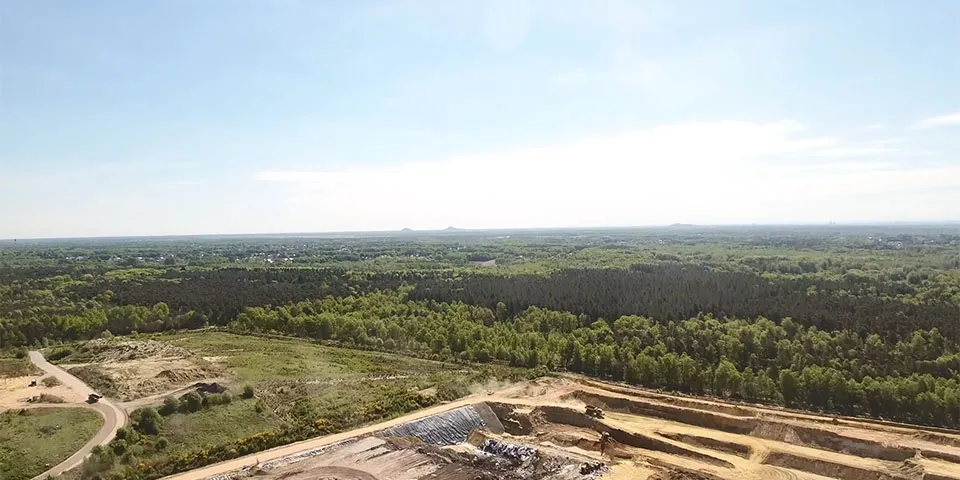
Some materials cannot even be incinerated to recover energy. These include contaminated soil, asbestos-containing products and certain types of plastic and glass. Landfill is the only solution for these residues. They can be stored there in a controlled and safe manner, either permanently or temporarily, pending new technologies that could allow them to be recovered. This is a realistic prospect. Several waste and recycling companies are exploring the potential of Enhanced Landfill Mining (ELFM), which involves safely excavating materials that were once landfilled so they can be recycled or converted into energy. It is a promising technique with many benefits: it will further reduce the need to import raw materials, making our region less dependent on other countries and cutting the CO2 emissions associated with imports. In short, even if we move towards a fully circular economy, final treatment capacity will still be needed.
Limit the overall environmental footprint
It would also be good to look at the entire life cycle of products, from concept through to possible final treatment, to determine their true environmental footprint. Imposing very strict regional or national standards that lead to final treatment taking place abroad under less favourable environmental conditions would not be a good example of corporate social responsibility. It harms people, the planet and profit: economic activity moves to countries where operating is ‘cheaper’ and environmental requirements are less stringent, while the economic benefits are lost to our country. That is why we are calling for sufficient capacity for final treatment, preferably in locations where it offers the best performance in terms of energy, CO2 emissions and capacity. After all, final treatment will remain an essential final stage of a strong circular economy for a long time to come.
Question about this story? Ask your question
Keep following this
Get an email when a new story is published. No account needed.
- ThemeCircular business under changing regulations
- SubjectDenuo







