












“Brussels wants to halve greenhouse gas emissions by 2030”
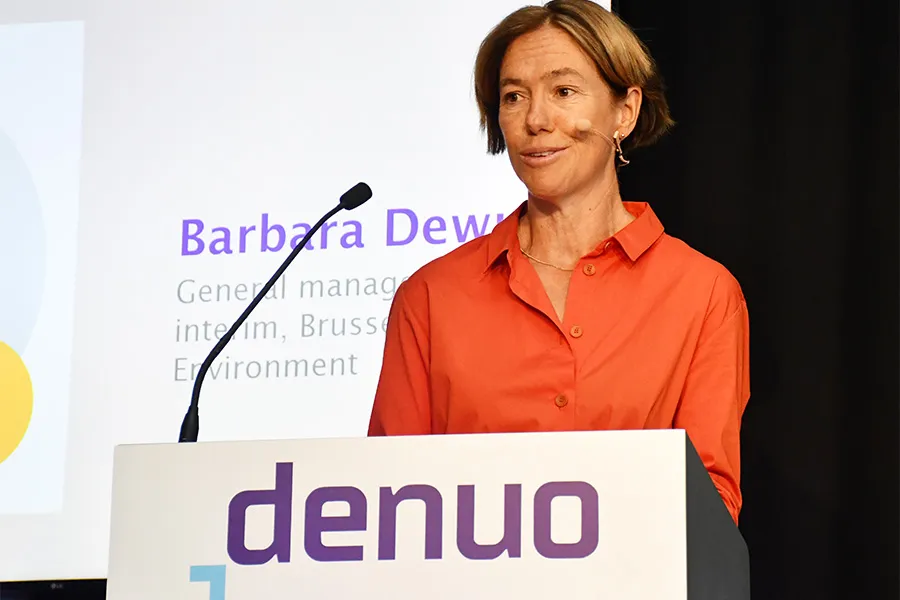
The waste and recycling sector is an essential link in bringing about the transition to a circular economy. This was also the message confirmed by keynote speaker Barbara Dewulf, acting director-general of Leefmilieu Brussel. Her conclusion was that low-carbon transport and more efficient waste processing in a densely populated urban environment are a shared responsibility for all stakeholders.
Dewulf opened with the good news. “Belgium has a particularly excellent waste and recycling sector. The Belgian waste and recycling sector ranks among the top 5 countries in Europe with the lowest CO2 emissions per capita. But at the same time, we are already feeling the first effects of climate change here. So we must continue our efforts across all sectors.” Brussels is doing so with its new Brussels Air-Climate-Energy Plan, which calls for action at three levels. “Specifically, by 2030 we want to reduce direct greenhouse gas emissions by at least 47% compared with 2005, and then achieve climate neutrality by 2050.”
Calculating and tackling indirect emissions
But the biggest problem in Brussels is indirect emissions. “Only 17% are direct emissions, because we do not produce most raw materials ourselves, but import them. If we want to achieve these ambitions, we will also have to learn to consume better and less, and make better use of our raw materials.” Leefmilieu Brussel is currently working on a calculation model to identify the most effective measures, so that indirect emissions can follow a similar trajectory.
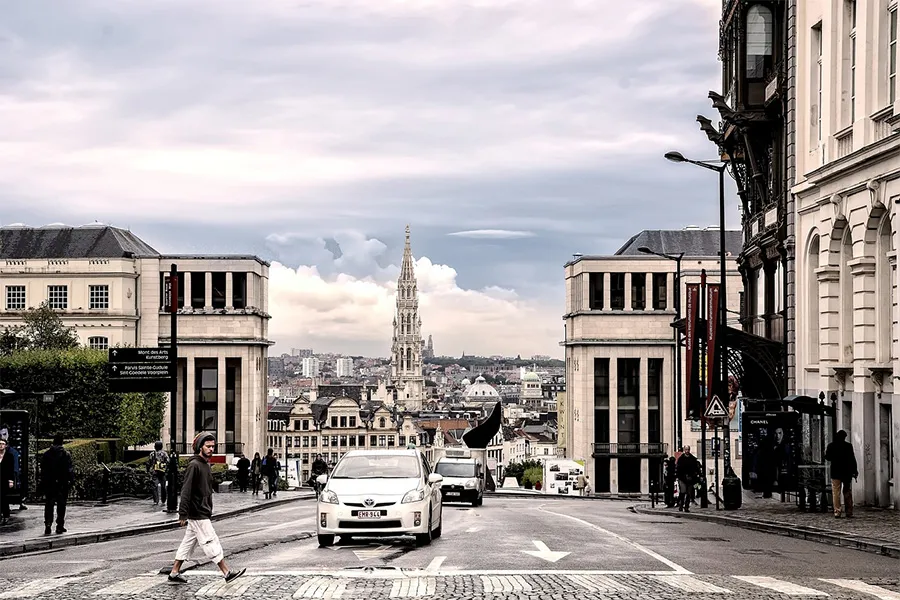
Less waste sent to incineration plants
To tackle direct emissions, Brussels is focusing mainly on its buildings, transport and waste. Waste incineration, for example, accounts for 8% of Brussels’ emissions. “The percentage of waste sent to the incineration plant must fall by 30% to avoid CO2 emissions. At present, this amounts to 330 million tonnes of household waste and 210 million tonnes of commercial residual waste, equivalent to the annual CO2 emissions of 180,000 cars.” Leefmilieu Brussel’s plan focuses primarily on commercial residual waste. “At present, only 35% of the waste produced by businesses is recycled. This must rise to at least 70% in the Brussels-Capital Region by 2030.”
Economy and ecology go hand in hand
An ambitious support programme has therefore been developed, with assistance for professional sectors. “We cannot do it alone. Support is needed. To focus on prevention. To improve the quality of sorting. To promote reuse. To achieve more extensive producer responsibility.” It is also clear that the economy and ecology will go hand in hand in the capital in the coming years. “The Shifting Economy plan includes various actions to create a new economy based on the sustainable management of raw materials, better access to waste streams and local production.” The various Brussels administrations will introduce support measures to channel the challenges of a circular economy and waste prevention towards businesses taking part in the Region’s economic transition, which look beyond financial objectives alone.”
Waste management adapted to an urban context
Leefmilieu Brussel wants to use various incentives to support this. “We want to identify and remove the barriers to the further development of a circular economy.” Waste management is also part of this evolution. “The expansion of the blue bag scheme is a step in the right direction. We are continuing to examine the separate collection of different streams. Pilot projects are also under way to adjust the frequency of collection schedules. And we are looking at how to recover raw materials in smaller volumes. We are also appealing to Denuo members to help us deliver this ambitious waste policy, adapted to a densely populated urban environment. It is a matter of continuing to optimise things together to achieve our sustainable, circular objectives.”
Question about this story? Ask your question
Keep following this
Get an email when a new story is published. No account needed.
- ThemeCircular business under changing regulations
- SubjectDenuo







