












‘We can now make high-grade oil from mattress foam’
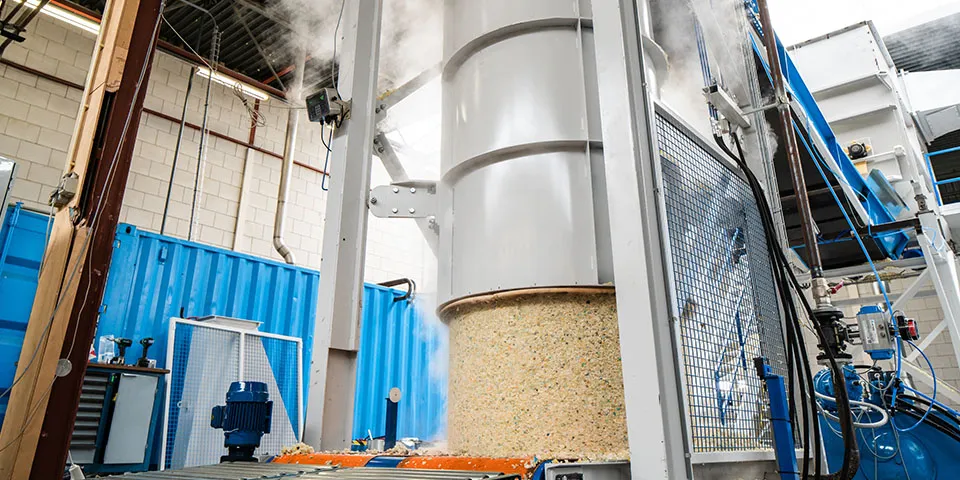
Recycling company RetourMatras has been turning discarded mattresses into usable materials for years. Soon, it will add a new material to the mix: the company will process the foam in those mattresses into the high-grade oil from which it was originally made. RetourMatras developed the specialist equipment it uses for this with support from an RVO.nl grant scheme. ‘Everything we do, we do for the environment.’
Retourmatras
RetourMatras currently converts 95 per cent of the material in old mattresses into usable raw materials. ‘This saves around 40 kilos of CO2 emissions per mattress,’ says Nanne Fioole, the company’s director and founder. ‘That amounts to a saving of almost 40 million kilos of CO2 emissions a year, based on one million recycled mattresses across our three factories. Once we start chemically processing the foam from the mattresses, the savings will be much higher.’
Processing almost everything
RetourMatras started recycling mattresses ten years ago. Until then, most discarded mattresses ended up in incinerators. ‘Most of the CO2 savings come from collecting the mattresses in the first place,’ says Fioole. ‘But that is just the starting point for us. We will soon be processing 2,000 m3 of old mattresses a day. We can’t turn just 5 per cent of the mattresses that arrive here into usable raw materials.’
RetourMatras strips the mattresses using specially developed equipment. It cuts away the mattress fabric. ‘Our employees then remove the metal springs by hand. That leaves us with the foam, which can be latex or polyurethane foam.’ All the mattress components are collected separately and recycled. The company collects the metal for the metal industry. It compresses the fabric into bales for reuse in the textile industry. The latex and polyurethane foam are also cut up and bundled into transport-ready bales. Fioole says: ‘We ship some of these latex and polyurethane foam bales abroad, but process as much as possible ourselves. We shred them and press them together with a binder and hot steam. This also kills all the bacteria. We call the new end product bonded foam.’
Finding a solution together
‘Bonded foam can be used, among other things, as insulation material or underfloor cushioning,’ says Fioole. ‘But we have much more foam than is needed to meet demand for bonded foam. Shipping the foam bales also generates quite a lot of CO2 emissions. Everything we do as a company must contribute to reducing CO2 emissions. So we started looking for other ways to process the foam. This might also help reduce the surplus.’
Eventually, RetourMatras joined forces with several partners. In a joint project, they found a chemical way to process the polyurethane in the foam into a special polyether polyol, the viscous material used to make the foam. Fioole says: ‘The market for this is enormous, because polyether polyol is an important chemical building block for many other foam products, and for hard plastics, for example.’ Producing ‘second-hand’ polyol generates 35 per cent fewer CO2 emissions than conventional production. ‘And we have now developed a circular lifecycle for mattresses!’
To demonstrate the technology, RetourMatras received a Demonstration of Energy and Climate Innovation (DEI+) grant from the Netherlands Enterprise Agency (RVO.nl). The funding is being used to invest in machinery. ‘That €1.2 million gave us just the extra push we needed to move forward,’ says Fioole. ‘A project like this is not without risk. If it didn’t work, we would have lost our million-euro investment and would have had to look for an alternative.’ RetourMatras is now testing the chemical processing method at its factory in Lelystad. Fioole says: ‘If it proves successful, we can use it at other sites too.’
Learning a lot from each other
Around 1.5 million mattresses are discarded in the Netherlands every year. RetourMatras wants to help ensure that they are all recycled. ‘We are expanding rapidly. We are working on plans for a fourth processing plant in the Netherlands, which will keep transport distances as short as possible. We intend to draw on RVO.nl’s expertise and grants to build the plant. Once it is up and running, we will be able to process one million mattresses a year.’
The circular processing of mattresses by the relatively small RetourMatras attracted the attention of retail giant IKEA and recycling company Renewi. ‘IKEA wants to develop everything in a circular way,’ says Fioole. ‘It is a really big company. The fact that they come to us for the technology behind mattress recycling is a great compliment.’ IKEA and Renewi have been co-shareholders in RetourMatras since June 2019. ‘They leave the management to us, but they share their extensive knowledge and give us good advice. We learn a great deal from each other. The support and expertise of RVO.nl, IKEA and Renewi enable us to keep growing and researching. And that is crucial to the development of the circular economy.’
Question about this story? Ask your question
Keep following this
Get an email when a new story is published. No account needed.
- ThemeMaking use of textiles and other waste streams
- SubjectBRBS Recycling






