












The Quality Assurance (Building) Act is also on its way
Coming into force on 1 January 2024. Initially, it will apply only to new-build projects, but from 1 July 2024 it will also cover renovation work. This article explains the Wkb, its relationship with the Environment and Planning Act and the key points for suppliers to consider. A KOMO certificate helps.
The Wkb aims to improve the quality of buildings in the Netherlands and strengthen the position of construction consumers. To this end, the Wkb introduces quality assurance inspectors. These are private-sector inspectors who assess the quality of buildings against statutory technical requirements. Quality assurance inspectors oversee the entire process, from the drawing board through to construction. Oversight is shifting from public to private parties. The municipality nevertheless retains the authority to take enforcement action, with the same powers as before.
Quality assurance plan
The quality assurance inspector draws up a quality assurance plan setting out how the technical building requirements of the Environment and Planning Act (the Buildings and Living Environment Decree, Bbl) will be met and how (financial) risks will be covered. It also sets out inspection stages and checkpoints. All relevant information is ultimately included in the completion notification. If insurmountable defects are identified, the quality assurance inspector must flag them and report them to the competent authority (Building and Housing Supervision). The builder must also inform the client whether and how they are protected against risks that may arise during and after construction as a result of late payment or the builder’s bankruptcy.
Consequence classes
The requirement to appoint a private quality assurance inspector applies to buildings requiring a permit and is being phased in by consequence class, starting with consequence class 1. This covers buildings where the consequences of failing to meet the technical building requirements are limited, such as homes, houseboats and holiday accommodation. The VNG website provides useful examples of the consequence classes. The Act will later also be extended to consequence classes 2 and 3, categories in which failure to meet the technical building requirements carries a real or substantial risk of personal consequences. Examples include historic buildings, metro stations and hospitals.
Main contractor’s liability
An amendment to the Housing Act stipulates that, for buildings requiring a permit, quality assurance inspectors must use a quality assurance instrument approved by the TloKB (Admission Organisation for Quality Assurance in Construction), and that the instrument must be used by a quality assurance inspector approved to use it. The KOMO KiK instrument, discussed below, has been approved.
The main contractor is liable and must be able to demonstrate, for up to 20 years after handover, that the required quality has been delivered. The main contractor is fully responsible and liable for everything it builds. This is provided for by an amendment to the Civil Code (BW) and also applies to buildings that do not require a permit on technical grounds. The Wkb does not govern agreements with subcontractors.
Relationship with the Environment and Planning Act
The Wkb and the Environment and Planning Act have deliberately been brought into force at the same time. Under the Environment and Planning Act, the permitting process is split into two parts: a spatial planning component and a technical building component. This is also known as ‘the split’. For the spatial planning component, the building plan is assessed against the environmental plan (Article 5.1, first paragraph, of the Environment and Planning Act). For the technical building component, the quality assurance inspector assesses it against the Buildings and Living Environment Decree, part of the Environment and Planning Act (Article 5.1, second paragraph, of the Environment and Planning Act). This sets out the rules for the construction, use and demolition of buildings. If the two Acts do not come into force simultaneously, it will be difficult to ensure compliance with building regulations.
Evidence required, including for infrastructure projects
The civil engineering sector appears not to realise sufficiently that the Quality Assurance (Building) Act (Wkb) also applies to it. In the civil engineering sector, the following construction projects must comply with the Wkb: all construction and renovation projects, other than buildings, up to 20 m high that are wholly or partly above ground. This includes, for example, a sheet-pile wall made of concrete blocks, a weir, lock, aqueduct, embankment or small cycle tunnel. Roads, on the other hand, do not fall under the Wkb based on these criteria.
Builder’s liability extends to suppliers
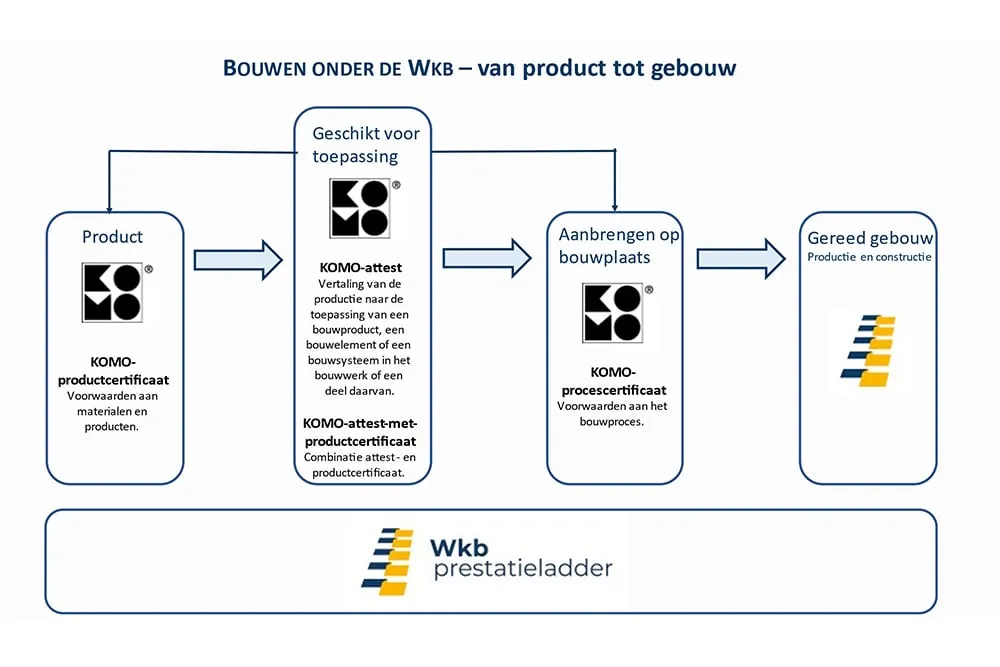
The builder is liable for all defects not recorded in the handover report, and therefore has a significant responsibility. They must hand the client a consumer file demonstrating that the required quality has been delivered. Many construction defects result from the incorrect use of materials and construction products. Builders will therefore choose to use certified raw materials, construction products and construction processes as much as possible. To minimise risk, the Wkb may also mean that builders and clients place greater emphasis on certainty than they have to date. Liability will not stop with the builder, but will also extend down the supply chain to the supplier. This is a particular point to consider for suppliers of secondary raw materials, as producers and clients sometimes perceive these as carrying additional risks. Suppliers can reduce the risks by demonstrating the quality of their products and processes with a certificate. CE marking with a declaration of performance is not sufficient in this context. It indicates the quality of the product, but not its suitability for the intended use. KOMO certification links a construction product’s suitability for a particular use to strict conditions of application and assesses whether the installer has complied with them. This also reduces risks.
Certification plays a central role
Because Stichting KOMO anticipated the Wkb early on, products and construction processes bearing the KOMO quality mark demonstrate that construction is being carried out properly and provide evidence that the right products and working methods have been used. This can lower the cost of the quality assurance inspector, as fewer or no checks may be needed on site. In addition, the KOMO quality assurance instrument (KiK) has been developed to support builders. This instrument has been approved by the TloKB and includes detailed documentation and a risk analysis with control measures to reduce risks. The KiK tool also generates the mandatory files for the competent authority and the consumer. It is aimed primarily at builders and clients. Suppliers that already have their internal quality assurance in good order will not need to change much. In practical terms, they can be confident about the future if they supply products with a KOMO certificate, such as recycling aggregates certified under BRL 2506 part 1. As liability and responsibility under the Wkb extend down the supply chain, this provides recycling companies with additional certainty, helping keep the risks posed by the Wkb manageable.
This article was produced in collaboration with Stichting KOMO, see www.komo.nl
Question about this story? Ask your question
Keep following this
Get an email when a new story is published. No account needed.
- SubjectBRBS Recycling






