












Nitrogen dossier continues to concern stakeholders
It will not have escaped anyone’s notice that the courts have recently issued several important rulings on the already highly complex nitrogen dossier. In this article, I will discuss the main implications of these rulings for businesses. I will also look at some possible solutions, using the flowchart we have drawn up.
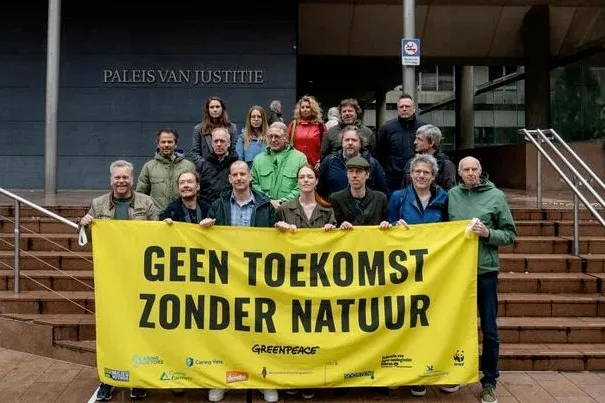
On 22 January 2025, the District Court of The Hague ruled [1] in the case brought by Greenpeace against the state. The case can be compared with the Urgenda climate case in 2015 and the case brought by milieudefensie against Shell. In each case, the demand is that greater efforts be made to meet legally agreed targets. In the Greenpeace case, the court ruled that the state must take further measures to ensure that, by 31 December 2030, nitrogen deposition is below the threshold value across 50% of the area of nitrogen-sensitive nature. This is the so-called ‘critical deposition value’ (KDW), which has been determined for all protected habitat areas.
The target was introduced on 1 July 2021 through the Nitrogen Reduction and Nature Improvement Act and is now part of the Environment and Planning Act. It is a results-based environmental quality standard (nitrogen target), and the law requires a nitrogen reduction and nature improvement programme to be drawn up to achieve it.
NLPG
A striking detail in the ruling is that the court found that work on the programme had been under way since the law was introduced, and that the national government and provinces had been fully engaged in the National Programme for Rural Areas (NLPG). More than €24 billion had been made available for this. The court notes that the current government has scrapped the programme without putting any other concrete plans in its place.
The budget has also been cut to just €5 billion. This is a step backwards, the court said, at a time when additional measures are needed. Although this ruling does not have direct, specific consequences for individual businesses, it does show that concrete policy is needed to demonstrate how the targets will be achieved. This will also become clear below when we look at the consequences of the other very recent rulings.
Rendac and Amer power station rulings
On 18 December 2024, the Council of State issued two important rulings [2] with immediate consequences for projects. As with the landmark PAS ruling (Programmatic Approach to Nitrogen) in 2019, the rulings have retroactive effect from 1 January 2020. This means that many projects now lack a nature permit. Before turning to the immediate consequences, I will first discuss the three main changes. These concern the status of internal netting, the scope of the reference situation, and the possibility of using existing nitrogen rights.
Internal netting
Since 1 January 2020, it had been possible to carry out projects without a nature permit by applying what is known as internal netting. Internal netting simply means offsetting the nitrogen deposition from an activity (a business) against the deposition from a new or modified activity at the same location. This approach is widely used, as it is reasonable to establish that some form of nitrogen emissions had already been authorised at the site where a project is being carried out. To enable the projects to proceed, a difference calculation was performed using the Aerius calculator. If it showed no additional nitrogen deposition, no nature permit was required. Only an environmental permit for the project was then applied for.
Environmental permit
The Council of State has now ruled, partly in response to a number of judgments by the European Court of Justice, that internal netting is a mitigating measure. The law stipulates that a provincial nature permit is required when mitigating measures are used. Many projects permitted after 1 January 2020 therefore now lack a nature permit, formally known as an ‘Environmental Permit for a Natura 2000 activity’. The ruling confirms that internal netting is still allowed, so applying for the permit retrospectively would seem logical. This is possible in principle, but the court has attached several conditions, restricting the options, including for permits already granted. These conditions relate to the assumptions used for the reference situation and the additionality requirement. These restrictions apply only where no nature permit has been granted for the activity.
The reference situation
Internal netting requires a reference situation. In short, this means that nitrogen emissions from an activity were authorised before the Natura 2000 areas were designated. Previously, the permitted situation could be used for internal netting, regardless of whether the activity was still actually taking place. The Council of State has approved this approach in several rulings. In its rulings of 18 December 2024, the Administrative Jurisdiction Division revisited the issue. The permitted situation can no longer be used as the basis: it must also have been physically realised and must not have been permanently discontinued. This means that projects have used an overly generous reference situation for netting, which, with today’s knowledge, could probably not be authorised.
Additionality requirement
The additionality requirement is the biggest short-term obstacle to granting permits. Additionality means that, when a permit is granted, it must be established whether the existing nitrogen-emitting activity would in any case have to be discontinued to restore the condition of nature. This makes national and provincial policy relevant, as it sets out the measures to be taken to meet the nitrogen targets in the law (see the Greenpeace case). The government’s decision to scrap its previous policy without replacing it with new measures means there is no clarity on what action will be taken, and therefore no clarity on the additionality requirement. Previous rulings show that a permit involving netting cannot be granted unless it has been established that discontinuing the activity is necessary for nature. It is this part of the ruling that has led several provinces to suspend all permit decisions for the time being.
What can be done?
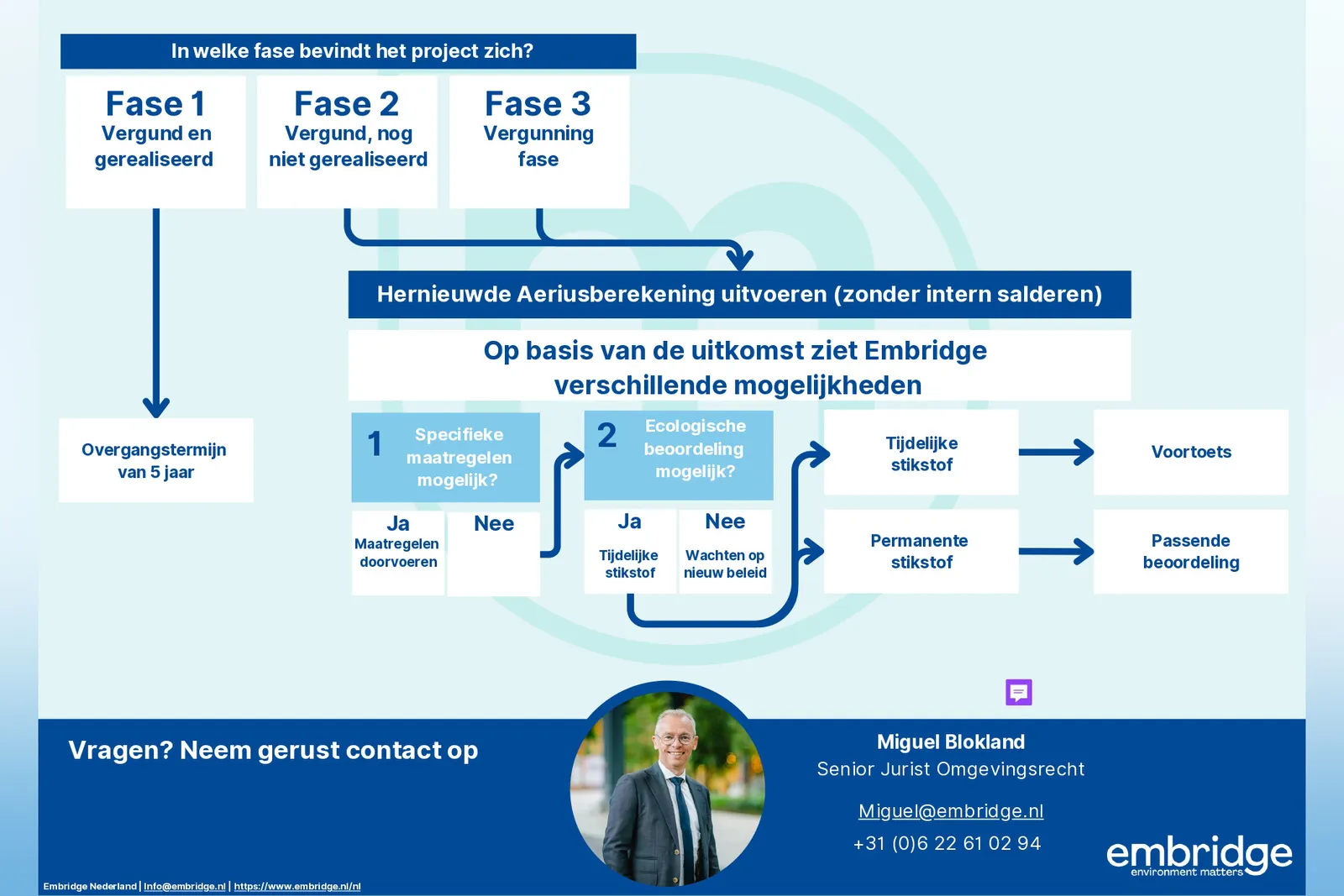
At Embridge, we always try to find solutions. The first step is to establish what stage the project has reached. We distinguish three stages (see also the flowchart):
1. The project has been permitted and completed.
These projects are covered by a five-year transitional period. A permit must be granted for them within that time. During the five-year period, the authorities do not have to take enforcement action. These projects are therefore not the highest priority.
2. The project has been permitted but not yet completed.
We believe these projects risk receiving a letter from the province stating that the nature permit is missing and that work must not begin until the permit has been granted.
3. The project is still at the permitting stage.
For projects at stages 2 and 3, the internal netting approach used should be reviewed as soon as possible. This starts with a new Aerius calculation without internal netting. Decisions must then be made in consultation with the project proponents, based on the results. We see three options:
- Can project-specific measures be taken to ensure that Aerius calculates no additional deposition > 0.00 mol/ha/yr?
This could include electrifying components. If these measures are not legally required, there is some debate about whether they should also be regarded as mitigating measures. If so, the project would still require a permit. However, the likelihood of this being raised is low. - Is it possible to carry out an ecological assessment of nitrogen deposition as part of a preliminary assessment?
Since the Porthos ruling in November 2022, it has been established that an ecological assessment can be carried out for temporary nitrogen deposition. Such an assessment may also be possible for permanent nitrogen deposition. This depends on the level of nitrogen deposition and the nature areas affected. Not all nature is overloaded. In many cases, projects did not use this method because internal netting was much simpler. There are, however, situations in which this method can be applied. - Can the preliminary assessment prepared for internal netting, often little more than a difference calculation, be used to produce an appropriate assessment for a permit application?
In this case, the reference situation must be properly substantiated and the additionality requirement must be justified. If internal netting results in an overall reduction in nitrogen, this may help. This will need to be clearly demonstrated.
Conclusion
It is important to examine the options carefully. Preparing an ecological assessment generally takes an ecologist several days. For the many permit applications submitted before the Environment and Planning Act came into force, the building/environmental permit process and the nature permit process should be separated. The application already submitted can then be granted without the nature component. A separate permit for the nature component can subsequently be applied for under the Environment and Planning Act.

Question about this story? Ask your question
Keep following this
Get an email when a new story is published. No account needed.
- SubjectBRBS Recycling






