












Masonry rubble can be used in the brickmaking process without separation
Test by Limburgse Mineraalbrekerij and Steenfabriek Vogelensangh
The energy consumption (and CO2 emissions) of the brick industry, along with the circularity of its products, are both highly important. This article looks at the results of a large-scale test in which masonry construction waste was used as a substitute for clay, achieving both of these objectives in one go.
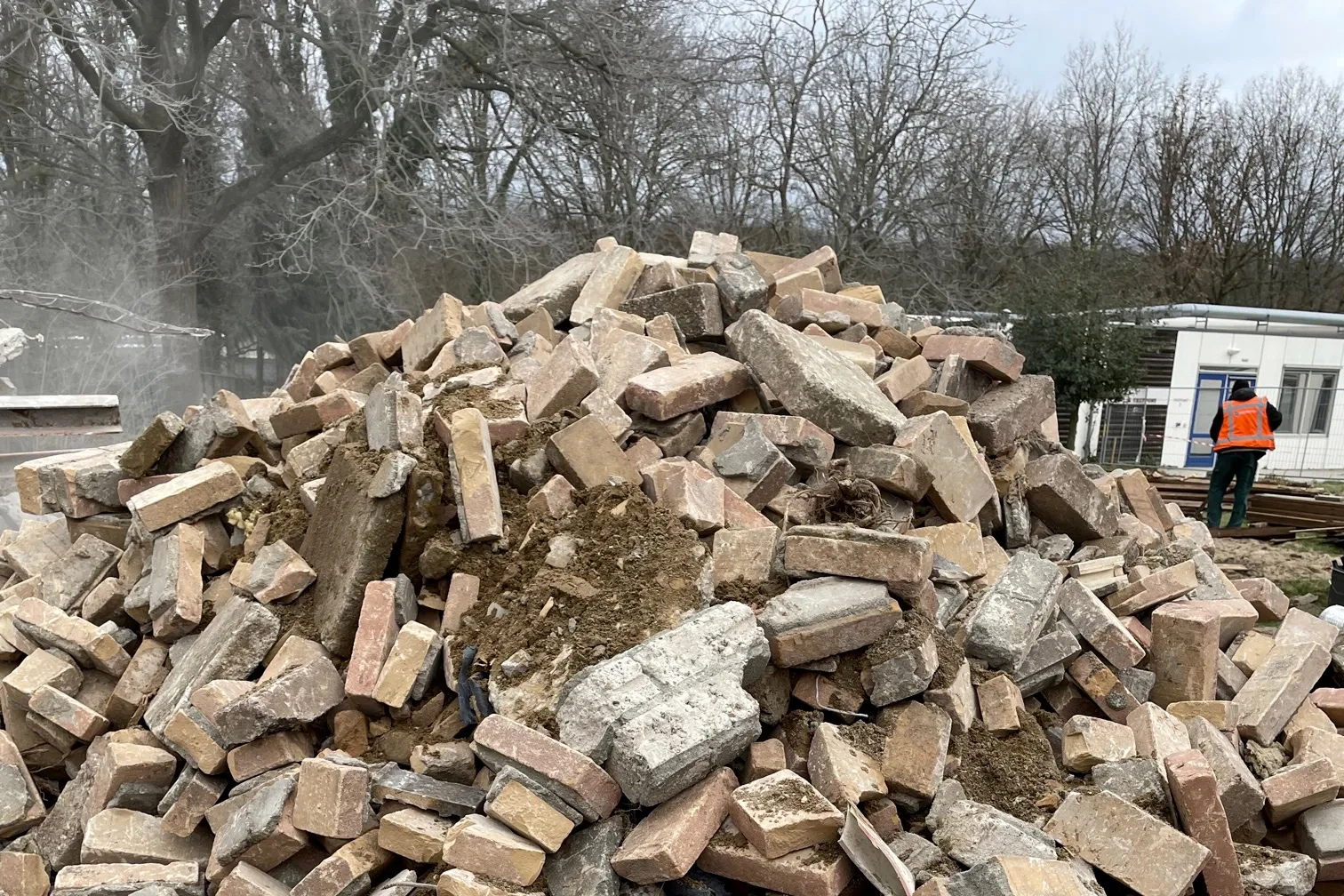
Using masonry rubble not only supports circularity, but has also proved to offer significant energy savings. Until recently, using masonry rubble in the brickmaking process required the mortar to be separated from the bricks, because mortar can adversely affect the process and the quality of the bricks. A recent study conducted through a collaboration between Limburgse Mineraalbrekerij (LMB) and Steenfabriek Vogelensangh found that brick masonry rubble (bmp) can be used directly in the brickmaking process, without removing the mortar, provided it is ground to the correct particle size and the existing brickmaking process is adapted to this new raw material.
Positive results
The study showed that the necessary adjustments to both crushing and brick production can be made within the existing plant setup. This means that no costly modifications or new or different installations are required. However, the correct particle size distribution is important, together with the choice and dosage of clay. An earlier phase of the study found that up to 60% (m/m) ground bmp can be added to clay to produce high-quality bricks. On the strength of these positive results, it was decided to carry out a larger-scale test with two objectives: to establish whether any adjustments are needed when scaling up production, and to obtain reliable process data. The latter is also important for determining the savings in energy consumption and CO2 emissions. The study was carried out partly at the two companies and partly at engineering consultancy IBR, which also coordinated the work. Process measurements were conducted by TCKI in Velp.
Crushing and screening
The process naturally starts with the demolition of buildings. It is important to selectively demolish brick masonry walls to minimise contamination from non-brick masonry. To obtain the required bmp, the team contacted Bloem, which then supplied around 200 tonnes of material to LMB for the initial tests at both LMB and Vogelensangh. Drawing on its experience from the previous study, LMB adapted its process for this test. As a result, pieces up to 40 cm can now be processed directly in its plant, without the need for pre-crushing. Crushing is intended not only to make the masonry rubble manageable in the brickmaking process, but also to achieve the required particle size distribution, ensuring that the mixture of ground bmp and added clay has the right workability.
Optimisation
Processing these larger quantities of bmp enabled LMB to further optimise its grinding and screening process under full production conditions, and gain a clear understanding of the required approach to scaling up production to full scale.
Once ground, these and other batches of bmp were transported by lorry to Steenfabriek Vogelensangh. The test also showed that logistical coordination of transport, storage capacity at the brickworks, and the use of wheel loaders and cranes are important aspects of establishing the entire supply chain.
Brick production
After the ground bmp, supplied to specification, had been transported to the designated storage area, a number of larger-scale tests were carried out, producing around 40,000 bricks, in preparation for a major production run. The aim was to optimise the process step by step as production was gradually scaled up, and to address effectively any problems that arose during the scale-up.
Two types tested
Since the brick industry is characterised, among other things, by the wide variety of colours in its products, two types of brick were included in the tests: one made with red-firing clay and another with yellow-firing clay. The difference between the clays is not limited to the colour of the finished product. They also have different processing properties and therefore require different process settings. This choice therefore provides a broader picture of the potential use of ground bmp in the brick industry. The brickmaking process consists of several steps: dosing and mixing the raw materials (clay and additives), then shaping them into an unfired brick. This is then dried in a purpose-built dryer until its moisture content is below 1%. The dried bricks are then fired in a kiln, with firing temperatures generally between 1,050 and 1,100 °C, depending on the type of brick and clay.
Long-term test
A longer test was carried out to gain a clear understanding of the required process conditions, the potential energy savings and the quality of the resulting product. During this test production run, TCKI (Technisch Centrum Keramische Industrie), working with Vogelensangh, took various measurements needed to establish an energy balance. Various measurements were also taken of the finished product. The test showed that ‘ground granulate’ supplied to specification can be used successfully in the brickmaking process. The resulting bricks meet all technical and aesthetic requirements. The study also showed that using the granulate can deliver overall energy savings, and therefore CO2 emissions reductions, of around 10%. The additional energy consumption compared with using clay, resulting from the need to grind the construction waste, has only a marginal impact and therefore does not affect the energy balance of the concept.
Significant energy savings
The test therefore showed that masonry rubble can be used in the brickmaking process without further separation, provided it is supplied to specification as ‘ground brick’. This can also deliver significant energy savings. This development is not yet complete, of course. The test and analysis of the results indicate that further optimisation of both the material’s use and the energy savings is possible. More experience also needs to be gained with a wide range of masonry rubble types and their interaction with the different types of clay used in the brick industry. The key finding is that the feasibility of this application has been demonstrated, giving individual plants a basis for assessing how they can benefit from this new development.
New product on the market
The results are encouraging enough for Vogelensangh to have already launched the new product, named Ecofir, and to be working on delivering its first concrete projects.
Question about this story? Ask your question
Keep following this
Get an email when a new story is published. No account needed.
- SubjectBRBS Recycling






