












Less concrete beneath the road

There is considerable focus on concrete recycling. For many years, concrete rubble from demolition, construction and production rejects at concrete manufacturers has been processed by rubble recycling companies for use as road sub-base material.
The current shift towards a circular economy aims to close product loops and achieve high-quality reuse of raw materials. The concrete industry is taking up this challenge, increasing demand for old concrete to be used in new concrete. The Betonakkoord sets out ambitious targets. The recycling sector is keen to contribute, but sees potential future shortages of recycled concrete aggregate for road construction. Kiwa-KOAC therefore carried out a study on mixed recycled aggregates with lower concrete content, commissioned by BRBS Recycling.
Road construction
The use of mineral-based materials from demolition and construction in road building has been standard practice in the Netherlands since the 1980s. Dutch recycling companies ensure the beneficial use of millions of tonnes of mineral-based products that would otherwise be landfilled. The landfill ban on these materials has made a major contribution to this form of recycling.
The Netherlands has no good domestic alternatives for this application, and at the time, recycled aggregates from urban mining proved to be an excellent solution.
Recycled aggregates, particularly mixed recycled aggregate, which must consist of approximately 50% concrete particles, are excellent sub-base materials. No primary materials perform better. This is shown in the table below, which gives the key property, bearing capacity, expressed as the stiffness modulus. Primary materials generally have a lower stiffness modulus of around 50 MPa.
An excessively high stiffness modulus leads to more cracking and is undesirable.
The Kiwa-KOAC study examined mixes containing 50% recycled concrete aggregate (reference), 32.5% recycled concrete aggregate and 15% recycled concrete aggregate. As with standard mixed recycled aggregate, the remainder of the mixes consisted mainly of bricks and other comparable stone types. The mixes were made up to equivalent specifications through controlled composition, by fractionating and sorting the samples and then recombining them to specification, and homogenisation. The samples were characterised using standard grading and single-point Proctor density tests.
The mixes were then placed in large test rigs where measurements could be taken using a handheld Light Weight Deflectometer (LWD). Kiwa-KOAC has standardised and validated this method. This allows the material to be placed and confined at a practical thickness, enabling a good simulation of the field application of sub-base materials.
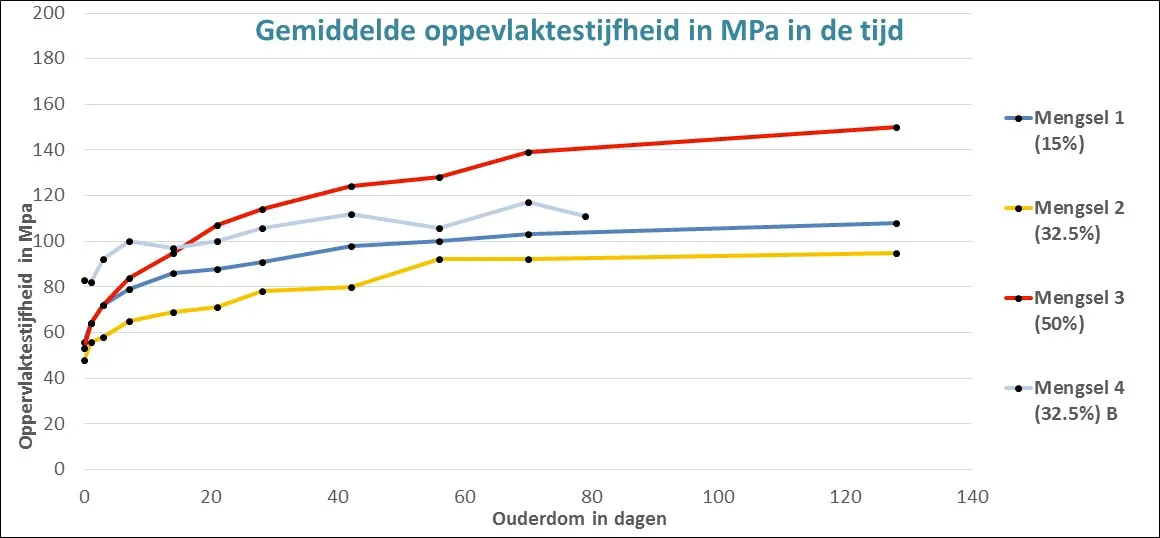
Stiffness was measured in MPa at different points in time. The results are shown in Figure 1.
Compaction
The results broadly matched expectations, with higher concrete content delivering better performance. However, the sample containing 32.5% concrete performed less well than the sample containing 15% concrete. Closer inspection showed that this sample had not reached the target compaction of 101%, achieving only 96%. When the sample was installed at the correct compaction level, it too performed as expected (see Figure 1, mix 4).
Converting measured values to field values
The initial measurement results are not directly comparable with values measured in the field. A conversion was therefore applied to estimate the actual stiffness values. This established that the laboratory values obtained were comparable with field values. On this basis, the following stiffness moduli were adopted as design values:
✓ Mixed recycled aggregate with 50% concrete: 400 MPa
✓ Mixed recycled aggregate with 32.5% concrete: 300 MPa
✓ Mixed recycled aggregate with 15% concrete: 200 MPa
Given the statistically limited scope of the study, these values should be considered indicative. Extensive experience with mixed recycled aggregate containing 50% concrete shows that the standard design value for mixed recycled aggregate, 400 to 600 MPa, provides a conservative estimate of the actual values achieved in practice. This is, of course, subject to the product being of good quality and correctly installed.
Since mixes with less concrete have lower stiffness, the study then examined whether this could be offset by using more asphalt or increasing the layer thickness, in order to achieve the same service life. The calculations were carried out using OIA, Ontwerpinstrumentarium Asfalt, the standard Dutch software for this type of calculation. Many variables affect the results, including axle loads, traffic speed, road design and sub-base quality. These were kept as constant as possible.
The results show that compensating for a weaker sub-base layer quickly requires a substantial increase in sub-base thickness and/or asphalt thickness. As the asphalt layers are the most expensive and least sustainable part of the road construction, this is not an attractive option. Very thick sub-base layers are not an attractive option either, given that the raw material is already scarce.
Calculation experiments were also carried out using variations in traffic intensity, sub-base stiffness, …
These variations were found to have a limited effect on asphalt layer thickness, but sub-base stiffness has a major effect on sub-base thickness. This can quickly result in sub-base layers more than 1000 mm thick, which is not considered realistic in practice.
Conclusions
- The stiffness of mixes with varying concrete content behaves as expected: as concrete content decreases, stiffness also decreases.
- The stiffness development of mixes containing recycled aggregates is significant, increasing rapidly at first, by more than 60% in 28 days, but continuing to rise slowly over time. At a lower degree of compaction, this increase is also smaller.
- The effect of a few percentage points in concrete content cannot be measured significantly.
- Proper compaction has a major effect.
- For a comparable service life, the design asphalt thickness is only slightly affected by the stiffness of the sub-base mix. Mathematically compensating for lower stiffness with a greater sub-base thickness quickly results in substantial layer thicknesses. At a design stiffness of 300 MPa (32.5% concrete), this is still reasonable (+ … mm), but further reductions are considered unrealistic.
Innovation
The quality of a sub-base layer could also potentially be maintained by using alternatives. Innovative recycling companies and contractors are working on methods to achieve this. One approach could be to identify additives that promote strength development, improve particle packing or have similar effects. These innovations were not part of this study. It is up to the market to take this forward.
Next steps
With the aim of using less old concrete in road construction, in favour of its use in concrete, it could already be worthwhile to use 10% less concrete in mixed recycled aggregate for road construction. (Assuming 18 Mtonnes of road construction aggregate, 10% could yield almost 2 Mtonnes of recycled concrete aggregate.) One option would therefore be to standardise a mix containing 30 or 40% concrete in the mixed recycled aggregate. Lower contents seem less promising, unless other innovations are introduced.
Further substantiation and expansion of this study, along with tests in trial sections, will be needed. This is costly and time-consuming research. For now, demand for concrete is not increasing enough to justify such an investment, but if the Betonakkoord and Circulaire innovaties require it, additional research will be needed.
Question about this story? Ask your question
Keep following this
Get an email when a new story is published. No account needed.
- ThemeCircular construction and demolition
- SubjectBRBS Recycling






