












From football pitch to picnic table
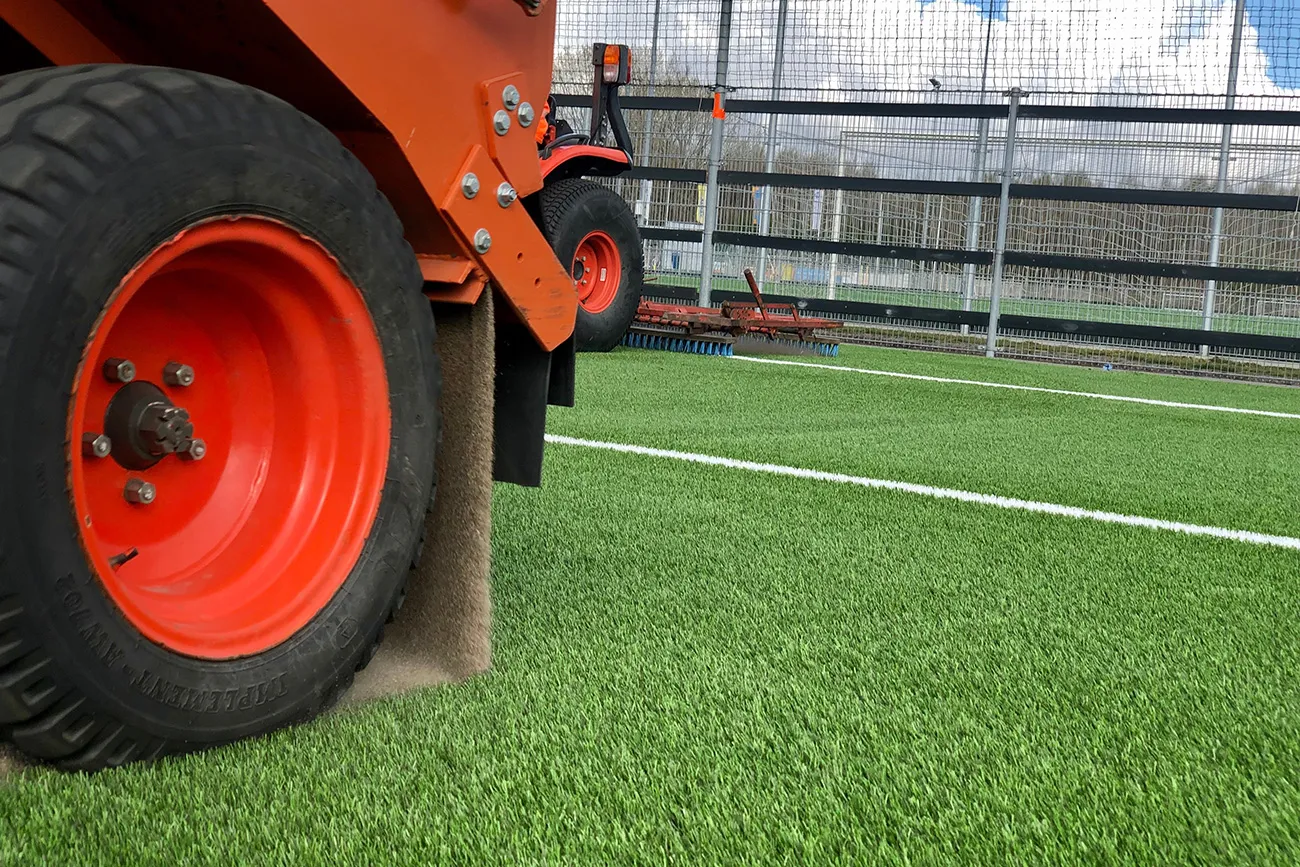
GBN-AGR recycles end-of-life (EoL) artificial turf pitches into high-quality raw materials
What began in 2020 as an innovative and bold idea to solve a market problem has, three years later, developed into a stable, robust and successful process. The recycling plant operated by GBN Artificial Grass Recycling (AGR) in Amsterdam has set the standard for artificial turf recycling in the Netherlands and Europe. The backlog of artificial turf pitches is visibly shrinking, and demand for the high-quality products is strong. “A circular economy starts with choosing circular solutions,” says Eric van Roekel, director of GBN-AGR. “When the whole chain shares a common goal, a major transition gets under way.”
Artificial turf recycling in the circular cluster of Amsterdam’s Western Harbour Area is compelling proof of this. The entire process takes place on 30,000 m2, producing three circular products: (sports) sand, rubber granulate and recycled turf agglomerate (RTA). These high-quality circular raw materials demonstrably meet the highest standards, making them suitable for a wide range of sustainable applications.
In environmental terms, the sand meets the highest standard (Class AW) under the Soil Quality Decree. In terms of sports performance, it meets the NOC NSF M4a standard, making it suitable for use as circular infill sand in new sports pitches. The sand is also suitable as a circular raw material in the production of concrete and asphalt.
The rubber from sports pitches is high quality and is given a new lease of life through GBN-AGR’s recycling process. It is used in new artificial turf pitches or as a circular raw material.
RTA is an agglomerate made from recycled artificial turf carpets. In GBN-AGR’s process, the artificial turf carpet is beaten clean, washed, shredded and then processed into this agglomerate. RTA is a circular raw material for sustainable plastic products, including edging boards, picnic sets and bank protection. It is also suitable for EcoCept®. This is a sustainable, innovative sports-performance layer developed to enhance the performance of artificial turf pitches.
Matching supply with demand
“In the Netherlands, we have matched the large supply of end-of-life artificial turf pitches with specific demand,” says Eric van Roekel, director of GBN Groep. “The process is Kiwa-certified and audited every year, as are the products themselves. Despite the national labour shortage, we have built an excellent, enthusiastic team that is literally working towards the future every day. Before GBN-AGR was founded, artificial turf recycling did not exist. Together with the team, we had to work out the process from scratch and fine-tune it. The result is a robust process and a team that recycles more pitches than become available each year. We will further increase capacity this year by recruiting new staff. Before production began in 2020, we had already received end-of-life pitches for two seasons. That backlog is now shrinking, helping us solve a major waste problem. Our team has worked incredibly hard to achieve this, and it is something to be proud of!”
Choosing circular solutions
Every year, 200 artificial turf sports pitches in the Netherlands reach the end of their service life. Previously, they ended up in a large waste pile because there was no responsible way to recycle them. GBN-AGR’s plant has the capacity to serve the entire Dutch market. Various customers buy its high-quality products, which deliver significant environmental benefits. Transparency about the process gives local authorities and sports clubs confidence that their worn-out artificial turf pitches are processed responsibly and given a fully circular new lease of life. This has helped preserve the market for artificial turf pitches.
“Customers have an important role to play in the transition to a circular economy,” Van Roekel stresses. “Local authorities have sustainability targets. By consciously choosing circular sand from their old pitches as infill for new artificial turf pitches, they reduce their CO2 footprint. They can also choose plastic edging boards and other circular applications, helping to avoid wasting increasingly scarce virgin raw materials. How great would it be if the RTA from the local football club’s end-of-life artificial turf pitch were installed at the club as a picnic table six months later! Several local authorities are already doing this, and they deserve recognition.”
New developments
“Prices for recycled raw materials are under pressure from fluctuating prices for virgin raw materials, for example as a result of lower or higher oil prices. But what matters is the total cost of ownership. Consumers’ mindsets need to change. When delivering a project, do you choose a cheaper wooden board, for which a tree has been felled? Or do you choose a board made from RTA, which may have a higher purchase price but lower lifetime costs, without depleting virgin raw materials? A long-term perspective is essential, and that applies to our recycling process too. Recycling is becoming increasingly attractive because we keep improving our process and seeking out new partnerships.”
Van Roekel is referring to discussions with artificial turf pitch designers and manufacturers about investing in design for re-use. Making circularity the new standard for the future makes a difference. GBN-AGR is also working with the market to develop circular products for the Dutch rail infrastructure sector, and with various industries to find innovative ways of using RTA in new products. “It is great to see our products being used everywhere, including 30,000 tonnes of sand in projects each year.”
The production process itself is also becoming more sustainable. GBN-AGR is certified at the highest level of the CO2 Performance Ladder, and the entire plant runs on green energy. It is investigating a responsible destination for the small amount of contaminated sludge left after washing the sand and rubber. Once that is resolved, the recycling process will be almost 100% circular.
A sustainable world
“We have a certified circular process for recycling end-of-life artificial turf pitches. Our quality products are certified, we have a range of customers and our logistics are well organised. The whole circle is complete, which is unique in the Netherlands and even in Europe. As a frontrunner, we play an active role in circular working groups and are members of industry associations at home and abroad. As a recognised training company, we offer placements to interns, and as an innovative company, we are constantly developing. We are driven to make a meaningful contribution to a sustainable world through high-quality artificial turf recycling. Working with GBN-AGR means choosing to make an impact, create circularity and truly work towards the future!”
More information: www.gbn-agr.nl
Question about this story? Ask your question
Keep following this
Get an email when a new story is published. No account needed.
- SubjectBRBS Recycling






