












Circularity is a real challenge!
Marijn Bijleveld is a senior researcher and theme lead for Raw Material Chains at research consultancy CE Delft. In this role, she works on sustainability issues relating to raw materials and products, among other things. Life cycle assessment (LCA) is the common thread running through her work. At the Recyclingsymposium in Gorinchem, Bijleveld reflected on the R-ladder. “It all started with the Ladder of Lansink.”
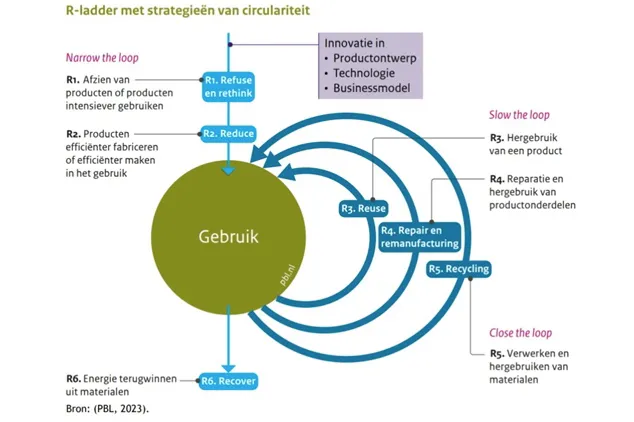
Bijleveld sees circularity, or closing raw material loops, as an important means of achieving a sustainable society. “I like to link circularity to actual, measurable sustainability. As a theme lead, I focus mainly on strategic projects. I contribute ideas on the data needed for monitoring, both to determine the degree of circularity and to provide insight into a product’s environmental impact.” The R-ladder is based on the well-known Ladder of Lansink. Bijleveld says: “This 1979 diagram shows a waste hierarchy, with landfill at the bottom and reuse at the top. At some point, the R-strategies were added. Reuse still sits roughly at the top, but ‘Recover’ and ‘Recycling’ have been added at the bottom. Landfill has therefore been removed. The R-ladder is not a waste hierarchy, then, but more an overview of what needs to be done to reduce environmental impact. The diagrams suggest that the higher up the ladder you go, the greater the environmental benefit. We see this borne out in our environmental research into waste treatment routes and disposal versus reuse.”
Not a hierarchy
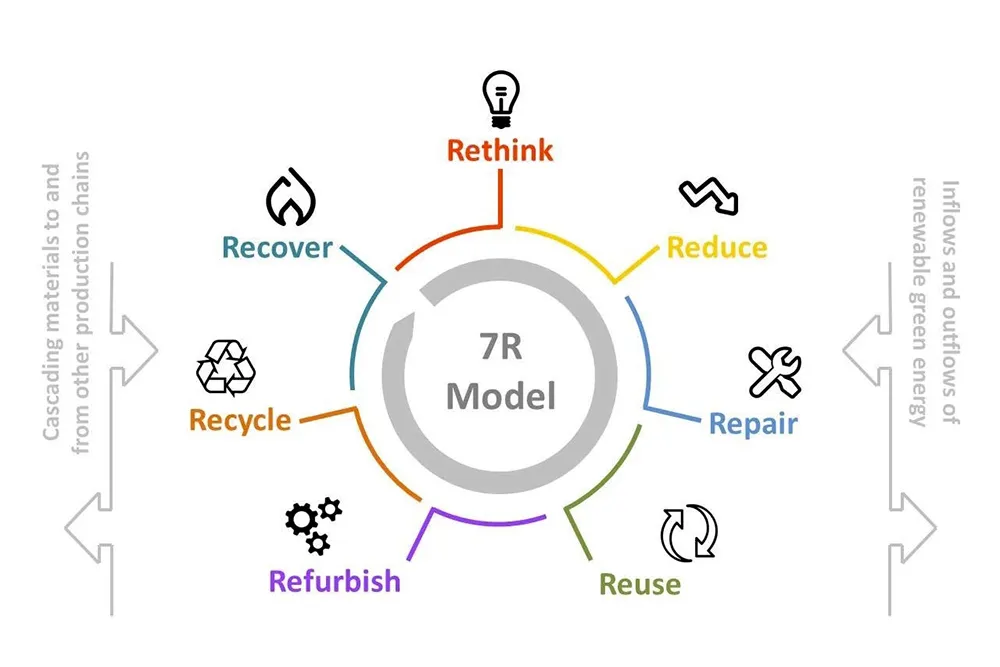
Bijleveld observes: “The current PBL diagram shows a link with circularity. There is still a hierarchy. However, all the Rs are relevant, as the government also says. The next version, the 7R model, no longer shows a hierarchy. That is an important observation. There is also a diagram with ten Rs, linked to the stages in the chain.”
1. Refuse (avoid unnecessary use),
2. Reduce (use fewer raw materials),
3. Redesign (redesign with circularity in mind),
4. Re-use (reuse the product),
5. Repair (maintenance and repair),
6. Renovation (refurbish the product),
7. Remanufacture (make a new product from a second-hand one),
8. Re-purpose (reuse the product for a different purpose),
9. Recycle (process and reuse the material),
10. Recover (generate energy through incineration or fermentation).
“This model makes it clearer than the others that action can be taken at various stages of the chain,” Bijleveld emphasises. “It is an ‘and, and, and’ approach. We are now dealing with the legacy of the past and need to process the materials that become available today to the highest possible standard. In the current situation, you design for circularity, and demolition and reuse will look very different in the future.”
‘Everything you don’t produce delivers an immediate environmental benefit’
Bijleveld calls it a ‘hopeful diagram’. “It shows that things can be done differently. As a business owner, you can see where you can make a real contribution, and that is something I also want to convey to BRBS members. Many companies currently work in recycling, but I want to encourage them to look at renovation and repair too. You can dismantle rather than demolish, and reuse the materials. As a business owner, you do need to know what you ‘need’. Developments and insights are constantly evolving, and the R-diagrams provide direction.” The reason Bijleveld and her colleagues are researching how raw materials and construction materials can be managed even better is that the world’s population has doubled since the 1970s, while production and consumption have increased much more. And that simply is not sustainable! Hence the strategies for extending product lifetimes and reducing product use, for example, with the ultimate aim of managing our raw materials more sustainably.” But there is also room for improvement in recycling. Bijleveld says: “A great deal of stone-like material in construction is still recycled and processed into road sub-base. This serves a purpose, but it is not circular, because it does not create a structural material. The challenge is to recycle using sustainable energy in a way that avoids the use of raw materials with a high environmental impact.”
Designed for disassembly and more bio-based materials
“The end-of-life stage looks very different now from how it will look in the future,” Bijleveld emphasises. “You can already prepare for what things will look like if the circular economy takes hold. I also believe that demolition contractors and recyclers could make their voices heard more strongly and set requirements for designers and clients. ‘We want to be able to dismantle this, so it needs to be built differently.’ Otherwise, we will remain stuck with the old way of recycling instead of reusing.” Bijleveld also wonders aloud whether BRBS would consider changing its name. “So, instead of ‘Branchevereniging Recycling Breken en Sorteren’, it would become ‘Branchevereniging Demonteren Opwerken en Hergebruiken’. With BDOH, you would also be supporting R-strategies focused on product retention. That is a real challenge!”
Question about this story? Ask your question
Keep following this
Get an email when a new story is published. No account needed.
- SubjectBRBS Recycling






