












Chemical recycling, an irreversible path to a sustainable reality?
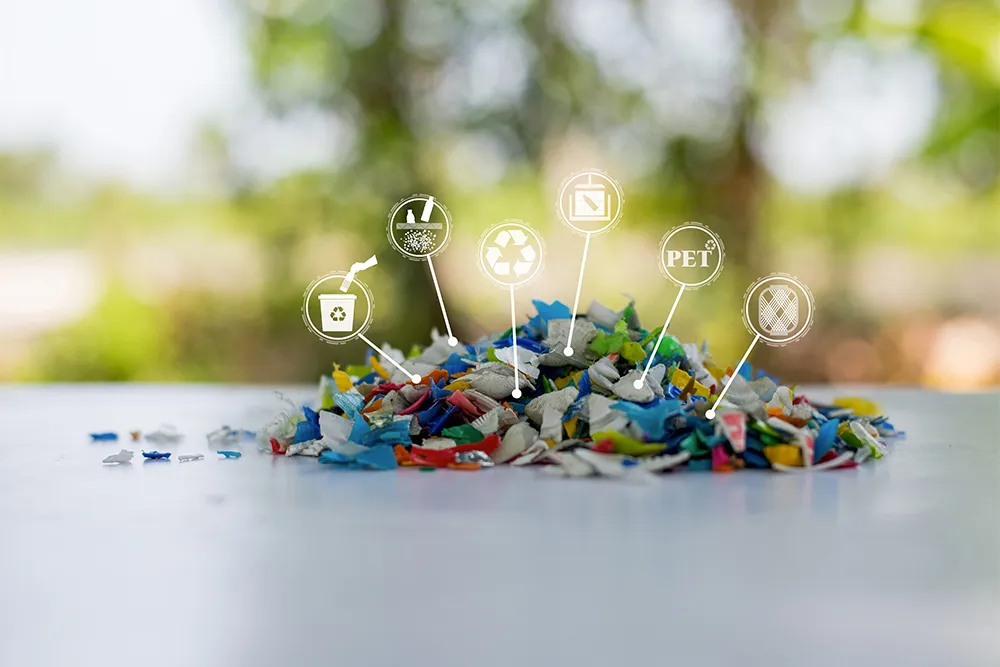
The Dutch waste sector is on the brink of a revolutionary change with the rise of chemical recycling. On behalf of supporting partners Circulaire Biobased Delta, Chemelot Circular Hub, Chemport Europe, TNO, TKI Chemie en Circulariteit, Ministerie van Infrastructuur en Waterstaat and Infinity Recycling, Freek Van Eijk, director of Holland Circular Hotspot, presented the publication ‘Chemical Recycling in a Circular Perspective’, which highlights the crucial role of chemical recycling in driving the transition to a circular, carbon-neutral chemical industry.
Van Eijk on the importance and development of chemical recycling: “Momentum for chemical recycling has grown considerably, driven by concerns about waste management and climate change, and the pursuit of a circular economy. At present, only 12% of plastics enter a recycling loop, so much remains to be done in waste management. Europe’s and the Netherlands’ ambition to be climate-neutral by 20250 has prompted the petrochemical industry to take the shift to alternatives such as biomass, CO2 capture, and waste containing carbon molecules, such as waste plastics, very seriously and to take the first steps.”
Alternative feedstock
Van Eijk emphasises that the drive for change in the petrochemical industry stems from the need not only to switch to renewable energy and green hydrogen, but also to find an alternative feedstock that does not come from fossil resources. These industries are based on C and H molecules, and biomass, including organic waste, and waste plastics are highly suitable candidates as sources of carbon. Under a business-as-usual scenario, the amount of plastic will triple by 2050 (OECD). The transition to a closed loop for plastics is crucial. The ultimate aim is to eliminate fossil inputs for plastic production by 2050/2060. Where will the input material come from? Nexans/Technip predicts that by then all but 1% of plastic waste will be valorised (35% mechanical recycling, 45% chemical recycling and 19% energy recovery). The CBBD expert team estimates that by then, inputs for global plastic production will comprise a combination of carbon capture and utilisation (CO2), biomass, and mechanical and chemical recycling.
‘A quick conclusion: chemical recycling will grow to exceed mechanical recycling in volume and will require major investment’
Multiple technologies
Chemical recycling is currently a buzzword. In fact, it covers several technologies, including dissolution, which is actually physical recycling, depolymerisation, pyrolysis and gasification. It is seen as a necessary complement to mechanical recycling, which has limitations in terms of applicability and achieving and maintaining high quality. Chemical recycling cannot do without mechanical recycling: the two are complementary. To generalise, mechanical recycling performs better environmentally than chemical recycling, but chemical recycling performs better than incineration. The environmental footprint of chemical recycling is therefore worse than that of mechanical recycling, but its advantage is that it can produce qualities that are ‘as good as new’ and can, for example, be used in food applications. “Chemical recycling is seen as part of the Dutch strategy, but international coordination is essential because both the feedstock market and the end market cross borders,” says Van Eijk. “So agreements need to be made on import and export rules, end-of-waste status, what counts as recycling and what does not, as well as alignment on accounting rules.”
An independent market for chemical recycling
European lawmakers are moving towards a requirement for recycled content in plastic products. The industry must be climate-neutral by 2050. We are therefore seeing many new partnerships emerge between established names in the chemicals and retail sectors and start-ups. A chemical recycling start-up often takes six to eight years to reach the commercial stage. To comply with regulations, investment is needed now. The overview of chemical recycling on page 24 of the report ‘Chemical Recycling in a Circular Perspective’ illustrates investment in this sector, including companies such as Sabic-Plastic Energy, Shell-Blue Alp, Niaga Covestro-Cure and Indorama-Ioniqa, which are developing and scaling up their business models together. The Netherlands aims to produce 10% of its plastic output from chemical recycling by 2030. It is very important to ensure that chemical recycling does not become an excuse to keep producing low-value, short-lived plastic products, such as fast fashion. We must focus on a truly circular economy in which, for example, reduce, redesign, reuse and refurbishment take precedence over recycling.
Worlds coming together
The chemical and waste industries are two completely different worlds that need to move closer together in terms of business operations, as well as permits and regulations. Closing a high-quality loop requires international coordination on matters such as end-of-waste status, quality standards, carbon accounting, and international and national legislation and regulations. All in all, the Netherlands is on the brink of chemical recycling. The Netherlands is a living lab and can demonstrate leadership in technological and regulatory innovation through supply chain collaboration and public-private partnerships. Dutch best practices have a world of opportunity ahead of them, because chemical recycling is set to scale up. This is a time when the waste sector and chemical industry are coming together to create a more sustainable future. With support from governments, businesses and international partnerships, the path to chemical recycling looks promising and inevitable … but let’s make sure it is circular!
Find the report ‘Chemical Recycling in a Circular Perspective’ here.
Question about this story? Ask your question
Keep following this
Get an email when a new story is published. No account needed.
- SubjectBRBS Recycling






