Recycling to bring production back to Europe

No sector is immune to the “polycentric S-P-E-E-D crises” (Social, Pandemic, Environmental, Economic, Democratic). Chinese predation on natural resources is also affecting European imports (more than 600 medicines were in short supply before COVID19, as well as semiconductors, etc.). In total, 137 strategic products and materials[1] are putting the EU’s economic sovereignty at risk. Moreover, disruption to supply chains (20% of freight held up in ports, shipping costs increasing tenfold, etc.) is weakening businesses operating on a just-in-time basis.
The “invisible and free Western hand” depends on an increasingly visible and rigid Eastern arm. The laws of thermodynamics are immutable, and natural resources are being extracted at such a rate that even if underground reserves remain accessible for another 10 generations, the “natural recycling” of dispersed resources takes millennia. How can we reduce our dependence on Chinese extraction, refining and production processes? By creating circular systems for waste resources from urban mines, we can increase our resilience, rebuild economic activity and create 700 000 jobs (for workers with lower qualifications) in the EU by 2030 2, jobs that are difficult to relocate.
The recycling industry is a strategic ally in increasing resource efficiency, both in terms of the quantity and quality of recycled volumes across all economic sectors.
Three measures would reduce the losses and dispersal shown in the diagram below
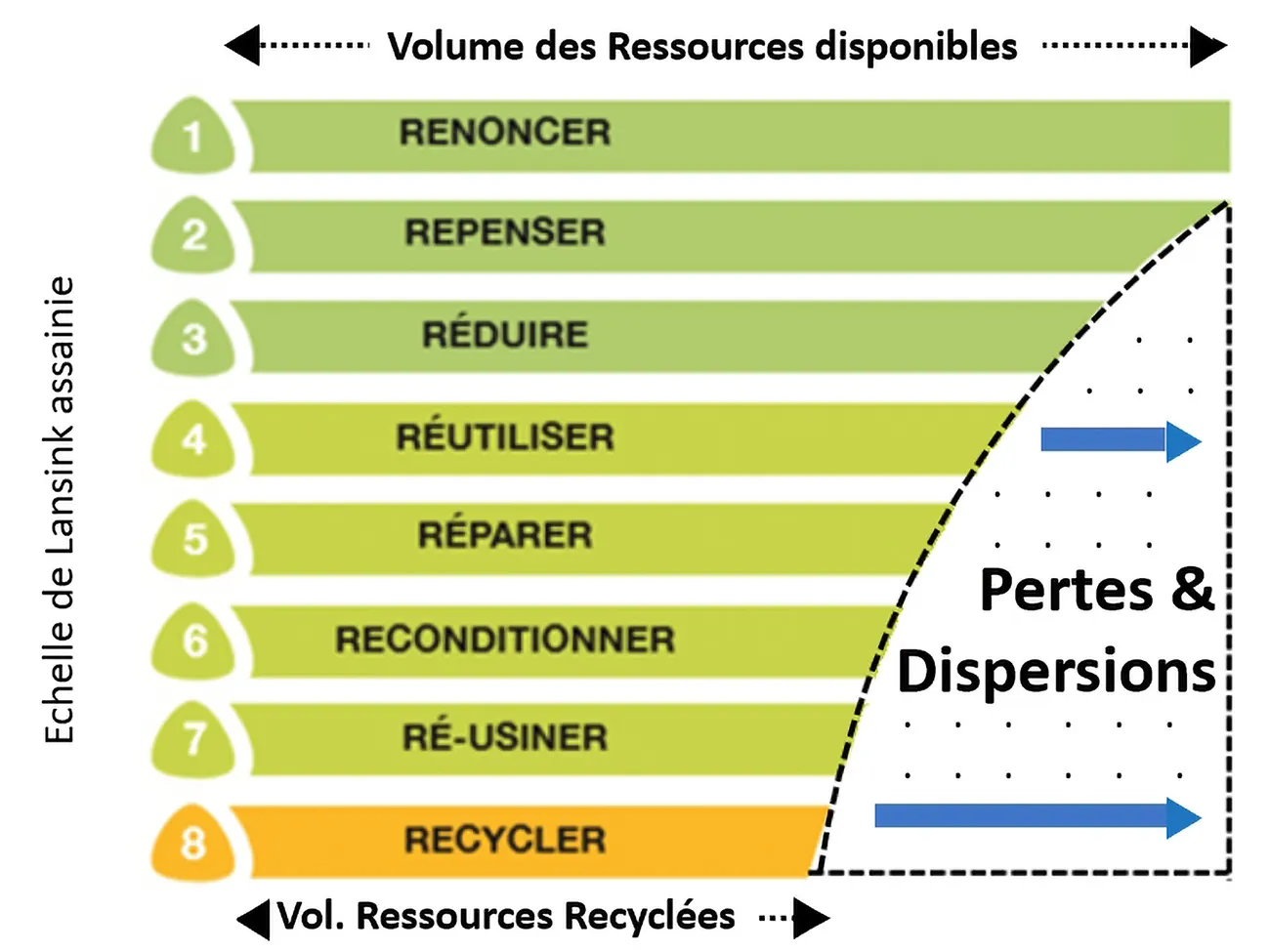
The first measure is to share and refine the analysis of the 67 million tonnes of waste resources produced annually in Belgium, giving manufacturers greater visibility on the consistency, quality and quantity of potential circular inputs. For those generating these resources, detailed analyses would make it possible to redirect their procurement towards single-material and recycled inputs, while eliminating resources that cannot be recovered. At the technological level (AI, robotics), Reverse Metallurgy should be replicated in other sectors. The more the recycling industry cooperates and shares these detailed analyses with businesses operating at other levels of the Lansink scale, the greater the downstream volumes will be.
The second measure is to rethink business models around resources: eco-design products to make their components easier to identify and separate, and to improve their longevity, disassembly, repairability, reusability and recyclability. Products containing strategic materials should be subject to a deposit scheme. Extended producer responsibility (EPR) has shown its limitations in bringing about real change in industrial practices. This is an opportunity to promote functionality-based business models and diversify services and revenue, while increasing the volumes that can be recycled at end of life.
The third measure aims to “clean up” the LANSINK scale: recycling must be the final accepted stage in the EU by 2040. Waste exports outside the EU, incineration and landfill must be banned. The EU must raise its standards (by making repairability and recyclability mandatory) to address health concerns (methane leaks from landfill sites account for 3,4%3 of CO2 emissions).
We have all the ingredients (skills, knowledge, capital and industries) needed to increase the circularity of critical materials.
[1] Industrial Strategy for Europe | European Commission (europa.eu)
[2] 2020 Commission Communication entitled “Critical raw materials resilience: charting a path towards greater security and sustainability”
[3] 2% for 2°C! Institut Rousseau (institut-rousseau.fr)
Question about this story? Ask your question
Keep following this
Get an email when a new story is published. No account needed.
- SubjectOpinion