












Water filters made from recycled glass, thanks to Dryden Aqua and MSort
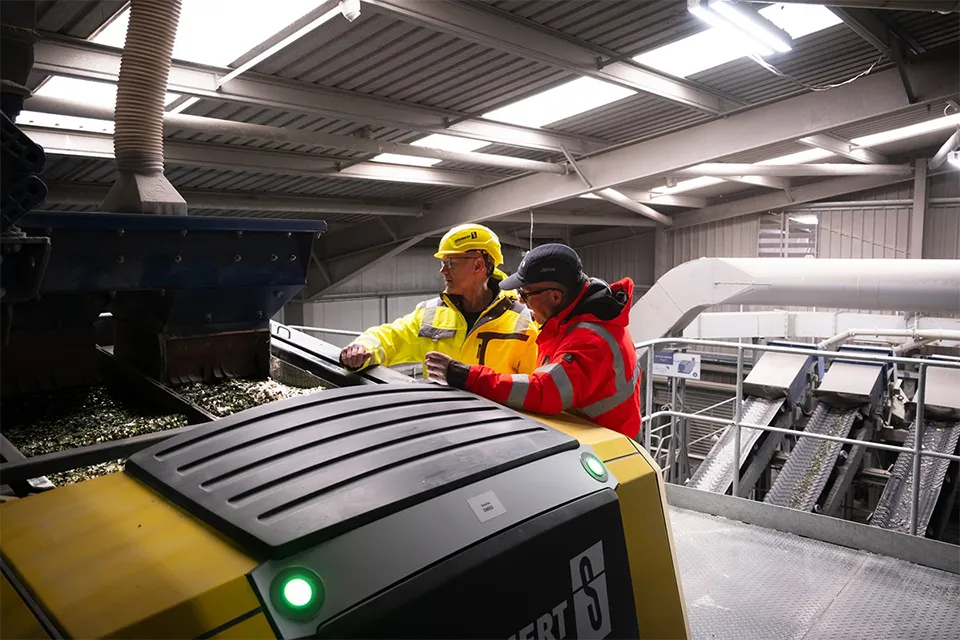
Scotland, Edinburgh: STEINERT’s MSort sorting technology transforms recycled green and brown glass into AFM® filter media for water treatment.
At Dryden Aqua Ltd., clean water starts with a secondary raw material that many consider waste: used glass bottles. The company makes AFM® (activated filter media) from recycled green and brown glass. AFM® is a glass-based filter medium that is activated and resistant to biological fouling. It is used in drinking water treatment, swimming pools, aquaculture, and industrial and municipal water applications.
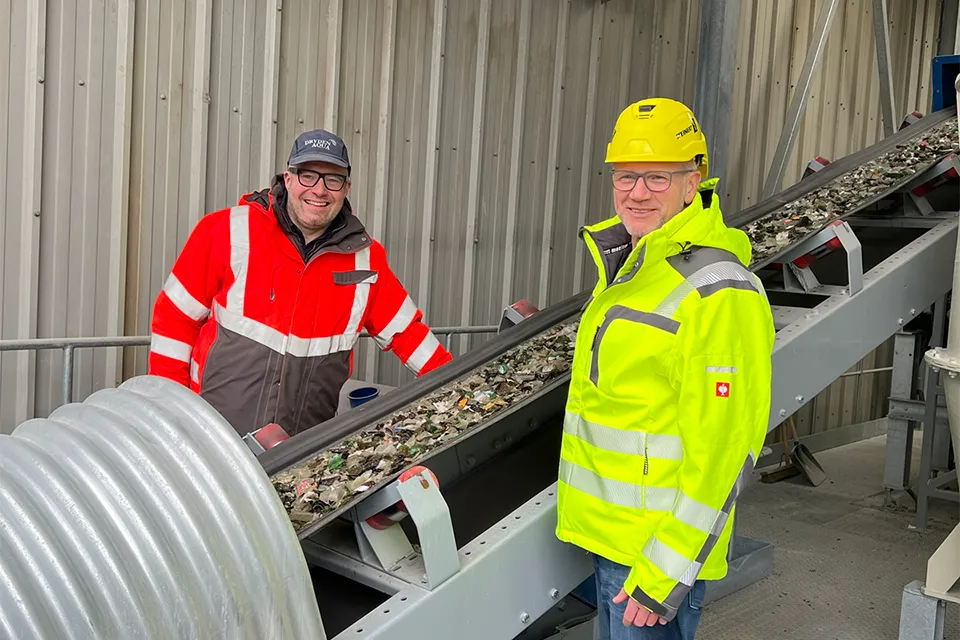
“We want everyone to have access to drinking water,” says Jamie McBride, operations director at Dryden Aqua.
Jamie McBride grew up in the UK glass recycling industry. His family background and decades of experience in cullet processing have shaped his vision, from conventional cullet recycling to the high-precision production of AFM®. “The quality of the filter medium depends on the raw material, and therefore on our ability to process recycled glass with the utmost precision.”
The idea came from Howard Dryden, founder of Dryden Aqua. A marine biologist, he studied the conditions in which marine mammals were kept in artificial enclosures. Filtration was often inadequate, systems had to be heavily chlorinated, and sand, the conventional filter material, had a major drawback: biofilm could form on its surface. His aim was to develop a filter material that could purify water more effectively while creating better conditions for people, animals and the environment.
Only suitable glass is used as a raw material
Dryden Aqua receives waste glass from across Scotland. Green and brown glass are essential, as both have the specific properties required for the activation process that follows. Sorting systems therefore remove flint glass, metals, ceramics, stones, porcelain and other contaminants before the glass is processed into high-quality filter media.
“Our standards are extremely strict because this is drinking water,” stresses McBride. “The purity of the material is essential from the outset.”
During pre-treatment, metal separators remove ferrous and non-ferrous metals, such as bottle caps, lids and other metal residues. The MSort AX Twin then carries out the first sorting stage, separating flint glass from the green and brown glass fraction. At Dryden Aqua, the MSort AX is used for wet sorting from a particle size of 6 millimetres. MSort AF sorting systems are used for the second stage. They sort dry material ranging in size from 4 to 60 millimetres and remove impurities such as ceramics, stones and, in particular, porcelain. Material is fed evenly, analysed by sensors according to its colour and shape, and then separated with great precision. This produces a clean, high-quality green and brown glass fraction, known internally as “Gramber”.
This fraction forms the basis of the filter medium. Dryden Aqua offers the product in a range of particle sizes, from particularly fine 0.25-millimetre grains for demanding filtration applications to coarser grains of up to 6 millimetres.
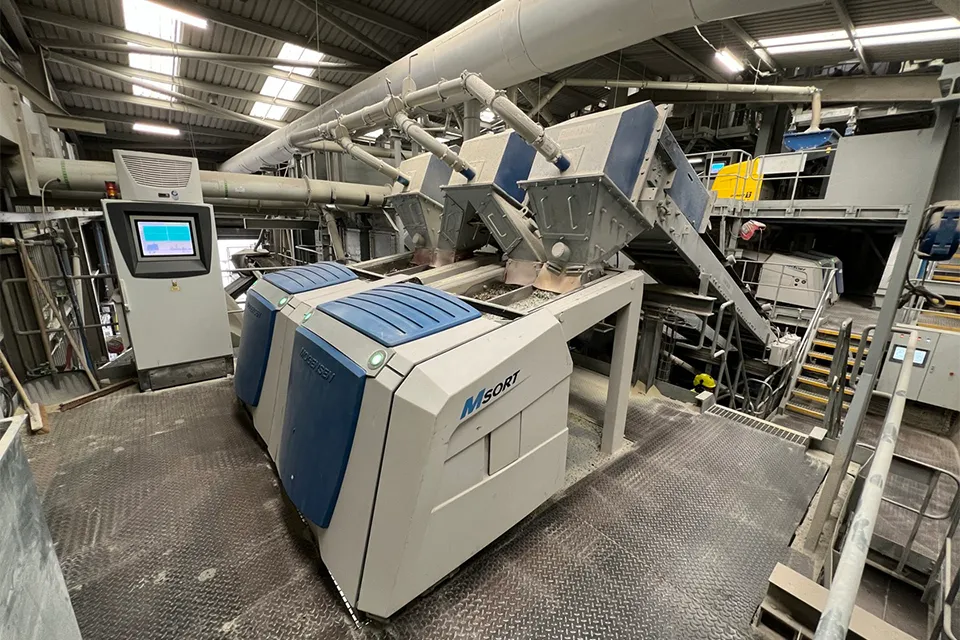
Technical precision and decades of partnership
For Dryden Aqua, sorting is a decisive step in achieving quality. McBride therefore compares the processing plant to a kidney: like this organ in the human body, it removes unwanted substances from the material stream. The collaboration between Dryden Aqua and today’s STEINERT MSort goes back a long way. Jamie McBride describes a partnership with MSort, and previously Mogensen, that has lasted nearly 30 years. Over that time, the focus has been on jointly developing a production process tailored to Dryden Aqua’s specific needs.
“At Dryden, we had to make a million mistakes to find one or two solutions,” explains McBride. “That’s real pioneering work, real research and development. You need partners who work with you, and who don’t dismiss every idea out of hand as far-fetched.”
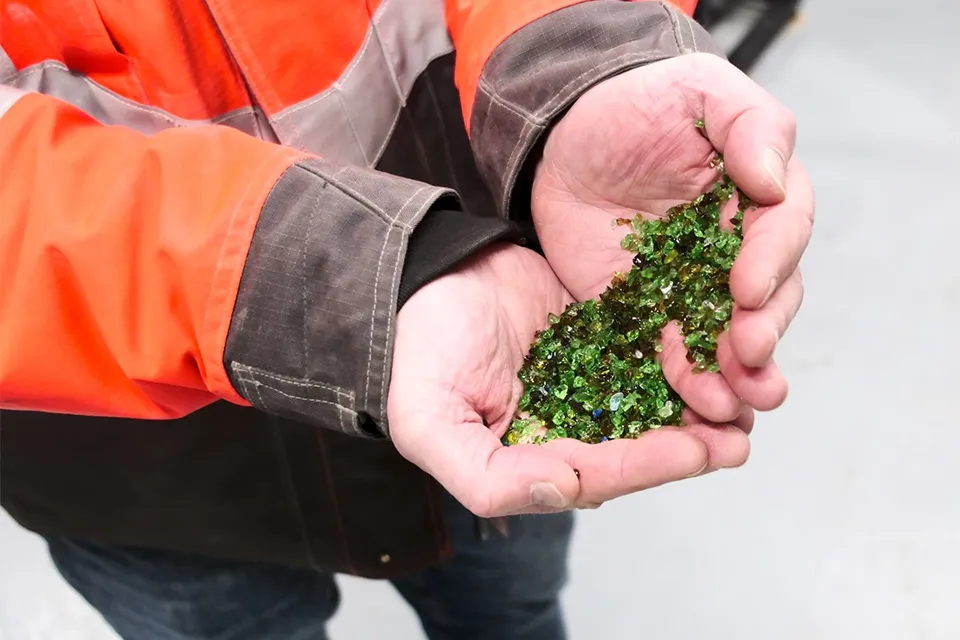
This approach characterises the partnership between Dryden Aqua and STEINERT: technical precision on the one hand, and openness to development work on the other.
“For Dryden Aqua, sorting is not just a routine process, but a decisive factor in the quality of an extremely sensitive product. That is precisely what makes this collaboration so special: we can exchange ideas with Jamie McBride, explore the technical possibilities and develop solutions that help ensure the high purity of recycled glass,” says Eddie Lüth, sales director at STEINERT MSort.
“We have selected the best technologies from various sectors and integrated them at our sites in Scotland and at our headquarters in Switzerland,” says McBride. “This allows us to decontaminate the glass systematically and achieve exceptional colour quality and purity. This is precisely where the production of our AFM® begins.”
From recycled glass to better water quality
Dryden Aqua’s work is a perfect example of how recycling, water treatment and industrial precision can go hand in hand. Used glass bottles are turned into a high-performance filter material. Sorting becomes central to product quality. And this long-standing collaboration has led to a process that supports Dryden Aqua’s vision: making drinking water accessible to as many people as possible.
Question about this story? Ask your question
Keep following this
Get an email when a new story is published. No account needed.
- ThemeGiving materials a second life
- SubjectNews







