












How virtual simulation, physical AI and modular automation are ushering in a new era of logistics
When warehouses become living ecosystems
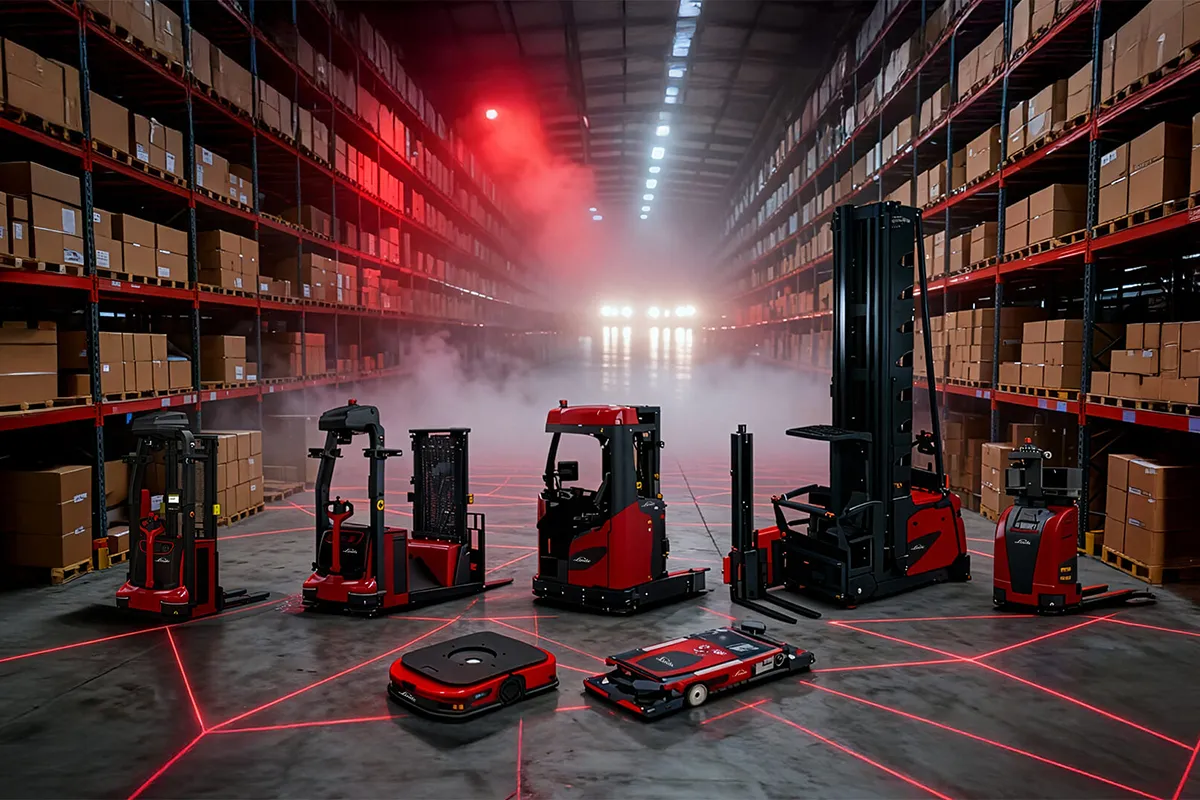
For anyone who attended the Linde Automation Summit 2025 in Aschaffenburg, the shift was impossible to miss: automation has reached a tipping point. This is no longer about a handful of experimental robots or isolated AGVs. What Linde Material Handling presented over the two days amounted to a genuine revolution in the logistics system, transforming the warehouse into a precisely orchestrated organism.
The message running through all the presentations was clear: automation has now come of age. And that changes everything.
From manual warehouse to cyber-physical network
The intralogistics sector has always been dynamic, but the challenges companies face today are structural. The labour shortage is no longer a temporary phenomenon, but a constant. Lead times are shrinking, orders are becoming more fragmented, and seasonal peaks are becoming more extreme. More and more companies understand that their warehouse does not simply need to be more efficient, but must be fundamentally redesigned.
Linde’s Summit made this shift tangible. No buzzword-filled speeches, but practical demonstrations, test cases, simulations and robots in operation: no show, just systems that worked. At a time when the term “AI” often promises more than it delivers, this was refreshing.
Flow as the fundamental principle
For anyone who followed the sessions closely, one message kept recurring: automation is no longer about the technology itself, but about flow.
As Torsten Rochelmeyer, Senior Director Strategy & Solution Portfolio (Linde), put it:
“An AMR travelling from A to B is not automation. A system that understands and optimises every process parameter: that is automation.”
This vision was reflected in four recurring pillars, woven into the demonstrations and testimonials:
Hardware capable of handling variable environments
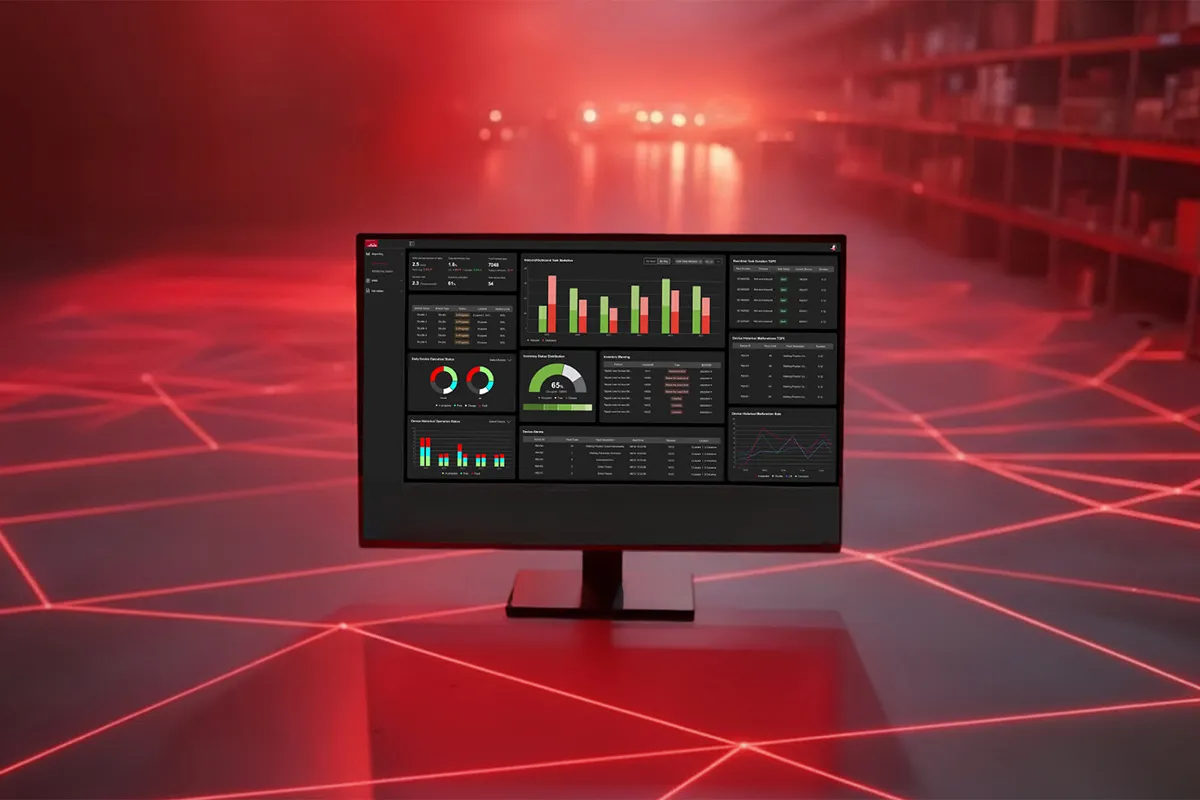
Software that orchestrates the whole operation
Digital twins that eliminate risks before they emerge
An operating system that gets smarter every day
The last of these was arguably the most revolutionary. Automation no longer stops at commissioning: it evolves, learns and adapts, sometimes day by day, sometimes with the seasons.
Technology finally capable of handling brownfield sites
In Europe, nine out of ten warehouses are located in existing buildings. Innovation therefore only makes sense if it can be deployed in these non-standard environments. Linde showed that its hardware is designed not only for pristine greenfield sites, but also for variable conditions: changing light levels, unexpected obstacles, ageing infrastructure, uneven floors, mixed traffic, seasonal peaks…
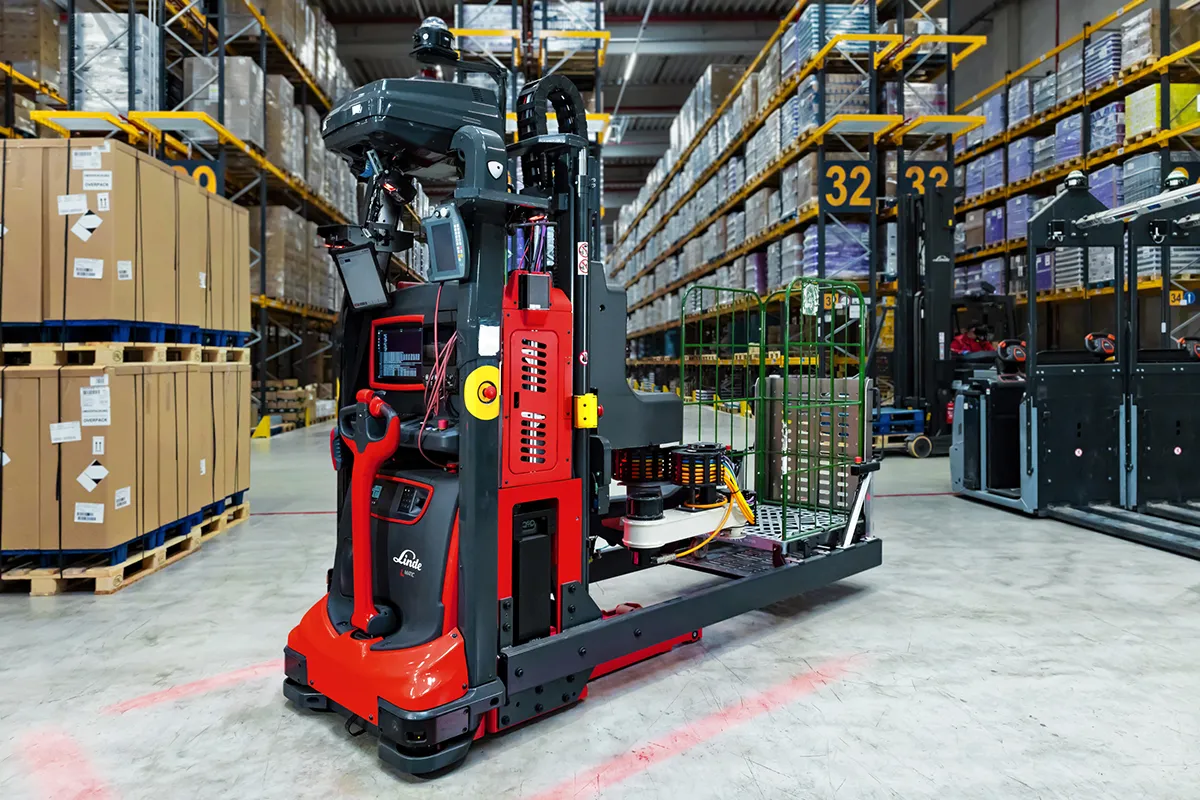
The Linde E-MATIC, the first automated counterbalance forklift truck, stood out in particular. Not for its futuristic looks, but for its ability to fit into almost any typical application, indoors, outdoors, at loading docks, in aisles and on gradients. Automating a forklift truck is extremely complex. It requires robust sensors, additional safety layers and advanced navigation. This is precisely where Linde demonstrates its maturity: a vehicle that is reliable, low-maintenance and truly futureproof.
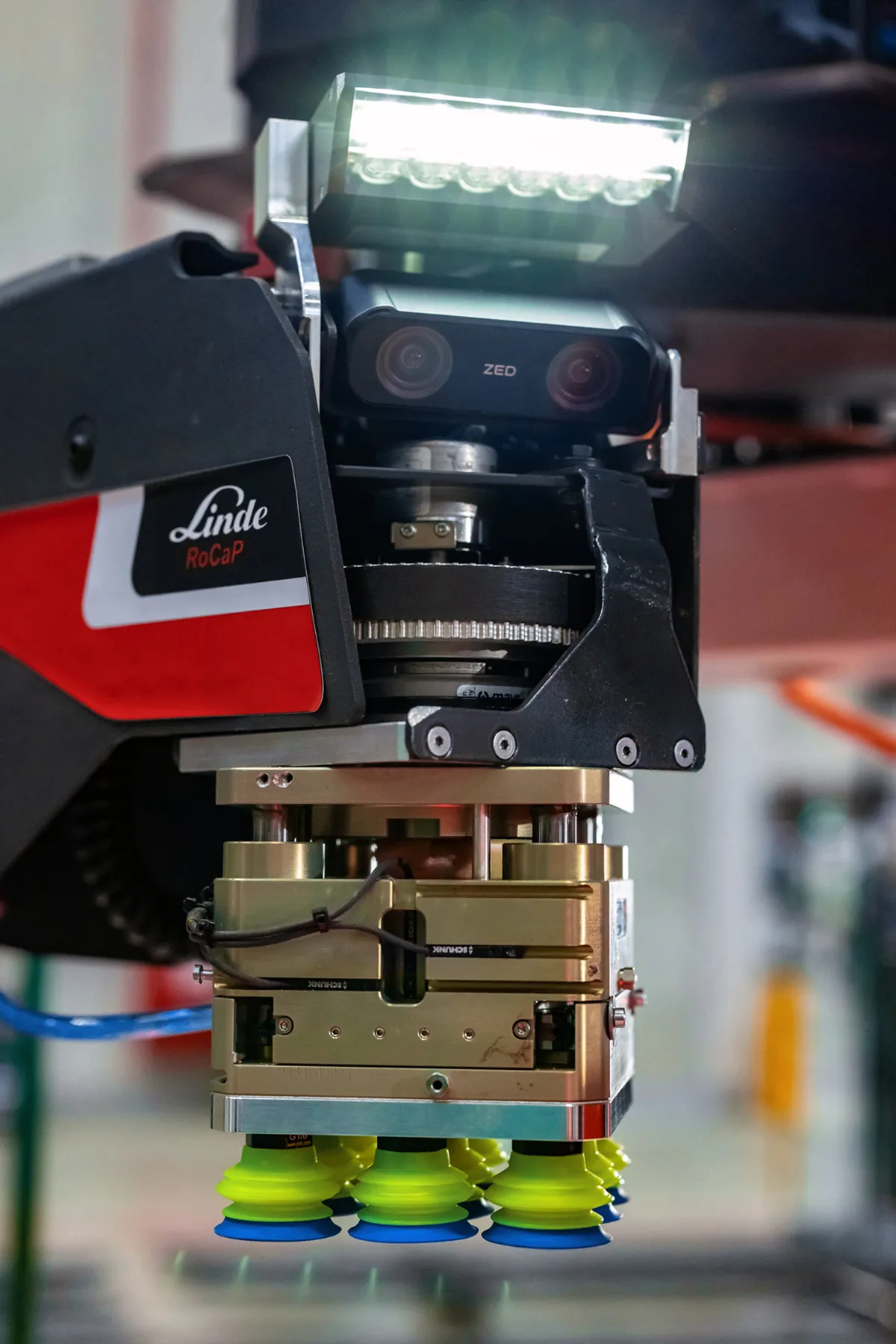
Another highlight was RoCaP, the picking robot developed in co-creation with the ROSSMANN group. It combines autonomous navigation with a robotic arm capable of picking heavy boxes from racking. This is no science fiction: it is a direct response to labour shortages and ergonomic challenges. Notably, RoCaP operates in existing racking, with no infrastructure changes, making it one of the first genuinely operational robotic picking systems for brownfield sites.
Where the real magic happens: the digital twin
The session led by Daan Van Schuylenbergh (Head of Solution Design Automation BU) and Piotr Kwiatkowski (Solution Design Engineer Automation BU) was a real eye-opener. It showed that the future of automation no longer starts on site, but in a digital replica of it.
Using the portable NavVis VLX 3D scanner, Piotr walked through the Experience Hub. The result was an ultra-precise, photorealistic digital twin, generated in no time. Everything is captured automatically. This makes it possible to simulate every scenario imaginable: traffic flows, congestion, picking routes, collision risks, robot density, buffer zones, aisle widths, throughput projections…
The impact is significant: the engineering and validation phase is radically shortened. Where commissioning was once a slow and risky process, 80% of commissioning now takes place in the virtual environment, without risk or error.
Implementation times fall sharply
Errors are detected before they occur
Decisions are finally based on objective data
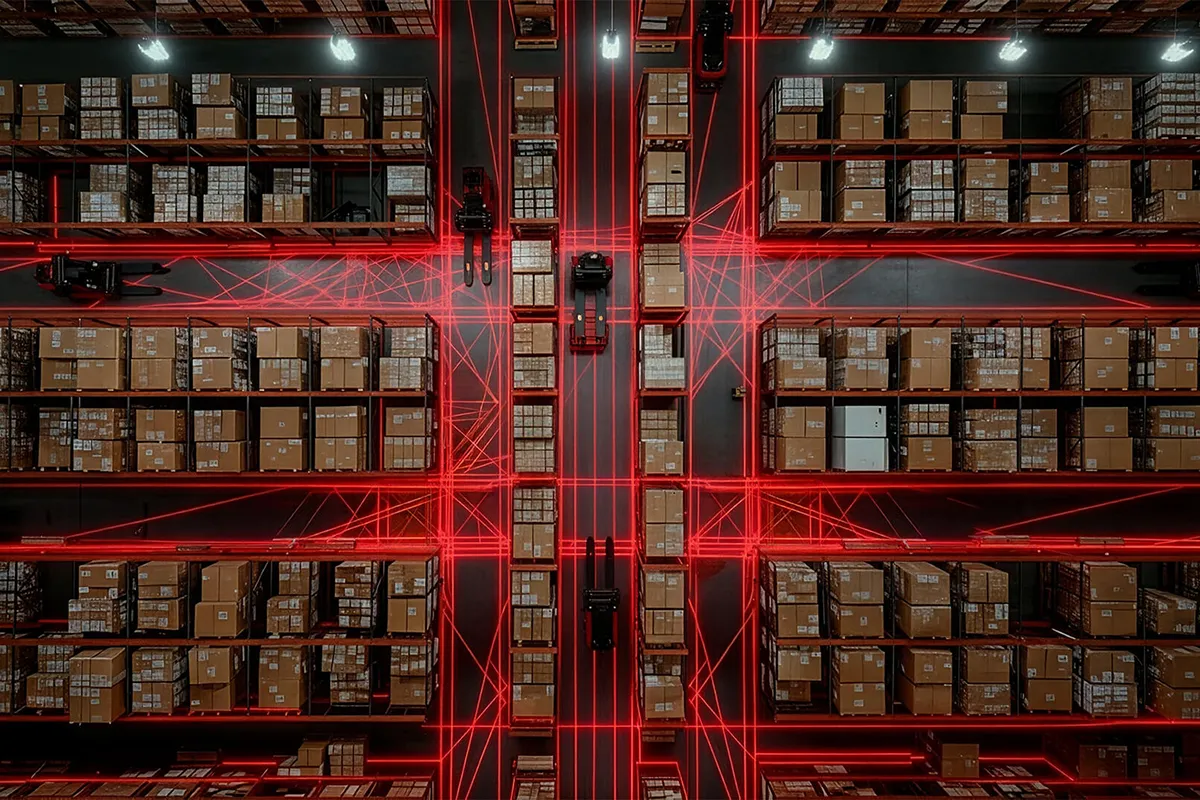
MEGA is… mega
The digital twin is not a standalone module. It is at the heart of a wider transformation. Linde’s parent company, KION Group, has formed a strategic alliance with Accenture and NVIDIA. Together, they have created MEGA, Metaverse for Engineering, Guidance & Autonomy.
Not a conventional software platform, but a physical AI architecture for intralogistics.
With MEGA, robots are no longer tested only in the real world. They are trained virtually in thousands of scenarios: varying order profiles, obstructed aisles, unpredictable human behaviour… The simulation power of NVIDIA Omniverse delivers in minutes what previously took weeks, making ROI projections much more reliable.
Crucially, the digital twin remains permanently connected to the real warehouse. Sensors send a continuous stream of data to the simulation, which in turn returns optimised parameters. The system thus becomes a self-learning organism that adapts to changes.
MEGA turns automation into a systems architecture, a foundation on which companies can build for decades.
The orchestra that brings every instrument together
If hardware represents the muscles and the digital twin the brain, then software is the conductor. The MATIC:move platform is not only fast and stable, but also designed for heterogeneous fleets:
AGVs from different manufacturers
AMRs using different protocols
Conveyors
Fixed automation
WMS and ERP integrations
Where conventional systems operate in silos, MATIC:move acts as a central hub. A low-code interface allows workflows to be modelled. For complex operations, MATIC:move+ handles traffic management and multi-vendor integration.
The key idea: automation does not have to be “all or nothing”. With MATIC:move, it becomes modular, scalable and progressive.
Safety and acceptance as essential conditions
One prominent theme at the Summit was the focus on the human factor. Impressive as the technology is, success depends on safety and clear change management.
Luca Borg, Logistics Expert at ROSSMANN, explained how the company gradually involved its employees in the RoCaP project. Not through major campaigns, but through transparency, live demonstrations, ergonomic benefits and simple interactions with the robot.
The result: employees see the machine not as a threat, but as physical support, especially as RoCaP consistently handles the heaviest boxes.
Safety is built in throughout: multiple sensors, redundant brakes, clear light signals and safe stop zones. Mixed traffic, unavoidable in almost every warehouse, was demonstrated live several times.
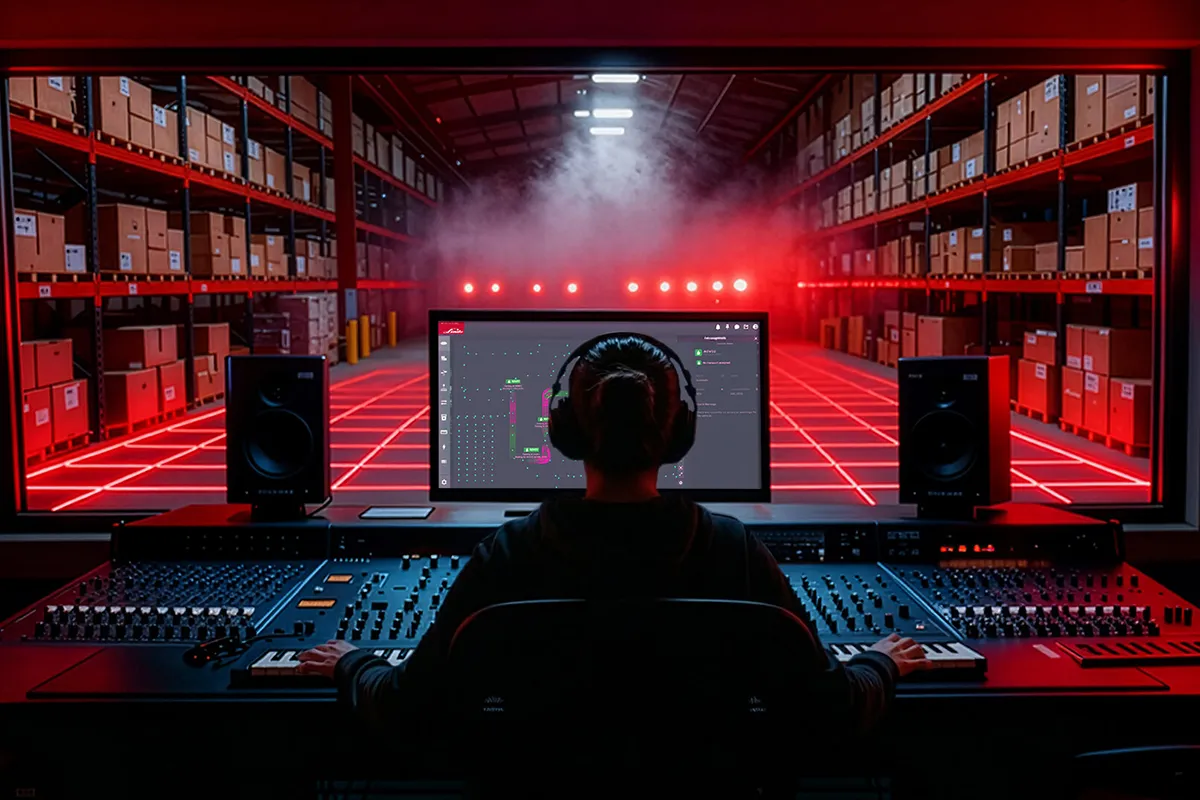
Accelerating automation: insights from a global player
One of the most illuminating presentations came from Dr. Oliver Zuchowski (Head of Intralogistics Automation, Bosch) and Matthias Koblitz (Senior Automation Consultant, Bosch). Their message was clear: automation only succeeds when companies stop thinking in terms of isolated projects and adopt a systemic approach, guided by consistent criteria, standards and partnerships.
Bosch has thus moved from a series of independent projects to a mature automation framework deployed across Europe. No more patchwork of solutions, but:
predefined selection criteria
a centralised partner catalogue
a clear decision-making model
and a significant reduction in project lead times
Known internally as the pitstop-approach, this method cuts wasted time at every stage: requirements, engineering, validation and commissioning. Zuchowski stressed that true scalability comes when automation is embedded in the organisation, with clear governance, a common language and shared technical standards.
The rise of systemic automation
The key takeaway after two days in Aschaffenburg is that automation is gradually becoming a complete enterprise architecture. The most advanced organisations show that the greatest acceleration comes when technology, processes and organisation are brought together within a coherent framework.
Digital twins and Omniverse make it possible to eliminate errors before they occur. Projects become shorter, more predictable and less dependent on trial and error. And solutions such as a robotic case picker or an automated forklift truck prove that automation can work in existing infrastructure, without excessive investment.
This was the thread running through the Summit and what made it so powerful: automation is maturing into a scalable system, capable of learning and evolving alongside the growing complexity of modern supply chains.
Question about this story? Ask your question
Keep following this
Get an email when a new story is published. No account needed.
- ThemeModernising recycling facilities
- SubjectNews







