












Productivity without waste, a call to action from mb crusher
Connectivity is a key feature of the modern economy. MB crushing equipment is on the front line, connecting communities, economies and countries.
The economy increasingly needs infrastructure to connect supply chains across countries and communities of people across metropolitan areas. However, building housing, road and sewer networks, gas pipelines and water pipes, public facilities and other infrastructure is becoming increasingly costly and, today, even more complex because of the huge delays caused by global shortages of materials.
Without adequate infrastructure, the economy cannot thrive. Without materials, connections cannot be built. This may seem like a vicious circle, but the solution is simple and can be summed up in one phrase: infrastructure means doing more with less.
How did we reach this conclusion? By looking at what our customers have done to overcome difficulties in sourcing materials. We saw how they used resources efficiently and how waste was avoided.
The results are astonishing: they cut costs overall and eliminated delivery delays simply by using their existing construction machinery and fitting it with MB Crusher equipment.
Digging trenches without buying backfill
At the Cerro Negro mine in Chile’s Atacama Region, a company excavated 80 km across the desert without having to buy and transport the sand needed to fill the trench. The customer fitted an MB-S18 screening bucket to its Doosan DX225LC to screen the material directly over the trench. The result was substantial savings and faster processing, while also preserving the land. Processing the material on site reduces the number of lorries and prevents local material from being contaminated by foreign aggregates.
Building aqueducts safely in urban areas
In Agadir, a port city in Morocco, a new aqueduct was built across the entire city. The Saharan climate meant the work had to be carried out quickly and with maximum safety for workers. Manually separating excavated materials would take too long, could not guarantee complete safety and, in particular, would not produce the uniform clods needed on site. Using an MB-S18 screening bucket mounted on a Doosan 240 excavator, the excavated materials were screened directly on site. The result: homogeneous, uniform material for use as backfill, work completed on time and complete safety on site.
Cutting the cost of preparing railway ballast
Investment in railway network development improves and facilitates economic exchange, speeds up freight transport, makes commuting easier and boosts tourism. Huge quantities of ballast are needed to build rail links. Ballast is essential to the proper operation of the railway itself, helping to minimise thermal expansion of the rails, absorb noise, drain water and prevent vegetation growth.
Two interesting examples come from India and Italy, with a common denominator: preparing large quantities of ballast by reusing materials already available, simply cleaning and screening them. This makes the process highly cost-effective.
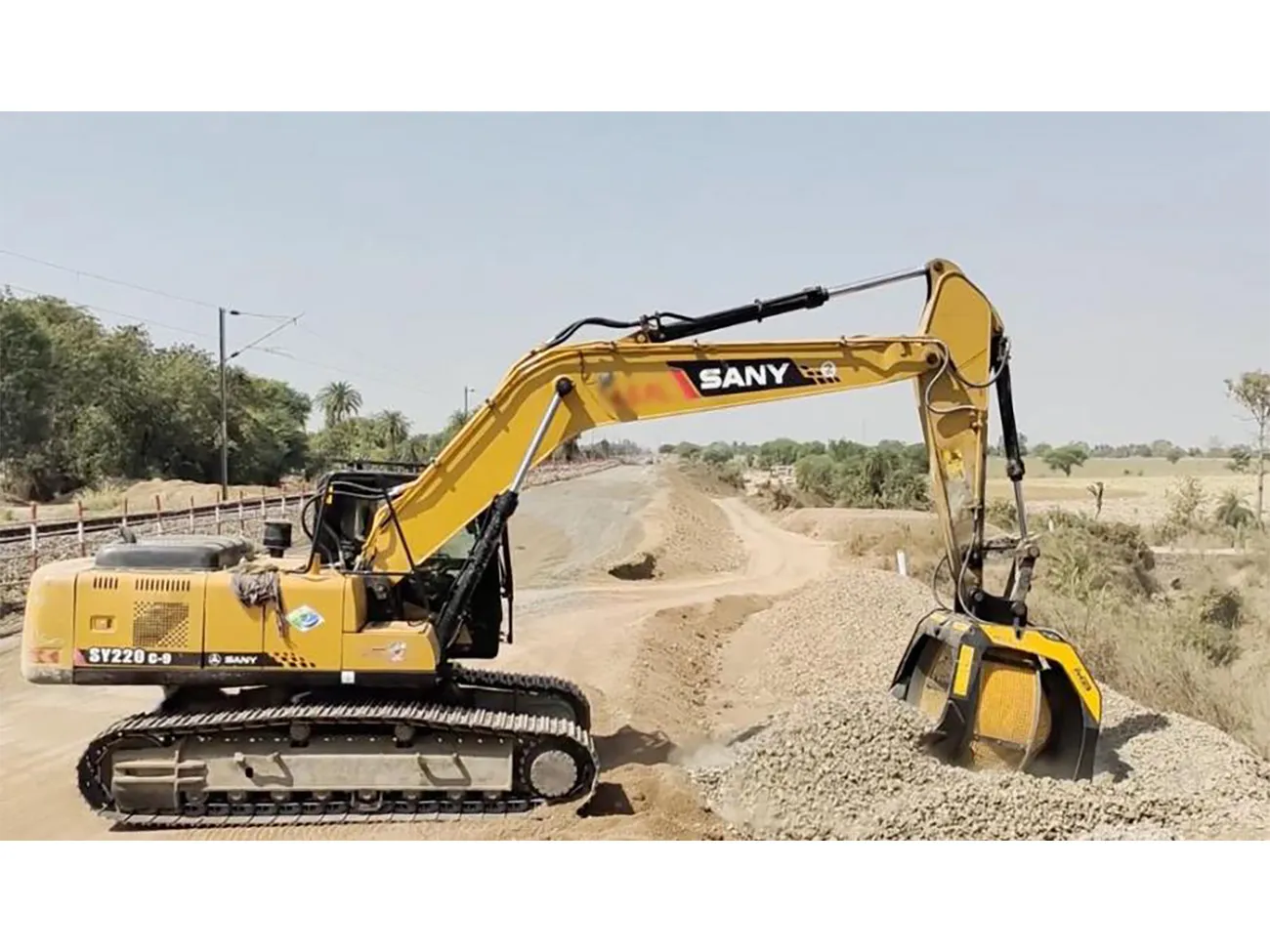
In India, an MB-S18 screening bucket was used on a Sany SY220 excavator to screen material directly alongside the railway line. In Italy, the same screening bucket model was mounted on a Hitachi EX215 to clean material in the quarry and load it straight onto the lorry.
Materials were also reused during maintenance of the railway network linking Warsaw to outlying areas: old, unused sleepers were crushed with a BF70.2 crusher bucket fitted to an Atlas 1604 excavator. The crushed material was then reused as a sub-base layer for the subsequent installation of ballast.
Wasting nothing is the key to success. Connectivity brings prosperity. Let’s make it easier, faster and more sustainable.
Een zakelijke vraag aan MB Crusher? Get in touch
Companies in this story
Keep following this
Get an email when a new story is published. No account needed.
- ThemeModernising recycling facilities
- SubjectNews
- CompanyMB Crusher







