












Circular Wallonia: the strategy for rolling out the circular economy
The roll-out of the circular economy is seen as an opportunity to revive the economy in a regenerative way, within the planet’s limits. Given the context of increasingly scarce resources, their use must be optimised. This means prioritising repair and reuse, improving recycling, and above all adopting a systematic approach to innovation and the ecodesign of products and services, with the aim of minimising additional sources of waste. This model supports Wallonia’s industrial renewal objective and will make the region more resilient in the face of future crises and less dependent on resources. Mélanie Rensonnet, qualified attaché with the Circular Economy Roll-out Coordination Unit, explains the issues and challenges.
The vision
Wallonia’s vision is based on the following aims: moving towards a carbon-neutral economy; moving towards a resilient and inclusive economy; and stimulating innovation as a catalyst. With Circular Wallonia, Wallonia intends to make progress along the path set out by Europe with its Green Deal. It has clear, realistic ambitions, rooted in five action areas, and gives particular attention to six value chains deemed a priority.

Regional momentum
Circular Wallonia did not start from scratch. This ambitious and highly detailed plan is the result of political developments. “Circular Wallonia is both a strategy and an action plan. The overall approach was to build on the existing regional momentum rather than create unnecessary new instruments and schemes,” Mélanie Rensonnet tells us. Indeed, a range of initiatives and schemes have emerged over the past few years, covering areas such as support, project funding, reuse and the management of waste resources. The Walloon Waste-Resources Plan, adopted on 22 March 2018, also marked a step forward, as it incorporated certain circular economy principles into waste management policy. Other plans and strategies address specific aspects of the circular economy, such as the Smart Specialisation Strategy. “Circular Wallonia, led primarily by Willy Borsus, Minister for the Economy, Research and Innovation, sees the circular economy as a lever for industrial and economic policy. That is the underlying philosophy, with innovation as a catalyst and the digital transition as a foundation,” explains Mélanie Rensonnet. Circular Wallonia is intended to be consistent with other strategic documents, and aims to coordinate, strengthen and amplify the region’s circular economy momentum.
A collaborative process
The transition to a circular economy calls for a systemic, participatory approach. The strategy incorporates economic, social and environmental concerns through a process that is both top-down and bottom-up, involving numerous meetings with stakeholders on the ground, public consultation and round tables. The Go Circular call for projects launched over the summer was also designed using a multi-stakeholder collaborative approach. “To refine the various forms of project support, a Circular Economy Barometer will be launched in the coming days. This is a wide-ranging survey of Walloon businesses, intended to assess their knowledge of and involvement in the circular economy. It will also help us find out why some actions could not be completed and better measure the effectiveness of the measures and instruments put in place. The results are expected by the end of the year,” adds Mélanie Rensonnet.
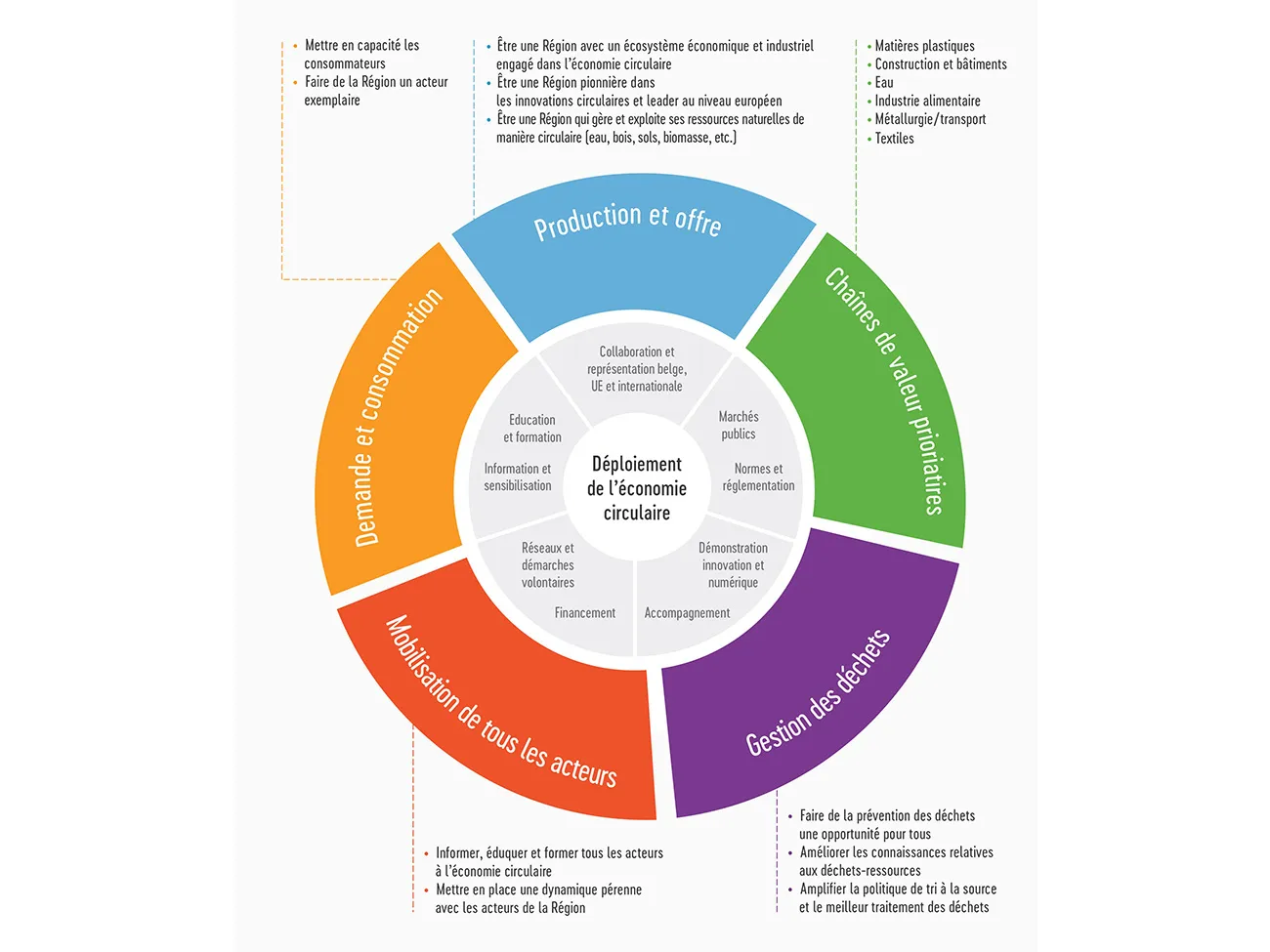
Governance is based on a dynamic, open approach
Circular Wallonia’s governance aims to ensure that measures are implemented effectively through collaborative working that responds to the needs of stakeholders on the ground. It will be evaluated at regular intervals so that any necessary adjustments and/or proposed actions can be made. “Governance follows a participatory approach. For example, the circular economy platform brings together all Walloon stakeholders keen to join this initiative, and will meet once a year. A Circular Economy Week is also planned to strengthen engagement among all stakeholders. In addition, thematic communities foster exchanges between participants, while the working groups set up are more operational in focus. Task forces made up of public and private sector stakeholders have been established in particular around the priority value chains. A steering committee, comprising representatives of the three ministerial cabinets concerned (Borsus, Tellier and Morreale), meets frequently to streamline decision-making,” explains Mélanie Rensonnet.
To illustrate the relevance of the strategy, Mélanie Rensonnet tells us that a recent survey carried out among businesses in Flanders in June 2020, during the pandemic, found that circular businesses were experiencing fewer shortages than other businesses. Indeed, only 2% of non-circular businesses said they had experienced no shortages, while more than two in three businesses said they were withstanding the crisis well. The main shortages concerned customer demand, parts/materials and raw materials. This finding has significant implications for the challenges we face now and in the future. For more information about Circular Wallonia, visit economiecirculaire.wallonie.be or contact the Circular Wallonia Coordination Unit at: [email protected].
Question about this story? Ask your question
Keep following this
Get an email when a new story is published. No account needed.
- SubjectNews







